Rafael Uzcategui
During 2018, the situation of the human right to health in Venezuela was alarming. Unions and human rights NGOs reported that the shortage of medicines and hospital supplies was 80% and the country had lost 60% of its national health care capacities. Due to the drama of the situation, four special rapporteurs and independent experts of the United Nations made an urgent call to confront the crisis, indicating that “…thousands of people in Venezuela suffer from hunger, do not have access to essential medicines and are trying to survive in a spiral that “It doesn’t seem to have an end.” A year earlier, the population had carried out a cycle of mobilizations for four months with a regrettable death toll of 146 people in the context of the demonstrations. The end of the protests coincided with the dramatic increase in people who forcibly migrated and the beginning of the phenomenon known as “the walkers.”
What was the origin of the Venezuelan crisis? In her first report on the country, the United Nations High Commissioner for Human Rights, Michelle Bachelet, summarized it as follows: “the poor allocation of resources, corruption and the lack of maintenance of public infrastructure, as well as the serious investment deficit, have given rise to violations of the right to an adequate standard of living.” And although he recognized the impact of financial sanctions, he indicated that their effect aggravated the crisis that already existed when Donald Trump approved the first one in August 2017.
The acute shortage of medicines was the new “normal” for Venezuelans. Those who traveled abroad returned with their suitcases full of antibiotics, flu medicines and antihypertensives, as travel gifts for family and friends. That the X-ray services in public hospitals did not work or that there were no reagents for carrying out medical examinations had become commonplace. Therefore, it began to stop being news and disappear from the headlines. In addition to reports with statistics and percentages, it was necessary to create a different narrative to keep the deterioration of the health system in the public conversation. On social networks, such as Twitter, people asked for drugs that they could not get in pharmacies and on many occasions someone they did not know responded to give them a gift. In this fortuitous practice of mutual support there was an opportunity that two NGOs detected: Provea and Redes Ayuda.
Unlike its neighbors, Venezuela experienced relative political and social stability for many years derived from its oil wealth. Despite the inequalities, its inhabitants had material resources unknown to the rest of the continent. Its cycles of abundance allowed the creation of a culture of solidarity that began to form part of the image that its inhabitants had of themselves. In 2018, with all the conflict and impoverishment, that practice of empathy still existed. The key was to find some way to strengthen it. Redes Ayuda was a young NGO focused on digital rights, directed by Melanio Escobar. Provea, for its part, was a veteran organization in the defense of human rights, whose coordination fell to Rafael Uzcátegui. A common denominator of both activists was their love for music. On January 27, 2018, they agreed to carry out a curious pilot test: the release of the album “Divided we fall” by the band Zombies No, in which the price would be a medicine that would then be delivered to patients at the J.M de los Ríos children’s hospital in Caracas. The response was enthusiastic and the albums quickly sold out. That formula of stimulating support for people affected by their health and rewarding their solidarity allowed us to continue talking about the health crisis in a different way. This action, from now on, was called “Music for Medicines.”
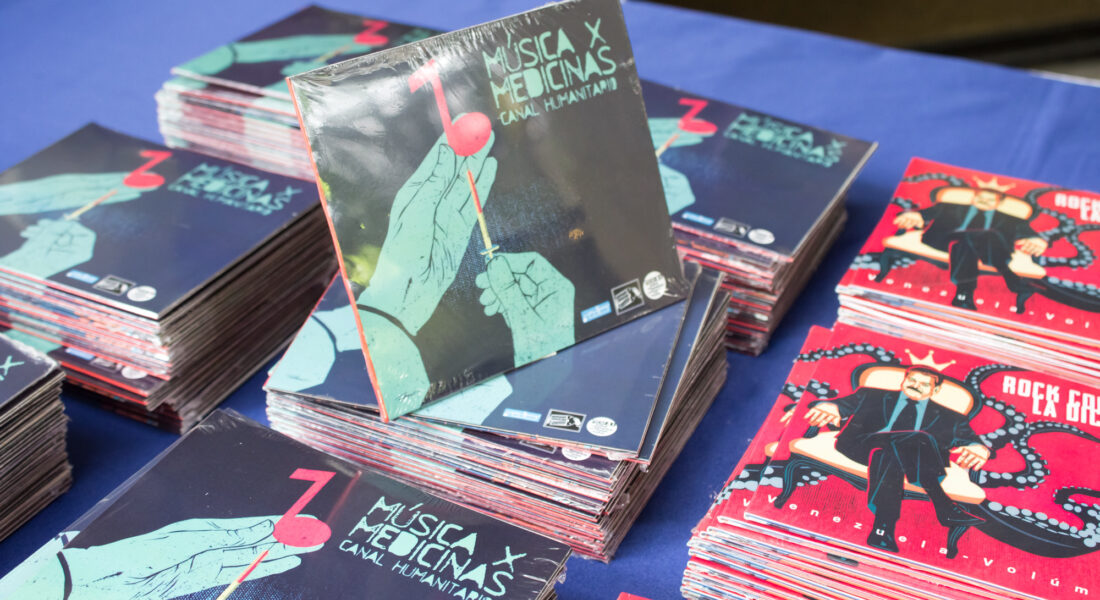
The first Music for Medicines was organized on July 21, 2018 at the Sala Cabrujas in Caracas. During the previous weeks, the two NGOs held a public call to receive donations of compact discs, cassettes and vinyl at one of the locations of the Lugar Común Bookstore in the city. These donations, plus compact discs produced by the organizations themselves with local artists, would be exchanged for current drugs and medical supplies and then distributed free of charge through a humanitarian work initiative. Admission to the concert – with the bands Onice, Ile Des Phoques and Agente Extraño – was free of charge, but if you wanted to take any of the musical objects you had to hand over an equivalent in current drugs or medical supplies. The event was a complete success. In addition to the amount of medicines collected, reports in the national and international media that talked about barter also multiplied—all of this served to address the issue of health collapse and how society itself was doing something to confront it in the media.
Under the name “Music for Medicines” (MxM), 24 concerts have been held in five states of the country (Capital District, Zulia, Lara, Portuguesa and Mérida), collecting more than twenty thousand boxes of medicines and medical supplies that have benefited the work. of ten humanitarian work entities throughout the country: Acción Solidaria, Mavid, Preparafamilia, Ángeles Chiquinquireños, Fundación Colibrí, Fundación Farelys, Convite, Mapani, Iglesia San Lucas del Llanito sector in Petare, First Aid Foundation of the University of Los Andes. Although the Covid-19 quarantine slowed the initiative, ten online concerts were held during the pandemic. MxM has become a replicable model and whoever wishes to use the “brand” must meet two requirements: that the event be free to enter and that the proceeds go to a local humanitarian organization. Provea and Redes Ayuda were in charge of sending the materials to be exchanged.
If the resources had been used to purchase medicines directly to be delivered to their beneficiaries, it would not have strengthened and expanded the culture of solidarity that is one of the objectives of the activity. MxM has transformed people who were not usually considered human rights defenders into activists for the right to health: booksellers, musicians, cultural managers and collectors. Not having money involved has allowed us to build the necessary trust so that more people want to get involved in a relationship in which everyone wins. Bands and soloists have projected their talent at a time when the crisis reduced the holding of cultural events and the editing of musical productions. Twelve albums made especially for the project have been available for exchange, six of them compilations that have included the work of 104 Venezuelan soloists and groups, with online versions for free download on this site. Two of these compilations, under the name of the project, allowed the meeting in a polarized country like Venezuela. The albums “Música por Medicinas 01” and “Música por Medicinas 02” included the talent of artists critical of the government, but also some of its sympathizers. In addition, seven books have been published for barter, four of them linked to the country’s musical history.
MxM has been a great learning experience for NGOs who wondered how to use musical culture as a space for meeting and cooperation, communicating content in a different way than technical reports full of statistics that are only consulted by specialists. This discovery has been called by Provea as “All rights for all languages”, and it allowed them the necessary confidence to continue experimenting with other arts such as comics, poetry, narrative and photography.
Rafael Uzcátegui
Sociologist, human rights defender and post-anarchist. Columnist in different media and author of the books “Rebellion beyond the left” and “Venezuela: the revolution as a spectacle.” Member of War Resisters’ International.
Translated by Damian Vazquez