Ana María Ardila Castro
Public universities in Colombia were one of the many scenarios where the effects of war were experienced during the internal armed conflict. Since 1929, when Gonzalo Bravo, considered the first martyr of the student movement, was murdered, violations of human rights have accumulated, ranging from torture and persecution to massacres, disappearances and hitmen, as set out in the Final Report of the Commission of the TRUE. Understanding why the State was cruel against these institutions requires complex analysis. To have a brief idea, five aspects can be highlighted: 1) access to higher education by subalternized groups; 2) training of critical thinking; 3) influence of the left, especially since the sixties of the last century; 4) sustained and increasing privatization of public higher education; and 5) role of the student movement in the social, political and economic struggles of the country.
As a nation, Colombia was based on colonial ideas that privileged classism, racism and machismo, having the logic of the internal enemy as a fundamental pillar. This logic was internalized even more since the end of the seventies with the Security Statute that sought to erase otherness, that is, any hint of opposition. Of course, public university communities have embodied a threat to national structures. The student movement, for example, has not only defended its rights, but has supported the causes of other social sectors, positioning itself as a leading actor in the mobilizations. This, evidently, has also made them the target of state violence through police and paramilitary forces.
Against this background, as a reaction to the repression, since the 1950s, throwing stones against the police was recorded – a form of protest where students threw stones (pedreas) at the officers as a rejection of the brutality exercised. Then, starting in the eighties, clandestine groups began to consolidate that, from anonymity, have carried out violent direct actions called tropeles. In them, members of the groups throw handmade explosive devices and stones against the police forces, represented by the Mobile Anti-Riot Squad (ESMAD)—now called the Dialogue and Maintenance of Order Unit (UNDMO). This Unit was created in 1999, founded on the same logic of the internal enemy and counterinsurgency that took on greater weight since the government of Álvaro Uribe Vélez and his democratic security policy.
Clandestine groups can be considered violent flanks of the student movement, although they have also always developed nonviolent strategies. In this sense, the tropes are counterproductive since their visibility has been taken advantage of by traditional media to create a narrative against the student body: a homogeneous group of terrorists, vandals and criminals. In this way, all forms of violence against these groups were legitimized and the rest of the actions they carried out both inside and outside public university institutions were nullified.
Although it cannot be stated that students act from nonviolent discipline, analyzing the situation of the student movement from nonviolence allows us to identify the strategies implemented, recognize their potential and results in specific moments and show how nonviolence could strengthen the movement. That is, read from Alberto Melucci’s proposal, this student process can be observed as a network of movement, which facilitates the differentiation between violent and nonviolent actors/nodes, highlighting the multiplicity and complexity of this framework.
In this text, the case of the Francisco José de Caldas District University (UDFJC) will be taken, a public university in the city of Bogotá that developed in a permanent crisis since its creation in 1950, and that during the last months—specifically since the beginning of the 2022—has mobilized and put into practice nonviolent strategies, even from clandestine groups that, it should be noted, are not limited to violent direct action and go beyond mobs.
Below are some of the events that motivated the actions. On the one hand, upon returning to in-person presence after the COVID19 health emergency, the infrastructure was found in very poor condition, as if no type of maintenance had been done during these years. Also the university reform, in conflict for more than a decade, did not show much progress. In addition to this, the budget crisis prevented internships and field trips from being properly developed in several careers, payments to full-time teachers were delayed for months and it was intended to close some curricular projects without prior socialization and agreement with the community.
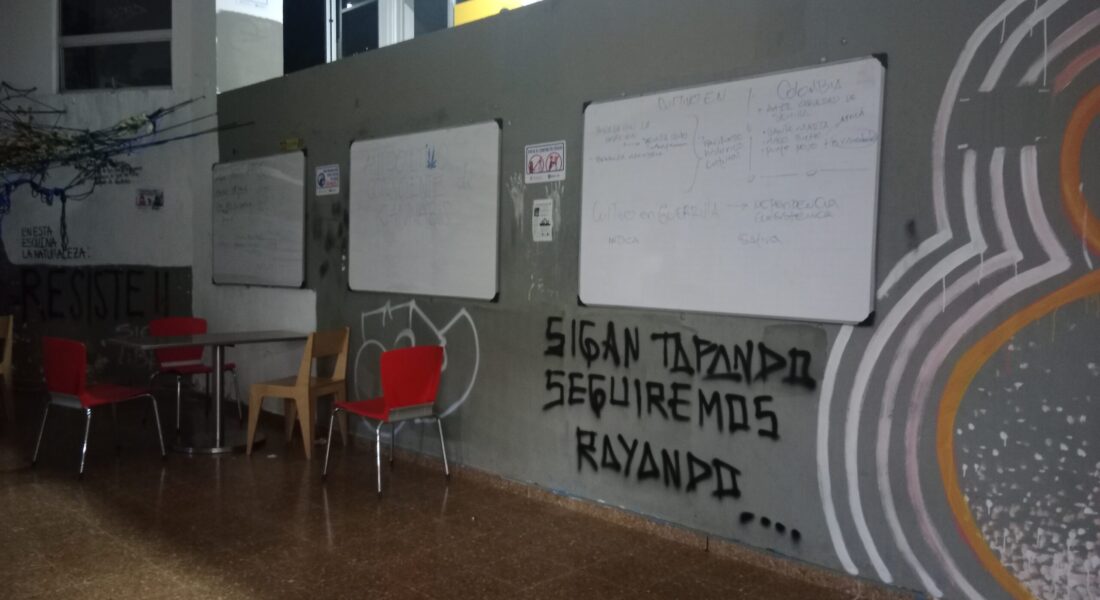
Given this, the students organized and expressed their demands in multiple ways, especially in the Faculty of Sciences and Education (FCE). One of the most common means was – and has been for years – graffiti, to which other formats and graphic techniques were incorporated to denounce the corruption of the institution and make visible their disagreements with the dynamics experienced at the university. In response, the dean of this headquarters censored the messages by covering them with gray paint, to which the students responded with more paint, expressing “Keep covering, we will continue scratching.” These expressions were joined by rallies, marches, peaceful and cultural protests, assembly processes and spaces for dialogue to discuss what was happening. Furthermore, in November 2022, at the entrance of the FCE the space was intervened in a creative way, making it difficult to pass through the stairs with a network made of fabrics that included questions about budget management, educational quality and guarantees for development. optimal of university life.
As a measure of pressure, there were riots at the FCE, at the Faculty of Environment and at the Paiba Customs Office, the current administrative headquarters of the university. Precisely, in this entire situation that has continued in recent months, the Clandestine Student Front (F.E.C.) has gained visibility within the community and not only due to its confrontations with the ESMAD – since they are one of the clandestine groups that carry out these violent direct actions—, also for his leadership and participation in other student spaces, making one of his harangues effective: “With hood or without hood, students to the fight.” Thus they have created and disseminated fanzines, they have made canelazos, through social networks they have motivated student participation in activities, they show great interest in the politicization of young people, they have painted murals, they have even raised awareness about the responsible use of the hood. With the above, reducing clandestine action exclusively to violent action, at least in this particular case, is unviable when the nonviolent strategies that this group uses are notorious.
Some of the results of all these strategies have been the gradual solution to the situation of full-time teachers, the repair of infrastructural damage that occurs in various university locations, the continuation of careers that were on the verge of closure, and progress in student applications such as double degrees and the return program for people who had lost their status as students. However, the distance persists between the administration and the student body, since the structural reforms have not been carried out and there are no conditions for broad and effective participation. On the other hand, violence such as stigmatization persists and is promoted from within, with accusations from the rector himself towards members of the student community and are continually reinforced by traditional media.
From what has been presented, it can be concluded that: a) the nonviolent strategies applied at the UDFJC, especially by the students, were effective in ensuring that the administration responded to their requests and initiated changes that have been demanded for decades; b) violence is constituted as a characteristic of the political exercise in Colombia due to the way in which power relations have been established historically, prevailing annihilation and the physical or symbolic disappearance of the other — the task is to overcome it and unlearn languages of confrontation violent acts that have been included in action repertoires; and, c) nonviolence has not been consciously incorporated into the action of the student movement, although it has characteristics of civil resistance.
In this way, the socialization, understanding and application of nonviolence can be useful in the search for different repertoires of action that contribute to the construction of a culture of peace within public universities. However, it is necessary that the defense of public education be a commitment shared by all members of the university communities and by citizens in general, which means redefining the conception of what is public and linking more people to the university movement. In addition to this, internal democracy must be strengthened. University administrations, if they really want a peaceful campus, must provide guarantees of participation that overcome the degrading and violent logics that have been systematically imposed. Finally, although nonviolent discipline has not yet been carried out, recognizing nonviolent strategies allows students to be separated from media representations that bias their action and make their struggles and commitments to social transformation invisible.
Text published on July 12, 2023 with the support of FES.
Ana María Ardila Castro
Graduate in Artistic Education from the Francisco José de Caldas District University and student of the Master’s Degree in Communication and Media at the National University of Colombia.
Translated by Damian Vasquez