Daniela Sepulveda Ruiz
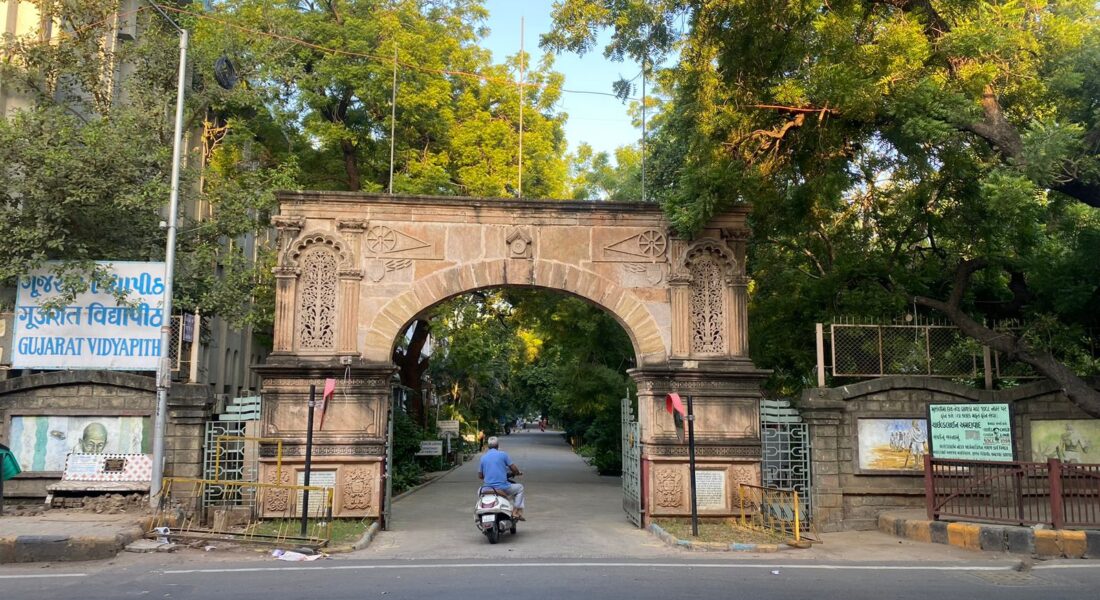
I have two months at Gujarat Vidyapith University, which was founded by Mahatma Gandhi in the city of Ahmedabad, within the state of Gujarat (India). Here I am learning about the theory and application of Gandhian nonviolence, and I must say that the approach is very different from what I knew as nonviolence before. To begin with, the university was founded on October 18, 1920. The word Vidyapith is divided into two: Vidya mainly means correct knowledge, and Pith, the places or seats occupied by wise people. Vidyapith can be interpreted as the seat of learning of the complete teachings and practices. At the inauguration, Gandhi said: “On this occasion, I would say without exaggeration that I have not done anything that can be compared with what I am doing today. I have only given a mantra, if a community can do it. I have performed the act of rishi”—in Sanskrit it is a term that refers to a realized and enlightened person.
In this university, nonviolence is institutionalized, that is, it has a transversal approach that can be observed in the distribution of spaces and how they were built taking nature into account. There are trees in the center of the street and in other areas, whether open or closed. This place is an ecosystem consciously created to learn by practicing and living nonviolence. It is a space where all the conditions are in place for you to live and develop in a nonviolent environment. Unlike other places in the city of Ahmedabad, here at the university you feel tranquility. You can find everything from orchards to Khambhati Kuwa, round structures that are buried and built with bricks, which function as rainwater retainers and channel water into the subsoil and prevent the university from flooding during the rainy season.
The International Course On Gandhian Nonviolence lasts four months, I have already completed two. Most of the time I did the activities on campus. Every day we practice a routine that Gandhi performed in the last years of his life. You start the day early, pray as a group and do Safai—a routine for cleaning common areas. There is time for personal activities before breakfast. In the first class of the day we learn how to make Khadi: a hand-spun and woven natural fiber cloth promoted by Gandhi as swadeshi or self-reliance that was used for the fight for Indian freedom and independence. The second and third classes are about Gandhian philosophy and nonviolence. Between classes, there is time for food. Once classes are over we have time to do homework before the last prayer of the day and dinner.
This is how the days progress in an intercultural group where the topics we address are shared and discussed. It is a group that draws on the culture of Nepal, Japan, Gambia, the United States and Mexico. There are also Muslims, Hare Krishnas, Christians and a skeptic of the religion who was not saved from Catholicism in her childhood. So far we have had a study trip where I had the opportunity to visit three rural basic and university education schools. There the practice of nonviolence can be seen institutionalized in another way, instilled in games, daily activities, classes, and common spaces.
So far, I have learned about the constructive program proposed by Gandhi, which considers communal unity, removal of untouchability, prohibition, production, industries and sanitation of communities, basic education, role of women, education in health and hygiene, national languages, economic equality, labor, people with leprosy, the student body and the place of civil disobedience within the construction program. Ahimsa, which is based on the principle that all people belong to a whole and, therefore, advocates respect for life and the avoidance of violence towards others, and active nonviolence that recognizes the importance of action, of the practice. My reflections revolve around our ability to recognize the relationship between individual actions and the reality we live as a society. To recognize that the end does not justify the means, on the contrary, the end and the means must be in accordance.
I believe in the divinity of humanity when it acts conscious of its interconnectivity, its interrelation, its coexistence. An act of love is both an expression of hope for humanity and a light toward human dignity. We must be brave to seek, care for, protect and defend love and for the consequences that this implies.
Thus, if truth is the end, nonviolence is the means and the only means that will lead us to live in that world that we dream of cannot be anything other than supreme love, which sets aside otherness and considers the environment as a extension of our body. That search brought me here to learn Gandhian nonviolence from theory and practice. If Gandhi was determined to search for the truth, I will say that all my life I have searched for love and I have insisted on finding it everywhere. In the quest to live nonviolence I will say that nonviolence is love.
Taking the above into account, nonviolence is also recognizing the individual power to transform our way of thinking, saying and acting, in all the spaces we occupy and how that, collectively, ends up transforming our reality. That reality that makes us unhappy and that violates us. Disobeying social, political and economic mandates requires us to know the ways or strategies of putting nonviolence into practice to avoid perpetuating violence. Exercising conscious citizenship and getting involved in nonviolent actions individually or collectively, through collectives and civil society organizations, means strengthening social movements that seek social justice for all people.
Long live supreme love, the one that is genuine, brave, respectful, transparent and without secrets. May the magic of this life be present when it coincides in intention, time and place to conspire in favor of what we feel and not what ends up being utilitarian for a society that does not recognize us as humans.
Daniela Sepulveda Ruiz
Border of Tijuana, Mexico. He is an economist, activist and hacktivist. In addition, it promotes a proactive urban culture focused on the environment and the professionalization of advocacy activism based on nonviolence.
Translated by Damian Vasquez