Steve Striffler
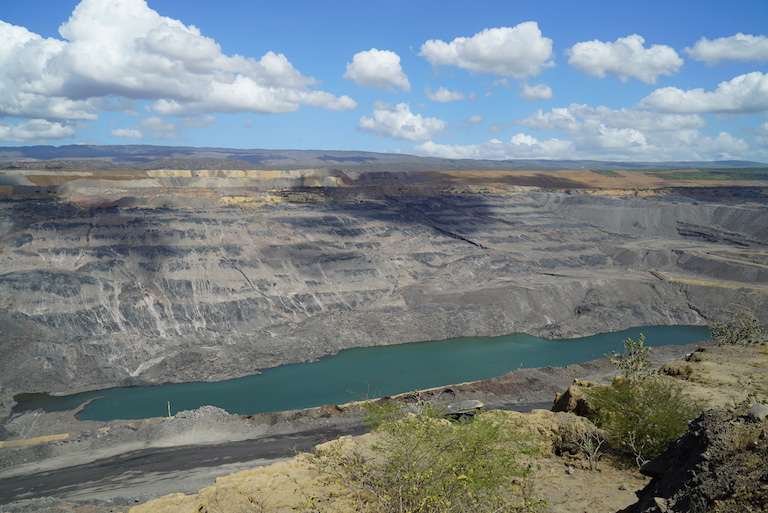
My scholarly interest in the history of Latin American solidarity emerged out of a political engagement around Colombia during the past fifteen years. Like much of U.S.-based solidarity with Latin America, the campaign I have been involved with began when Latin Americans—in this case, indigenous and Afro-Colombian communities from the northern province of La Guajira—reached out to international actors. They sought allies in the global North to support their struggle against the rapid expansion of an exceptionally large coal mine owned by Exxon, which in the early 2000s violently evicted the community of Tabaco from its ancestral lands.
Had the Cerrejon mine been owned by a less prominent company, or chosen a less conspicuously violent path for destroying a village, it is quite possible that community efforts to acquire foreign allies would have been unsuccessful. Even with the egregious violation of human rights by a prominent multinational corporation, the communities still struggled to find overseas allies and capture international attention. In an age of information overload, characterized in part by a seemingly endless supply of human crises, it is not easy to get on the global radar.
They eventually did, however, and ever since then a small group of activists from Europe, the United States, and Canada have supported the affected communities during an evolving conflict with the mine’s owners and the Colombian state. The campaign has utilized a range of tactics to put pressure on the mine’s owner by bringing global attention to its horrid behavior. This strategy of “naming and shaming,” whereby activists shine a global spotlight on companies or governments in order to alter their practices, has a long history within international solidarity. In our case, we took international delegations to Colombia in order to witness and publicize the devastation caused by the mine. We brought Colombians on speaking tours to educate and alert us audiences to the true cost of coal. We held conferences to publicize abuses and deepen alliances between communities and other actors. We pressed the mine’s owners at shareholders’ meetings and mining conferences. And we produced films, articles, and books in order to raise the profile of the cause both in Colombia and abroad.
These efforts generated concrete gains. When we began, the mine barely recognized the existence of the communities, and insisted that the eviction of Tabaco had been handled legally and properly. The matter was closed. The campaign not only forced the mine to reopen the case of Tabaco and address issues of compensation and relocation, but also shaped how the mine dealt with other communities as the enterprise expanded. The campaign served to connect communities with each other as well as with allies within and outside of Colombia—and provided a political education for everyone involved.
At the same time, given the incredible imbalance of power, there have been real limits not only to how much the mine’s actions can be influenced, but on the capacity of the campaign to improve the situation of the communities. The mine continues to expand and largely calls the shots in the region. The communities remain politically and economically marginalized, living under exceptionally difficult circumstances in a region where mining has made an already precarious existence nearly untenable.
In a larger sense, then, this campaign confronts many of the same challenges faced by much of Latin American solidarity work. To begin, the broader model of solidarity relies heavily on the ability of Latin Americans to capture the attention of international allies, who must then find ways to pressure corporations by garnering media attention, influencing shareholders, or accessing state power. Their capacity to do so, in turn, is a function of many factors, some of which are quite arbitrary. Most communities, for example, do not have the “benefit” of being exploited by a prominent global corporation such as Exxon.
Likewise, because international attention tends to be drawn to crisis and spectacle, and can require communities to display extreme suffering before a global audience, it can be fickle and fleeting as crises subside or simply fail to attract or sustain attention. A model of solidarity that relies on crisis or public outcry for its fuel can be prone to move from one fire to the next, addressing the most egregious aspects of particular cases before moving on to the next disaster. Typically, this leaves the underlying issues that produced the crisis in the first place unaddressed, and can have the effect of excluding most people from the political equation altogether, since relatively few people are exploited in ways that will ever place them on the public’s radar.
Even more, as much as these campaigns embody and are sustained by remarkable human commitment and energy, they tend to work from very limited political and economic power on both ends of the solidarity equation. The needs of those we work with in Colombia are overwhelming, and far outstrip any capacity that we—as international allies—possess or could realistically develop in the future. Indeed, the communities sought international support in the first place because they could not depend on the Colombian state to defend their interests against foreign mining companies. Nor could the communities mobilize sufficient allies or tap into social movements in Colombia to alter the mine’s practices, influence the government, or otherwise advance their cause. The pursuit of international support, although courageous and creative, signaled the weakness of their overall position. The balance of power was and is stacked against them.
At the international end, although a committed group of activists from a number of different countries have been working on this campaign for well over a decade, we have few financial or human resources. In comparison with the communities, we no doubt seem, and in some ways are, “powerful.” But we are a small group with no permanent staff, little budget, and limited political power. We have contacts and allies in numerous countries, and have (along with the communities) become skilled at identifying and accessing the mine’s pressure points. But there is no political base or larger movement that we can tap into for support or resources.
Nor are we alone. Although this “campaign” model of political engagement, whereby a relatively small group from the global North attempts to support the struggle of a poor and isolated group in Latin America, is not the only form that contemporary solidarity takes, it has become sufficiently widespread to warrant historical and strategic reflection.
How, in a sense, did we get here—to the point where this important, but relatively limited, form of intervention has become such a common form of solidarity? And, more importantly, how can we build effective international solidarity, particularly in a context where progressive forces are so politically marginalized? How do we practice and build revolutionary solidarity in the absence of revolutionary movements? What kinds of immediate, urgent, and (often) short-term struggles might help establish the building blocks for political movements that not only address moments of crisis or egregious cases of human rights abuse, but advance working-class power with the capacity to address broader issues of political and economic inequality—the very inequalities that make crisis and abuse such chronic features of everyday life in the first place?
These are the larger questions I try to address in my book, Solidarity: Latin America and U.S. Left in the Era of Human Rights, which looks at the history of U.S.-based solidarity and focuses in particular on how a campaign model of solidarity emerged through the human rights movement starting in the 1970s. I do not claim to have the answers to any of these questions (!), but here are two quick (and not particularly insightful) takeaways from my research.
- Build a U.S. Left – Latin Americans have been telling allies from the U.S. for decades that the most important thing “we” can do is transform U.S. policies and practices that undermine Latin American social movements and otherwise ensure that power and wealth are concentrated in the hands of few. This is a tall order, but until there is a left in the United States with the power to transform U.S. foreign/economic policy in fundamental ways the playing field will remain decidedly unfair for our Latin American allies – and severely limit international solidarity [Side note: It is hard to see how an effective left in the United States can be built without a labor movement and unions – so we need to revitalize and transform labor to build a broader left.]
- Build Movements from Campaigns – As the left grew weaker throughout the Americas during the 1980s and 1990s, and as neoliberal policies reduced government capacity and wreaked havoc on working people throughout the region, U.S.-based solidarity became focused on putting out a wide range of neoliberal fires. Within this context, it has been difficult to think and act strategically about how (a fairly fragmented and under resourced) international solidarity can (or cannot) advance broader movements with the capacity for shaping political power. It would serve us well to create political spaces for thinking through how such concerns can more deeply shape our politics and the kinds of projects we design and engage in..
Steve Striffler
He is director of the Labor Center and professor of Anthropology at the University of Massachusetts, Boston (USA). He is the author of Solidarity: Latin America and the U.S. Left in the Era of Human Rights.
Translated by Damian Vasquez