*Sofia Chipana Quispe
The time in which I weave these words links us to the strength of those who lived their time of transformation —the day of the dead, which for Quechua is the Aya Marqay Killa, that is, the time of the moon of those who they left. But, according to the grandmothers and grandfathers, they and they arrive to visit their loved ones. These are presences that come with the rains to water the seeds deposited in the womb of Mother Earth, just like their bodies that seek to be reborn to other ways of life.
From the offerings of food and drinks that we prepare to receive and receive them, I share with the permission of the ancestors and ancestors, the memory of the Taki Onkuy movement that allowed some peoples to resist the colonial invasion and the alienation of the cosmos. Surely there were other experiences that sustained the lives of the various peoples who inhabited the great Abya Yala, the land of vital blood, in full bloom, as the territoriality of Latin America is called, which still sustains the lives of the peoples who did not They only resisted or are resisting the systematic genocide of the capitalist and patriarchal colonial systems. A resistance from which other ways of life are woven, which we call spirituality.
From the strength of the time we inhabit, I evoke the presence and words of Bertha Cáceres in her conversations with the Gualcarque and Blanco rivers (in Honduras), with which she faced the Aqua Zarca hydroelectric project. From there I extract that shared feeling to give a title to the fabric (text) that I present: “I knew how hard it was going to be, but I knew that we were going to succeed, the river told me so”.
The link with the territories-bodies and the ancestral peoples have the strength of the memories that accompany their resistance to the realities of oppression, repression and extermination of their bodies called “Indians” and, together with them, their territories.
In the journey of the resistances, we approach the community of Taki Onkuy that is located in the years 1560-1572, almost in the early days of the colonial invasion, in the central (Ayacucho) and southern (Arequipa) regions of Peru —although some studies also place it in the Quechua regions of what is Sucre, in Bolivia. It is a movement named by the inquisitors as the singing disease because they had assumed song and dance to enter into communion with the destroyed sacred places, called w’acas, where they located the vital forces that acquired life in their bodies.
This resistance was sustained in the spirituality that would guide the renewal and reconstruction of ancestral spiritualities, to overcome the predominance of the religious and social structures of the invaders and the Inca elites that had spread through the Andean territories. For this reason, it is classified as a socio-religious movement that sought Andean unification from the common ties that came from ancestral spiritualities linked to mountains, lagoons, lakes, seas, forests and paqarinas —places where the strength and memory of the ancestors lives. and ancestors—, which referred to the origins of life. Origin that in Aymara is called Taypi, the time in which the cosmos began to harmonize and balance, and the life of the various beings began to germinate.
Taki Onkuy’s resistance came from the link with the heart of the Great Network or Community of Life, so through song and dance they sought to heal the wounded territories due to the imbalance produced by the defiling and inquisitive presence of the invaders. While some resisted through hand-to-hand combat against the invaders, the Taki Onkuy movement, based on its connection with cosmic and telluric forces, sought to interpret the messages brought by the movements of Amaru, the ancestral serpent that lives in the depths of the volcanoes, the high mountain ranges, and let its telluric force be felt through earthquakes and earthquakes that would make possible a new order.
The connection with Amaru, one of the vital forces of the cosmos, led to the search for a recreation of life and made other ways of life of many peoples in Abya Yala survive. On the other hand, it should be noted that Amaru was the force evoked through the appointment, as was done with the last Inca governor, Tupac Amaru I, whose uprising led to his beheading in the year 1572. This fact was related to the story of the Inkarri ( Inca King) whose decapitated head seeks to join his body. It is a force that supports the various uprisings, as were the significant organizations promoted by Tupac Amaru II (1780) and Tupac Katari (snake, in Aymara) in 1781.
The brief review that we present allows us to see the deep desire for the reconstitution of the territories and bodies in relation to the vital forces that flow, and maintain the life of the peoples. This supposes the connection with the millennial memory of which they are part and they seek their dignity to question the order established from the colonial system that is legitimized in the social and religious structures.
It is significant that, despite the imposition of these structures, the interpretations themselves maintain their resistance, as can be glimpsed in the Taki Onkuy movement in which its leaders assume the biblical Christian names related to the Cross of Christ: Juan Chocne (or Chocna), Santa Maria and Santa Maria Magdalena. Possibly, with great intention, to reflect his reality in that body of the crucified, or to see the fragility of the Christian God defeated on the Cross.
Although the memory of Taki Onkuy comes to us as part of the thankless memory, it allows us to see the link between the territory and the body that the Andean peoples maintained. Although we do not have many records regarding nonviolent resistance and those that reach us are mediated by the gaze of the chroniclers. However, they are perceived in the feeling that accompanies the resistance in the various territories, which permanently seeks to heal the territories, bodies and lands. It is not an easy process due to the criminalization of the defense of all forms of life assumed by the various peoples.
Well, it is about world experiences that resist from the web of their relational spiritualities, as shared by Bertha Cáceres in her replicated words, who had “learned to fight with music, with ceremonies, with spirituality”, in order to reestablish relations of reciprocal correspondences. who seek balance and harmony as a healing force that recreates life, in the face of the oppressions of patriarchy, capitalism, racism, sexism.
And as Lorena Cabnal puts it, from community feminism, it is about healing as a cosmic political path, in daily dynamics and relationships, where resisting is also recreating life —many times not considered as struggles and resistance by the hegemonic ways of understanding them —. Well, the peoples, from their vital principles, seek to face the impositions to maintain and improve their living conditions. This is the case of the process of selection, care and planting of seeds, which are generally assumed by women as a policy in which it is decided to safeguard food sovereignty and the care of ancestral seeds, against the extractivist policies of transgenic seeds and monoculture.
It implies processes that seek to be assumed in a holistic way, as happens in the demand of indigenous women who are not limited only to raising their rights, but to the dignity or healing of life. As long as the colonial patriarchal power does not recognize it with strength and power, they are not taken as struggles. In the same way it happens with the narrated stories, where the warlike power is imposed and not so much the resistance that managed to crack certain systems of domination.
I want to conclude with the healing memory of five other women, led by Domitila Chungara in the committee of housewives of the mining organization of the 20th century in Bolivia—who are little recognized in the struggles of the unions and the feminist collectives themselves, and less for the official story.
They, in 1978, began a hunger strike in La Paz, the seat of the Bolivian government, to confront the military dictatorship of Hugo Banzer, a political project that traveled through various territories as part of the Condor Plan that was applied in various countries by the School of the Americas, operated by the United States Army.
Domitila, her companions of her and her little daughters and sons, undertook a hunger strike to which thousands joined, managing to overthrow the dictatorship. Although the military regime articulated again, persecuting with greater violence, until the year 1982.
Domitila left a great lesson, that of asking to speak and defeating the main enemy: fear. What led her to face the bloody power of the military dictatorship, as part of the colonial extensions that took away and silenced the lives of thousands, to which must be added the millions of lives and ancestral peoples that were extinguished by the genocidal power that he systematically sought to silence other ways of life that posed a threat to his interests.
In this deep time of memories and presences (Aya Marqay Killa), we stay around the shared tables that receive the arrival of those who now live other forms of life, and we link ourselves to their transgressive memories, which awaken the reciprocity of healing, of land-territories and land-water-bodies.
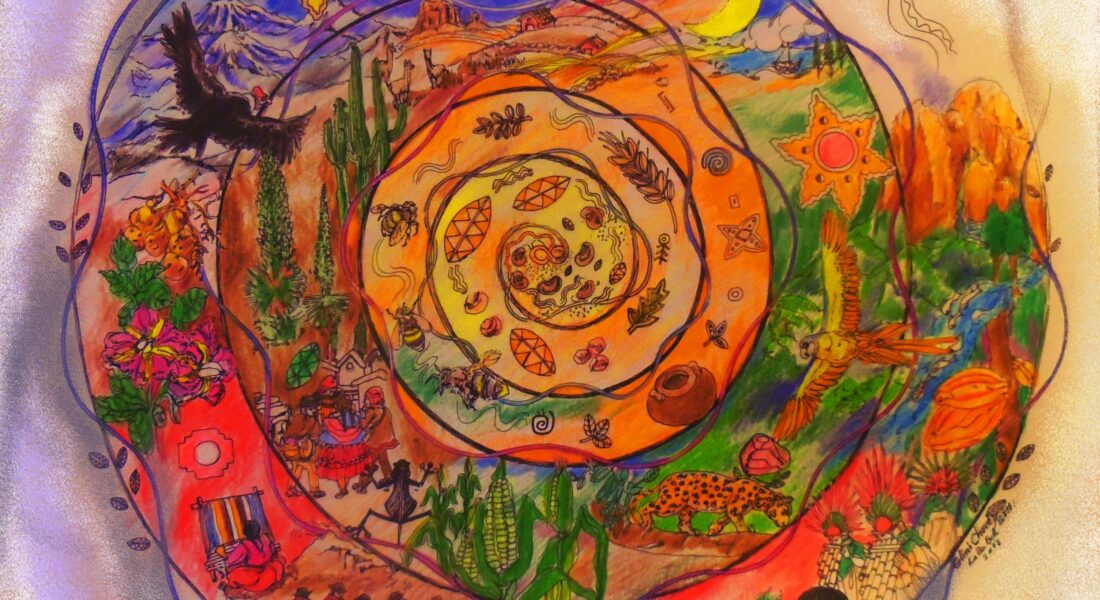
The fabric of life: it reflects a living fabric, extended and intertwined in all its dimensions and depths, where everything has its place and its time, interrelated in the harmonic movement of the forces that make Life, its cycles and returns. It reminds us of all beings in community, our ability to create and transform possible realities. We are the hands that weave in this extension of the heart. The photo is an art-weaving by Erlini Chove Tola Medina
* Sofia Chipana Quispe
She is an Aymara from the Plurinational State of Bolivia. She is a member of the Abya Yala Community of Indigenous Wise Men and Theologians, and she walks alongside the Andean Theology Community of Peru, Bolivia and Argentina.
Posted: November 21, 2022
Translated by Damian Vásquez