Maria Zeballos
Protest measures or tactics—also known as disruptive acts or methods of struggle—are all those actions that groups carry out to confront authority when they perceive injustices and grievances that have long been ignored by those in power. They are manifest acts that can be recorded in detail as done by conflict monitoring centers whose databases constitute historical records of social protest. Examples of these repositories are the Center for Studies of Economic and Social Reality (Ceres) in Bolivia, which began its records in 1970; and, the Unir Bolivia Foundation and the Center for Conflict and Social Cohesion Studies (COES), in Chile —both reporting since 2010. In order to know the dynamics of protest actions, we will carry out a comparative analysis between Bolivia and Chile, using data from these monitoring centers.
The age of Ceres allowed us to know that over the years there are pressure measures that are discarded and others that are adopted and become more popular. This is the case of the indefinite strike that was widely applied in Bolivia between the seventies and early nineties and the strike for a defined period – 24 or 48 hours, etc. – which lasted a little longer: until the beginning of 2000. While The hunger strike is the one that was least used and was present mainly between 1991 and 1997. Starting in 2000, the application of strikes began to disappear from the record. The tactic is closely linked to the action of groups with labor demands and is an action that Ceres classifies as passive because individuals protest by stopping doing something everyday which, in this case, is work. This trend is also seen in the COES record, where strikes and stoppages of activities decrease in the data starting in 2016 — and although it is a shorter record, there is an indication.
On the contrary, protest actions such as marches have begun to gain prominence since the late 1980s. At that time this method was the means most used by the mining and student movements that demanded the election of state authorities and the end of the dictatorship in Bolivia. The march remained a peaceful and effective method to this day and many groups used it as a form of resistance and protest in Bolivia. This is the case of the indigenous peoples of the Amazon in the 1990s who achieved partial modification of the Constitution and their inclusion with identity in the State, or vulnerable groups such as organizations of the disabled in Bolivia that marched 383 kilometers in 2016 to improve the conditions of their social income.
But, it is also striking that in the newer registries such as Unir and COES, a slight tendency towards a decrease in walking has been noted in recent years, perhaps because it is a sacrificial method since it consists of traveling on foot for long kilometers at a time. through the roads and it is not until the group arrives at its political destination that the opportunity for negotiation appears, as happened in the examples cited. Both measures—the strike and the march—are exhausting, and at least in Bolivia, in recent times it is perceived that the government relies on this exhaustion to overcome and win the conflict, reduce the strength of the protest and discourage the subversive intentions of other groups. Perhaps this strategy of power explains that the Unir Foundation data reflects a certain trend in the decrease of the group’s initial measures such as the announcement or threat of pressure measures, which was important until 2015. However, from that point onwards year begins to be little recorded, suggesting that the groups are going directly to action, ignoring the negotiation stage before starting the conflict.
Another moment prior to the conflict is the measure known in Bolivia as the “state of emergency,” which shows a slight increase since 2017. This low-impact measure—different from the governmental exception regime—is when the group declares itself ready to start the conflict. open if demand is not exceeded in previous states. It is generally a method used by high-ranking social organizations that have prestige in the face of the government and society—such as the Central Obrera Boliviana—and that, due to this position, achieve their demands with less effort. The state of emergency is also applied by these organizations when they gather around social movements and in critical conflicts, such as the 2019 national elections where the bet was on the legitimacy of the process and a position in the defense of the State against protests. from other groups that they perceive as destabilizing.
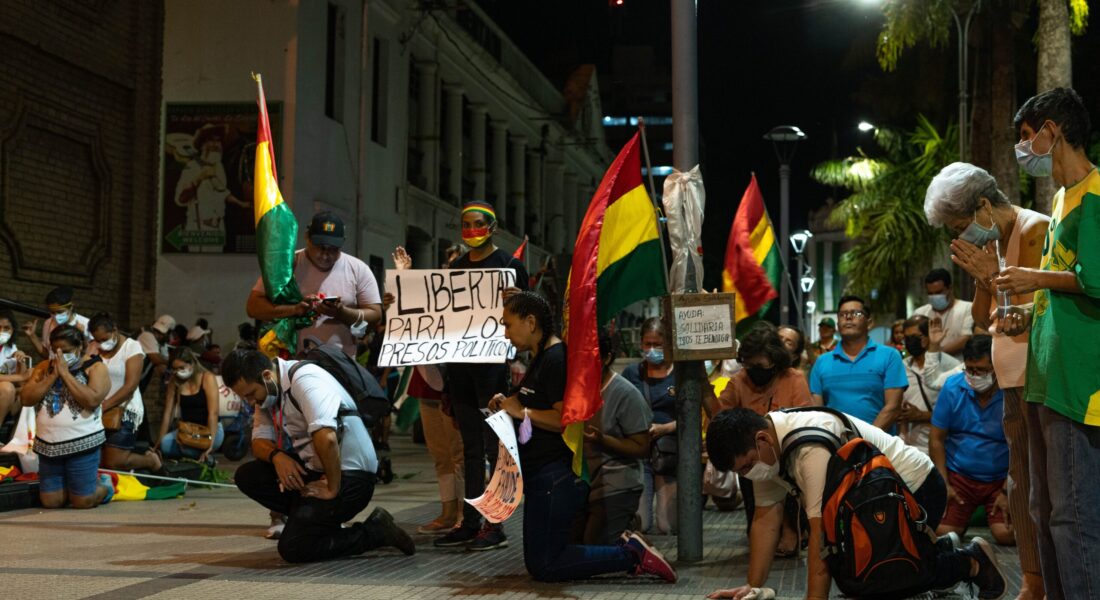
Instead, the action called concentration, vigil, sit-in, rally is taking center stage in Bolivia in the last three years before the pandemic. It can be said that it has the potential for effectiveness since it is statistically related to the governance crisis, comparable in effectiveness with the action of destruction of property. For the theory of civil resistance, this data is encouraging because it is a mainly peaceful demonstration. Although in other contexts such as Chile, nonviolent measures are not yet the purpose of the strategy since merely peaceful and democratic demonstrations such as assemblies, deliberations and events with speakers have a weak presence in the spectrum and do not experience changes over time.
What’s worrisome, is that violent-based measures are being applied. In Bolivia, the siege of cities was an old and almost exceptional measure, but it began to regain validity in 2018 with greater prominence in the electoral crises of 2019 and 2020 — and continues to be present. This measure has a symbolic load since it is inherited from the indigenous uprisings against the Spanish colony that is adopted by ethnic groups and peasants, but that today has a violent base because it seeks to deprive the inhabitants of a city in conflict. This conflict is more ideological than sectoral, that is, it is applied when a threat to political stability is perceived or against groups that are considered opponents of the government.
It is important to define how violence is measured in social conflict. In the Unir methodology, used to measure conflict in Latin America, a value from one (01) to five (05) is assigned to each demonstration in relation to the presence of police forces, repression, number of injured and dead, and impact on the stability of the government. Not all records assign this value directly, the information is contained in other variables that allow radicality to be identified in other contexts such as Chile and make the comparison with Bolivia. With this procedure we deduce that the most violent measures in both countries are the same: blockade, road blocks and seizures, seizure or occupation of facilities and buildings. Even those that are considered peaceful such as urban rallies, rallies, and marches are more likely to experience police repression and arrests of protesters. In Chile, looting of stores and supermarkets and attacks on police officers suffered a slight increase between 2019 and 2020. The groups classified as irregular in the COES are the most violent because they are related to the use of firearms, explosives, looting, burning of vehicles, property and buildings, destruction of private property, attacks on passers-by, attacks on the police. Although one might think that they refer to parastatal groups, they are related to demands for identity, heritage or memory for the defense of ancestral territories and human rights. Even civil groups identified with social demands related to values and beliefs, referring to the defense of cultural and gender identity and that are manifested mainly through art, present attacks between protesters.
In the same way, a value can be assigned to the demonstrations in the Ceres records (1970 to 2019) and investigate the history of the conflicts of the last fifty years in Bolivia. In the first instance we find that the most violent years were 1971, when Hugo Banzer’s military coup occurred, and 2008, the last year of the Constituent Assembly. In Chile, the most violent years on record were 2019 and 2020, the years of the so-called social outbreak. Preliminarily, these examples coincide with the Marxist theory that the most violent conflicts occur in historical crises where societies are immersed in ideological contradictions about the societal form and in the search for drastic changes in the regime and the daily order of things—of course. which is not the rule.
Finally, in the last thirty years, Bolivia and Chile experienced an increase in the application of nonviolent protest tactics, a period coinciding with the establishment of democracy and the expansion of citizen rights. The data express the indication that these measures have a similar effectiveness as violent actions in achieving high-impact objectives such as moving the foundations of the State. Furthermore, civil resistance offers a greater spectrum of actions for groups and movements, actions that need to be reinforced especially in times of political crisis when there are groups more willing to take extreme measures. The most democratic and deliberative practices that can encourage group gathering towards the clarification of goals under peaceful principles can constitute an important support for mobilization that seeks to challenge power.
Maria Zeballos
She is a Bolivian anthropologist, researching the formation of protest alliances between social organizations in social conflicts in Bolivia for her Master’s thesis in Critical Theory in the Postgraduate Program in Development Sciences at the Universidad Mayor de San Andrés.