Alexis Colmenares Zapata
Peace and democracy are two values that have in common tolerance and respect for divergent ideas. Both are built on the basis of negotiation and the reduction of violence. Likewise, both must have a direction that allows society to unite its efforts to achieve collective well-being. In recent years, Ecuador has experienced a series of political, social and economic changes that have generated a climate of uncertainty and tension in the country. In July 2022, tension peaked when a national strike led by indigenous organizations shook the country and highlighted the need to effectively address the challenges facing Ecuadorian society. These events are conducive to briefly reflect on nonviolent action as a key tool in the process of civil resistance in Ecuador.
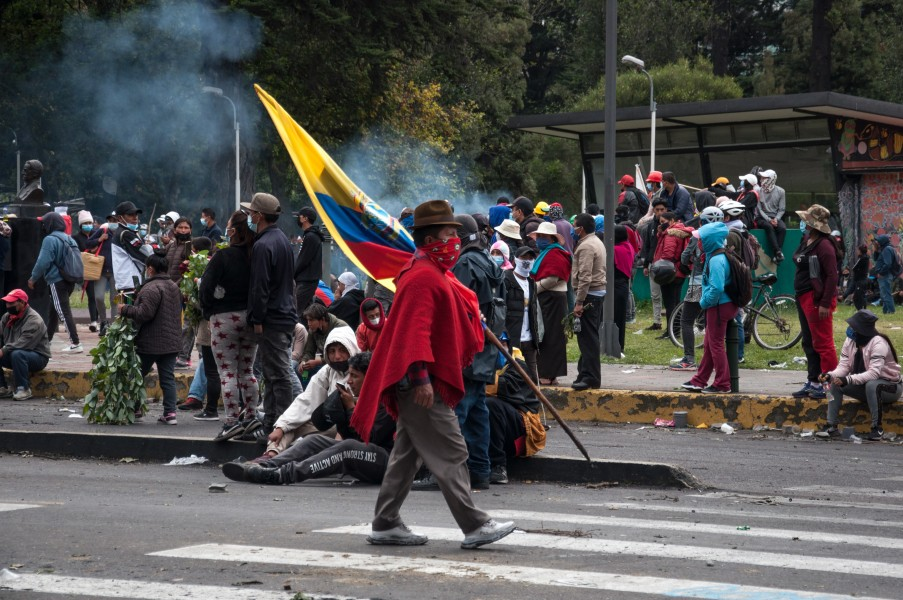
In June 2022, the South American country presented one of the longest strikes in the country’s recent history, which lasted 18 days and spread across a large part of the national territory, being most intense in the provinces of the Andean and Amazon region and particularly in the capital. The origin of these tumults was the dissatisfaction of various social organizations and indigenous representatives with the policies of Guillermo Lasso, who reached May 24, 2022, the first year of government in Carondelet.
During the first week, mobilizations were carried out in rural areas and in cities like Quito. In the second week, indigenous and peasant groups, led by the Confederation of Indigenous Nationals of Ecuador, Conaie, moved to the capital and there were other demonstrations in the main Andean cities, which caused the paralysis of the country and the lack of food and production. Finally, in the third week, an agreement was reached with the government to cease the de facto measures.
The indigenous organizations made it a precondition for lifting the strike that the Government respond to a ten-point document with different requests. The demands included different areas. Among them we can mention the freezing of fuel prices, the moratorium on debts in public, private and cooperative banks, not expanding the frontier of mining extractivism, combating insecurity, a greater budget for intercultural education and fair prices for agricultural products, among others.
During the three weeks of protest, conflict and violence marked the social and political panorama of the country. The demonstrations took an increasingly violent turn in several provinces. Thus, the deterioration of public spaces, attacks on official facilities and violent confrontations between protesters and State forces and infiltrators occurred. One can mention, for example, the attack on the State Attorney General’s Office and the escalation of violence in the city of Puyo – in the Ecuadorian Amazon. The most notable result was the loss of some human lives and many injuries on both sides, as well as damage to infrastructure, large economic losses, resentment, vandalism and frustration.
This strike was a call to action by indigenous communities and other social organizations seeking to protect their rights and the environment. The protests had important social and political effects, mobilizing a large sector of the popular classes and forcing the powers of the State to recognize the crisis and pay attention to it. In this way, political decision-makers and their representatives were thrown off balance by the direct action of the popular classes, especially indigenous people and peasants.
Thus, the protest in June 2022, which included peaceful demonstrations, road blockades and major paralysis of key sectors of the national economy, was a key tool in the process of civil resistance in the national strike and a response to the lack of dialogue and listening from the government. Through the organization of demonstrations, social movements managed to capture the attention of public opinion and pressure the authorities to listen to their demands. The use of demonstration as a form of resistance demonstrated—once again—the capacity of social movements to achieve their objectives.
Although the most visible face of the demonstrations was expressed through large mobilizations, blocking of roads and suspension of transportation, it was also possible to see a lack of efforts and strategies on the part of the indigenous leaders to maintain nonviolent discipline and contain the hotspots of violence. The use of violence within a nonviolent movement can have negative effects, such as delegitimization and discouragement from participating in it. Therefore, the best way to preserve the legitimacy of the demands of indigenous peoples and the support of public opinion was to maintain the nonviolent nature of the protest.
Civil resistance and nonviolent action are processes that have become increasingly common in the fight for human rights and social justice around the world. Nonviolent action is a form of protest that seeks to achieve social and political change without resorting to physical or verbal violence. This strategy can include peaceful demonstrations, civil disobedience, hunger strikes, boycotts, among other forms of nonviolent resistance. In the case of Ecuador, we can mention the symbolic takeover of the Arbolito Park and the House of Culture in Quito, during the national strike in June 2022. These forms of resistance have been essential for the construction of a more just society. and equitable.
Thus, after the acceptance of the dialogue between the opposing parties, on June 30, 2022, the indigenous organizations and the national government managed to sign an agreement with the mediation of the Ecuadorian Episcopal Conference to end the national strike. The actors in conflict signed an “Act for Peace” where the consensuses and commitments reached were established. In the first instance, the Executive agreed to reduce the price of fuel, to work to focus the gasoline subsidy, to repeal Executive Decree 95 on hydrocarbons and to reform Executive Decree 151 to prohibit mining activity in protected areas. For their part, indigenous organizations declared the cessation of mobilizations throughout the country and the return to the communities, as well as the suspension of all acts that could affect peace and public order.
Peacebuilding was also a key aspect during the national strike. Despite the intensity of the demonstrations, some pockets of violence and political disagreement, the use of nonviolent action and cooperation between different social movements allowed people from different communities and social groups to come together in order to work together for a common cause.
Through the promotion of values such as justice, equality and solidarity, social movements contributed to creating an environment of trust and dialogue, which allowed for more effective negotiation between the parties involved. Cooperation and teamwork were key to achieving significant progress in the fight for social justice and human rights in the country. Furthermore, nonviolent action and peaceful resistance enabled the creation of a space for dialogue and mutual listening, which contributed to greater understanding and a peaceful resolution of conflicts.
However, peacebuilding in Ecuador is not an easy or quick process. It is a process that requires the active and committed participation of all interested parties, including authorities, indigenous communities and social organizations. Repression and violence continue to be a recurring problem, and the demands of indigenous organizations and other marginalized groups remain unheard. From the point of view of negative peace—a term coined by Johan Galtung, a leading reference in Peace and Conflict Studies—understood as the reduction of direct violence, we can agree that the Peace Act achieved its goal of stopping violence and violent confrontation between protesters and law enforcement, addressing the immediate causes of the conflict—the ten points demanded by indigenous organizations. However, we must reflect—and question—whether these agreements addressed the underlying causes that generate and will continue to generate invisible and much deeper violence, such as discrimination, historical exclusion, racism and large gaps of social inequality, just to mention a few.
In a context of structural, cultural and direct violence, in Ecuador from time to time conflictive coexistence relationships are generated due to discrimination. In addition to this situation, there is no generalized recognition of the problems of racism and social exclusion that occur in Ecuadorian society. Both sensitivity to conflict and risk management point to the importance of generating a collective vision of the future for the construction and empowerment of social actors of a desired image for Ecuador in a short, medium and long-term time horizon.
It is important to continue working together to build a more just and peaceful future for all the inhabitants of Ecuador. Nonviolent action, civil resistance and social movements are powerful tools to achieve positive change in society. To achieve a truly peaceful and just society in the country, it is essential to address the challenges faced by communities from a comprehensive perspective. This means not only addressing economic and political issues, but also the cultural and social challenges facing the country’s most vulnerable communities.
Alexis Colmenares Zapata
Doctor in International Studies, career diplomatic official (2002-2017). He is a professor at the San Francisco University of Quito, the Institute of Higher National Studies (IAEN) and Flacso Ecuador.
Translated by Damian Vasquez