Andrea Moreta
In the protests I have attended in my city, Guayaquil, Ecuador, I have lived various experiences that, at the end of the day, leave me with a bitter and painful taste for how we are received and farewelled. At the beginning of the protests, we are received by a large team of members of the National Police of Ecuador—necessary, as long as the safety of the protesters is taken care of. During the course of the protests, and when they come to an end, we are sometimes intervened by the police force despite not carrying out any violent action. We are attacked simply for our presence at protests. That is the bitter taste that the protests in the fight for women’s rights produce in me. And it is also painful because the mothers, sisters and friends of the victims of femicides are present at the protests. It is regrettable that the State has failed to provide the necessary justice and reparation to the victims within the framework of the judicial process.
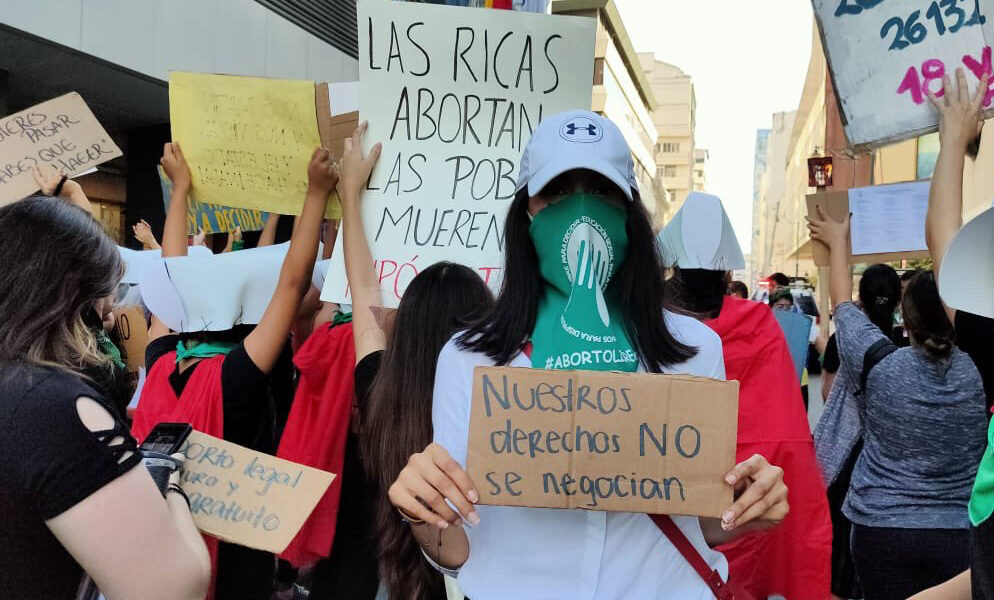
I frequently participate in protests that support women’s rights. I have been present on significant dates such as September 28th (Day for the Decriminalization of Abortion in Latin America and the Caribbean) and November 25th (International Day for the Elimination of Violence against Women). In my experience I have been able to observe a well-structured feminist organization, which has the support of many independent activists and people who, walking down the street where the march passes, support the cause. The presence of authorities such as traffic agents and police officers is also noted to control the supposed disorder that we cause. In reality, on these historical dates many mothers are present full of pain who march with bravery and courage asking for justice for their murdered daughter (femicide) or for situations where the State is not present. An example was when the feminicide of Lisbeth Baquerizo became public knowledge and her relatives marched to make their voices heard and demand that the State carry out appropriate investigations: the main suspect was her partner who is currently still a fugitive from justice.
The marches have different objectives. On the one hand, September 28th is about the fight so that all women can make free decisions about our sexual and reproductive health and rights, not just the most privileged. In Ecuador there are still legal restrictions and setbacks that threaten our reproductive rights, demonstrating the urgent need to guarantee equitable access to sexual and reproductive health for all women. For this reason, our fight aimed at nonviolence focuses on delivering bills to the National Assembly together with the Ombudsman’s Office, as well as going to the streets and expressing our discontent with the State. The truth is that, although the feminist organization fights to achieve this access, there are many obstacles on the part of legislators, a situation that becomes more complex with the religious beliefs of society.
On the other hand, November 25th is the fight to denounce the violence that is exercised against women in all areas, this being the most widespread violation of human rights in the world. What we demand in the streets are solid projects that effectively focus on the prevention and eradication of violence by allocating economic resources for the implementation of laws.
The marches are organized weeks before the dates mentioned above and work together with different organizations in the country. In 2020, I was able to participate as an activist and was doing internships at the Permanent Committee for the Defense of Human Rights (CDH). Together with the leadership of Executive Secretary Billy Navarrete, I was in charge of creating the schedule to give order and guidance to the mobilizations. Once this was done, the specific details of each march were meticulously planned: who was leading the march, the strategies to follow during the journey, as well as the songs that would be sung to maintain a unified and clear message. This process was carried out with great care and respect for the previously defined schedule to guarantee that each action was executed at the right time and in the right place. This detailed organization made it possible to maintain the coherence and effectiveness of the protests, strengthening the message and the presence of those who participated in the marches.
During the development of the marches, our focus was on the implementation of nonviolent protest and persuasion actions. This involved not only singing songs, but also close collaboration with various organizations and fellow volunteers who joined the cause. Previously, days before each march, we made sure to have printed the lyrics of the songs we were going to sing. This was a crucial aspect to ensure we projected our voices in a strong and unified way, especially considering that the marches were taking place in highly trafficked and central areas in the city of Guayaquil, capital of the coastal province of Guayas. This strategic approach allowed us to transmit our message in an impactful and audible way for all people present, thus reinforcing our presence and provoking partial participation of civil society in favor of the cause.
The organizations that accompanied us during the protests in 2020 were the Ecuadorian Center for the Promotion and Action of Women (CEPAM), the Fundación Mujer & Mujer, the Guayas Coordinator, Wambra Medio Digital Comunitario, Aborto libre Guayaquil, the Alliance of Organizations for Human Rights, the Rosa Luxemburg Foundation, the movements of diverse women in resistance and the feminist movement of Guayaquil. They all demanded respect for human rights, that our voice be heard in defense of the fight against violence against women, trans women, adolescents and girls. Shout that femicides are the results of a complicit society where gender violence has been normalized, which does not accompany the victims, but rather re-victimizes them and blames them for the events that have occurred, generating fear in the decision to report.
The purpose of the marches goes beyond protest, they also have a commemorative aspect and a tribute to the women who have died. This is done to keep his memory alive and recognize his importance. Furthermore, these demonstrations seek to pressure and demand the legal recognition of safe and free abortion, where the approach to abortion is more legal than moral, emphasizing the fundamental right of women to make decisions about their own body. The lack of legal recognition and the omission of policies in this regard contribute to the increase in preventable maternal deaths, a problem that could be addressed through the Ministry of Public Health, thus avoiding an unnecessary increase in female mortality.
Despite the adversities and repression, the experiences as an activist within the protests have been an emotional roller coaster. In each demonstration, strength and determination mix with pain and frustration as legitimate demands face resistance and sometimes repression from the authorities. These marches become moments full of emotion, where the voices of women resonate strongly in the streets. Every march, every song, every raised banner is one more step towards a future where women’s rights are respected by everyone, regardless of their origin or socioeconomic situation.
Seeing mothers marching and demanding justice for their murdered daughters (femicides) and other circumstances is heartbreaking. In those moments, protest songs become anthems of solidarity and demand for a more just world.
Article published on December 19, 2023
About the author
Andrea Moreta
Graduated as a lawyer in Ecuador. Currently, he works in free practice and is finishing his postgraduate studies as a Master of International Relations with a mention in Security and Conflict at the Latin American Faculty of Social Sciences (Flacso Ecuador).
Translated by Damian Vasquez