Anonymous
Today, although uncertainty floods our minds, we are completely certain of one thing: the Nicaragua of before no longer exists. The population decided not to remain silent anymore and showed their discontent against a dictatorship that clings to power. The oppressive response by the government generated a serious sociopolitical crisis, which began in April 2018 with a series of student protests against the reform of the social security system—extending to other sectors of society. These were immediately repressed by the regime, unleashing a spiral of violence that left hundreds dead and thousands injured.
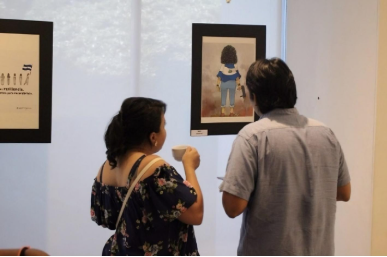
It was in this context of repression that, to preserve the lives of the protesters, forms of protest other than demonstrations and rallies were adopted, such as digital creative activism or also called artivism. Several people, using anonymity or pseudonyms to protect our identity, began to create motivational and satirical digital illustrations as an act of protest — this became our trench.
The preparation and publication of these illustrations began in an organic, disorganized and unplanned manner. It was a quick response motivated by the obvious repression that the government was exercising against the demonstrations. However, as the illustrations gained popularity, it was necessary to design and plan an orderly campaign on social networks to send the protest messages in a more forceful, targeted and broad way.
The campaign was designed in such a way that a profile was created on social networks in order to publish illustrations weekly with the hashtag #SOSNicaragua. This hashtag was used as a public denunciation of the Nicaraguan sociopolitical crisis in April 2018. In this way, in an organic way, the illustrations could be seen by people interested in the development of events or news related to social protests.
A non-negotiable factor of the campaign was that iconic elements of Nicaraguan culture such as popular language, colors or national symbols be used in our illustrations. In this way, people could more easily identify with our messages of peaceful resistance and nonviolent protest. This campaign required closely following the news and events in Nicaragua since the information fed the production of the illustrations, whose initial objective was to denounce the violation of human rights and the repression of demonstrations through art.
However, this made the subject of the illustrations extremely restricted. There were weeks when there were no new events. Therefore, it was decided to include in the illustrations real stories of solidarity among the population under an increasingly repressive context. The purpose of this was not only to make protest illustrations about the government—and keep it as the main theme—but to compile these acts of humanity that demonstrate the nobility that persists in the Nicaraguan people.
Although the original campaign was modified to adapt to the reality and context that existed in the country, this change had unexpected positive results. Illustrations of motivation and solidarity were widely disseminated. In a short time, the illustrations were shared by thousands of people throughout the country and even among the Nicaraguan diaspora, becoming a very effective way of offering a message of hope and nonviolent resistance to an extremely wide audience. As a result of this popularity, we were contacted by social organizations that asked us for illustrations related to their institutional mission, particularly on issues of women’s participation in nonviolent resistance. They also asked us for permission to use our illustrations on book covers and banners.
As the protests intensified, the government became increasingly isolated and desperate to maintain control. However, our work on social media and other digital media had created a new form of nonviolent civil resistance that they could neither control nor repress: digital activism became increasingly important. We convinced ourselves that we could reach more people through social media than on the streets, where repression was increasingly brutal and where the safety and integrity of protesters was significantly compromised. With our digital illustrations we sent messages of support and motivation to people who were isolated, scared, injured or exiled, while also denouncing the human rights violations that were occurring.
Although work as digital activists is peaceful and nonviolent, it has not been without risks. We have received threats and cyber attacks and have been careful to protect our identity, post our artwork online, and navigate the web cautiously. Online censorship, defamation, and harassment are forms of digital violence that have been used by the government to silence activists and limit freedom of expression online. An example of this digital violence perpetuated by the government is the Special Cybercrime Law, known by the population as the “Bozal Law.” This rule came into force on December 30, 2020 and allows the criminalization of people who criticize or question Daniel Ortega’s government through social networks. Another example is the usurpation of telephone numbers of news channels critical of the government: the purpose is to silence them and replace their messages with information related to the government.
But these risks have not deterred us from continuing to fight in the face of realities that must change. Despite violence and repression, digital activists have managed to keep the flame of peaceful resistance alive and have shown that creativity and art can be very powerful tools in the fight for social justice and democracy.
Without a doubt, digital activism in Nicaragua emerged as a crucial tool to denounce repression and promote peaceful resistance against a dictatorial government that has limited freedom of expression and citizen participation. Digital activism empowers us to continue protesting oppression from a safer space.
This article is published under anonymity to protect the personal safety of the person who wrote this text, who lives in contexts of repression and political harassment in his country.
Text made in alliance with FES and published on June 21, 2023
Translated by Damian Vasquez