Daniela Brik
I am preparing to write about one of the issues that are exhaustively more complex to elucidate for a simple observer in a civil resistance conflict, such as the one that Ecuador experienced in October 2019. But I take on the challenge posed by the Regional Institute for the Study and Practice of Strategic Nonviolent Action in the Americas and I will openly address the signs of the presence of infiltrators and agents provocateurs in that conflict.
The trigger was a presidential decree that sought to end four decades of fuel subsidies, in line with the commitments made by the Government of the Andean country with the International Monetary Fund (IMF) to obtain a loan of 4.2 million dollars. . The measure was considered a provocation by the popular classes and one more drop in a glass full of grievances, especially against the indigenous nationalities of Ecuador.
But, before putting this episode in context, I want to highlight as a journalist, who experienced the events firsthand, and a researcher, who analyzed these events in my master’s thesis, the enormous capacity for agency and organization that the Ecuadorian indigenous movement had. Despite his great diversity and multiplicity of visions and voices, he led the actions in the streets and at the dialogue table, getting the then president Lenín Moreno to back down and reverse the measure in order to pacify the country.
The social response led to mobilizations with an epicenter in Quito, which paralyzed Ecuador for eleven days in which between half a dozen and a dozen people lost their lives, according to various journalistic sources and national and international organizations, and around 1,500 were killed. wounded.
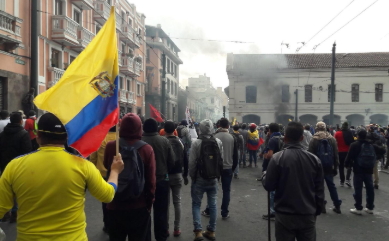
Authors such as Garrido and Mouly pointed out that “what began as a nonviolent campaign resulted in levels of violence never before seen in this type of mobilization in Ecuador.” However, from the first days of the demonstrations, violence was already palpable in the historic center of Quito, the scene of true pitched battles between protesters and public forces, which led to the early declaration of a state of emergency.
Much has been suspected, accused, theorized, said and published about the presence of infiltrators, agents provocateurs or, at least, foreign actors and particular political interests during the most violent days of the protests. However, in most cases a shadow of doubt has always hovered over the difficulty of contrasting and verifying information, testimonies and statements in this regard. On this issue we can differentiate some categories:
1. The presence of undercover members of the security forces.
Sources from the Armed Forces, who I cannot identify for security reasons, told me that during the days of greatest chaos in the capital, members of units of the Ecuadorian army were deployed in underground places in the city, which I cannot specify either, due to the need that they had to quickly access the historic center – where the Presidential Palace is located – without being noticed by the protesters. Among the objectives, the testimonies suggest that they could include i) the extraction of political representatives, ii) their tactical intervention in support of the police forces, or iii) the arrest of troublemakers – let us remember that since the beginning of the social protest, had declared a state of emergency.
There were also police and military agents dressed in civilian clothes at the calls, both in Quito and in nearby towns with an indigenous majority where the aim was to break the siege initially imposed by the security forces in order to reach the capital. This type of information indicates that the intelligence services were monitoring what was happening both on the streets and underground with several possible specific objectives.
2. The participation of non-state agents or provocateurs in the protest in Ecuador.
According to statements by protesters, indigenous leaders, the Government itself and journalists on the ground, during the protests there were riots in which people of other nationalities supposedly took part and who described themselves as Cubans and Venezuelans. These people, according to witnesses, were recognizable by their clothing because they did not belong to any group of protesters who knew them, or because they were located in specific places in the concentrations, such as on street corners and ends of protest lines.. It was suspected that they had stoked discontent with the aim of causing chaos or provoking a violent reaction on the part of the public forces.
It should be noted that these descriptions of the events are difficult to verify and as an observer during the days of greatest violence, it was impossible for me to identify agitators of supposed foreign origin. What I could see were hooded young people approaching and confronting the security forces, in addition to throwing objects, fireworks and Molotov cocktails. Also protesters heavily equipped with rudimentary shields and crouched behind defenses such as barricades built with the cobblestones of the historic center.
These types of actions, which require certain expertise and tactics in street fighting, were far from the nonviolent strategy and were more typical of the black-block—a street demonstration whose participants are characterized by wearing black clothing—than the product or consequence of the instigation of a few agents provocateurs.
In a parallel case, but which was linked to the logic of the “foreign agent” put forward by the Government, the arrest of nearly twenty people occurred in the vicinity of the Quito airport. The majority were Venezuelans and the photos published by the authorities presented the detainees in a humiliating position, according to human rights NGOs. Almost all were released shortly after as no basis was found for charges to be filed. These were mobile application drivers who waited outside the airfield for clients, the Venezuela Association in Ecuador explained to me.
3. Suspicions and accusations that there were Correismo infiltrators.
The narrative about these suspicions was that this type of infiltrators would have sought to sow chaos to destabilize the Government. This was pointed out by former President Lenín Moreno, but also testimonies collected for my thesis from indigenous leaders and journalists. The Government accused Venezuelan President Nicolás Maduro, an ideological ally of former Ecuadorian President Rafael Correa, of being behind the attempts to democratically destabilize the country.
An emblematic case was the burning of the Comptroller General of the Republic and the existing documentation that, eventually, would favor the political current of Correism “to destroy the evidence of corruption,” according to Moreno himself. Indigenous leaders such as Lourdes Tibán, of the Plurinational Pachakutik Movement, distanced themselves from those acts of vandalism by ensuring that the responsibility lay with “infiltrated and armed groups that were prepared by Correismo.”
On the other hand, the indigenous guard exercised some control over the demonstrations and disciplined the rioters; however, it did not prevent some young people, violent individuals or infiltrators of an interested group from using violent tactics and engaging in premeditated actions such as setting fire to the Comptroller’s Office or attacking the facilities of some media outlets.
In conclusion, and in order to avoid falling into the dialectical trap of such conflicting antagonistic narratives that were constructed during and after those days of great virulence, we can only affirm that the participation of infiltrators and agents provocateurs was very difficult to contrast and, from the From a sociological point of view, it is already part of the myth: that which is shared, regardless of whether or not it can be verified in reality. And the thing is that, in the heat of the protests, the Government, the indigenous leadership and the protesters used the participation of external agents or infiltrators when it was appropriate, just as they tried to silence their involvement when it was not convenient for them.
We can summarize that during the October 2019 demonstrations in Ecuador, where nonviolent actions of civil resistance were juxtaposed alongside others of unusual intensity, all of the categories noted above could have occurred and at the same time be part of the urban legend to justify actions. , confuse or intimidate the enemy.
—————————————————–
Text published on September 19, 2023
Daniela Brik
She has a degree in Journalism from the Complutense University of Madrid and has a master’s degree in International Relations from Flacso Ecuador. He has developed his professional career for more than 20 years as a correspondent for Agencia EFE. Her area of academic interest covers civil resistance movements, peace studies, conflicts and their connection with religion.
*The photograph belongs to the author of this text. Daniela Brik graduated with her master’s thesis, Ecuador 2019: deconstructing the anticolonialism underlying the protest.
Translated by Damian Vasquez