*Marian Mejía
Community pots are a symbol of resistance in social protests, they represent the community’s organizational process to accompany social mobilization and guarantee food in times of crisis. These were the silent protagonists of Colombia’s national strike in 2021 that “fueled” the social demands generated as consequences of COVID19. The social isolation resulting from the pandemic, which exacerbated job insecurity and increased food insecurity, plus the promotion of unfair policies such as the tax reform proposed by former President Iván Duque, triggered the social outbreak on April 21, 2021. In this context , community pots emerged to feed, support and care for the protesters of the social protests experienced in the country, strongly repressed by the National Police.
The community pots, made up mostly of neighborhood women, were installed at the concentration points of social protest. Most of these located in impoverished neighborhoods. In Bogotá, the pots were set up in public spaces such as streets, platforms or parks. The Portal of the Resistance was a point where the pots were installed in this city and women, young people and other volunteers converged around them who cooked and were in charge of chopping the food, serving the food, washing the dishes, managing the firewood, turn on the stove. They also managed food donations through networks such as the Al calor de la Olla Humanitarian Space. Many volunteers converged in this space to guarantee the food subsistence of the protesters.
In addition to making up for the community’s food shortages in the midst of the crisis, the pots wove solidarity and claimed care as a fundamental element to preserve life in the midst of the repression of social protest. In cities like Bogotá and Cali, safe spaces and meeting points were provided for people who wanted to demonstrate, demanding care as a fundamental element in social protest. In the Puerto Resistencia neighborhood of Cali, many of the women from the community pots saved the protesters from the arbitrary arrests carried out by the National Police. They even went so far as to mediate so that the repression of the Protestants decreased at the point of concentration. This was stated by Doña Marta, promoter of a community pot and known as “mama de corazón”, in an informal conversation I had with her.
Although there is not much documented information about the role that the women of the community pots played in the care and protection of the protesters, the experience that Doña Marta shared suggests that the women made peaceful resistance and managed to prevent, on repeated occasions, arbitrary arrests. Much of the actions framed in the pots revolved around guaranteeing food subsistence and intervening in the excesses and abuses of the National Police towards the protesters. These were the central axes that drove the community pots to maintain nonviolent resistance against the repression of social protest, carrying out a task of guaranteeing rights that the Colombian State had to attend to: the preservation of life and food security.
Cooking in the pots or intervening in other activities related to them, such as managing donations for food supply, generated the articulation of processes. The act of feeding in protests or the art of cooking a sancocho, a canelazo, arroz or aguapanela, encouraged and nourished the word. It generated meeting spaces where solidarity was created that allowed protesters to reinvent the ways of protesting. Through food, strength and hope were woven and nourished to the protesters who, in the midst of a hostile context, were criminalized and condemned with violent repertoires for exercising different forms of social protest. The community pots were a meeting point to socialize, accompany and support other cultural activities promoted since the national strike.
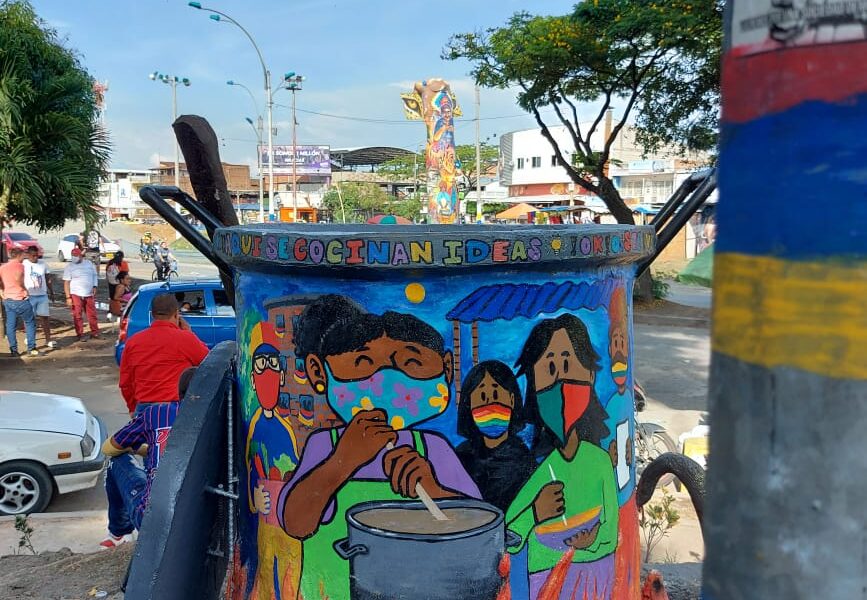
One of these initiatives occurred in Cali, a city that became the heart of the nationwide protests. The community of the Puerto Resistencia neighborhood built the Monument to the Resistance with the support of the women of community pots. They became involved in the organizational process of resource management that this activity demanded and fed the people involved in the construction of the monument. For this reason, the neighborhood community decided to build a second monument dedicated to the community pots in recognition for providing food. to the protesters within the framework of the national strike and because in those spaces ideas and proposals for collective action converged.
Nonviolent resistance to the heat of community pots was decisive for the maintenance of social protest in Colombia. Around these, bonds of solidarity were woven among the protesters that made nonviolent civil resistance possible against the excessive use of force by the National Police. They stressed that care is also political, they managed to safeguard the life and integrity of the protesters by opposing their arbitrary arrests. They became safe and peaceful spaces where discussions and initiatives of cultural activities could take place, such as the one that occurred in Puerto Resistencia, which question the repression by the Police of social protest.
In Colombia, they are now a symbol of collectivity and solidarity, where cooking resisted and fought.
Text published on January 5, 2024
About the author
Master in International Relations with a mention in Security and Conflict from Flacso
Ecuador. Political scientist expert in alternative methods of conflict resolution, justice
transitional and peacebuilding. More Cali than the Lulada, go!
Translated by Damian Vasquez