
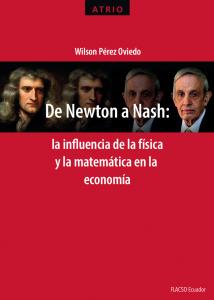
De Newton a Nash: la influencia de la física y la matemática en la economía
Sinopsis
Wilson Pérez Oviedo hace un examen crítico de la evolución y las limitaciones de la corriente principal de la disciplina económica. Destaca como ésta se ha inspirado en la física y ha adoptado las matemáticas como su lenguaje, hasta el punto de tratar de cimentarse en la axiomatización y la formalización. Debido al rigor de lo formal, este proceso ha develado los límites de la misma teoría, que pueden resumirse en la multiplicidad e indeterminación de los equilibrios en sus modelos. El análisis tiene como eje la interacción entre las acciones y decisiones individuales frente a los procesos de decisión y agregación colectiva. El autor analiza el papel fundamental que juegan las expectativas de las personas en definir la dinámica social y en el fracaso de las expectativas racionales como propuesta teórica para entenderlas. Su planteamiento consiste en retomar la concepción del individuo como ser social, cuyas preferencias y expectativas determinan y son determinadas por su entorno social. Así se lograría tender un puente hacia las otras ciencias sociales. Plantea también entender el papel de la multiplicidad de los equilibrios y resolver la indeterminación. Argumenta que, dentro de los límites que impone la consistencia macroeconómica y la compatibilidad de los incentivos, y ante la multiplicidad de senderos que se bifurcan en el futuro, lo que los humanos creen se hace realidad.
Premio Municipal Pedro Vicente Maldonado 2024
Wilson Pérez Oviedo. Ph.D. en Economía por la Universidad de Cornell. Profesor investigador de FLACSO Ecuador. Ha sido profesor visitante en la Universidad Carolina, en República Checa, y en la Universidad Sorbonne Nouvelle-París 3, en Francia. Sus intereses académicos son la economía política del subdesarrollo, la teoría económica y la teoría de la evolución. Sus publicaciones recientes incluyen “Decomposing the temporal variation in the business-sector private R&D intensity” (junto a Juan Fernández y John Cajas) que apareció en 2023 en la revista International Journal of Foresight and Innovation Policy; y en 2015, el artículo “Citizens, dictators and networks: A game theory approach”, aparecido en la revista Rationality and Society.
Forma de citar: Pérez Oviedo, Wilson. 2023. De Newton a Nash: la influencia de la física y la matemática en la economía. Quito: FLACSO Ecuador. https://doi.org/10.46546/2023-49atrio
Referencias
Acemoglu, Daron. 2009. Introduction to Modern Economic Growth. Princeton, NJ: Princeton University Press.
Akerlof, George A., y Rachel E. Kranton. 2000. “Economics and Identity”. Quarterly Journal of Economics CXV (3): 715-753.
Akerlof, George A., y Rachel E. Kranton. 2016. Identity Economics: How Our Identities Shape Oue Work, Wages, and Well-Being. Princeton, NJ: Princeton University Press. https://doi.org/10.1515/9781400834181
Albert Reka, y Albert Barabási. 2002. “Statistical mechanics of complex networks”. Reviews of Modern Physics 74 (1): 47-97. https://doi.org/10.48550/arXiv.cond-mat/0106096
Alesina, Alberto, y Eliana La Ferrara. 2005. “Ethnic Diversity and Economic Performance”. Journal of Economic Literature 43 (3): 762-800. https://www.aeaweb.org/articles?id=10.1257/002205105774431243
Amman, Hans M., David. A. Kendrik y John Rust. 2006. Handbook of Computational Economics. Vol. 1 y 2. https://www.sciencedirect.com/handbook/handbook-of-computational-economics
Anderson, Philip W. 1972. “More Is Different: Broken Symmetry and the Nature of the Hierarchical Structure of Science”. Science 177 (4047): 393-396. https://doi.org/10.1126/science.177.4047.393
Anderson, Philip, Kenneth J. Arrow y David Pines. 1988. The Economy as an Evolving Complex System. Boca Ratón: CRC Press.
Ariely, Dan, George Loewenstein y Drazen Prelec. 2005. “Tom Sawyer and the Construction of Value”. Working papers, Federal Reserve of Boston n.0 5-10. https://papers.ssrn.com/sol3/papers.cfm?abstract_id=774970
Arrow, Kenneth J. 1950. “A Difficulty in the Concept of Social Welfare”. Journal of Political Economy 58 (4): 328-346. https://doi.org/10.1086/256963
Arrow, Kenneth J., y Gérard Debreu. 1954. “Existence of an Equilibrium for Competitive Economy”. Econometrica 22 (3): 265-290. https://doi.org/10.2307/1907353
Aumann, Robert J. 1973. “Subjetivity and Correlation in Randomized Strategies”. Journal of Mathematical Economics 1 (1): 67-96. https://doi.org/10.1016/0304-4068(74)90037-8
Aumann, Robert J. 1995. “Backward induction and common knowledge of rationality”. Games and Economic Behavior 8 (1): 6-19. https://doi.org/10.1016/S0899-8256(05)80015-6
Azariadis, Costas. 1981. “Self-Fulfilling Prophecies”. Journal of Economic Theory 396: 380-396. https://doi.org/10.1016/0022-0531(81)90038-7
Baker, Keith. 1975. Condorcet: From Natural Philosophy to Social Mathematics. Chicago, IL: University of Chicago Press.
Baqaee, David Rezza, y Emmanuel Farhi. 2019a. “Macroeconomics with Heterogeneous Agents and Input-Output Networks”. NBER Working paper 24684. https://scholar.harvard.edu/files/farhi/files/ha-io-main.pdf
Baqaee, David Rezza, y Emmanuel Farhi. 2019b. “The Macroeconomic Impact of Microeconomic Shocks: Beyond Hulten’s Theorem”. Econometrica 87 (4): 1155-1203. https://doi.org/10.3982/ecta15202
Baqaee, David Rezza, y Emmanuel Farhi. 2019c. “The Microeconomic Foundations of Aggregate Production Functions”. NBER Working Paper 25293. https://www.nber.org/system/files/working_papers/w25293/w25293.pdf
Baqaee, David Rezza, y Emmanuel Farhi. 2021. “Networks, Barriers, and Trade”. NBER Working paper 26108 https://www.nber.org/system/files/working_papers/w26108/w26108.pdf
Basu, Kaushik. 2003. Prelude to Political Economy. Oxford: Oxford University Press.
Basu, Kaushik. 2014. “Randomisation, Causality and the Role of Reasoned Intuition”. Oxford Development Studies 42 (4): 455-472. https://doi.org/10.1080/13600818.2014.961414
Basu, Kaushik. 2018. The Republic of Beliefs: A New Approach to Law and Economics. Princeton, NJ: Princeton University Press.
Battigalli, Pierpaolo, y Martin Dufwenberg. 2022. “Belief-Dependent Motivations and Psychological Game Theory”. Journal Economic Literature 60 (3): 833-882. https://doi.org/10.2139/ssrn.3598771
Becker, Gary S. 1968. “Crime and Punishment: An Economic Approach”. Journal of Political Economy 76 (2): 169-217. https://doi.org/10.1002/9780470752135.ch25
Becker, Gary S., y Kevin M. Murphy. 2000. “Social Economics: Market Behavior in a Social Environment”. Journal of Institutional and Theoretical Economics 159 (2): 436-439. https://doi.org/10.1628/0932456032974899
Bentham, Jeremy. (1789) 2017. An Introduction to the Principles of Morals and Legislation. https://www.earlymoderntexts.com/assets/pdfs/bentham1780.pdf
Billingsley, Patrick, y John Wiley. 1995. Probability and Measure. 3.ª ed. Chicago: The University of Chicago Press.
Bissell, Chris. (2007). “Historical perspectives - The Moniac A Hydromechanical Analog Computer of the 1950s”. IEEE Control Systems Magazine 27 (1): 69-74. 10.1109/MCS.2007.284511
Blanchard, Oliver Jean, y Stanley Fischer. 1989. Lectures on Macroeconomics. Cambridge, MA: MIT Press.
Blaug, Mark. 2007. “The Fundamental Theorems of Modern Welfare Economics, Historically Contemplated”. History of Political Economy 39 (2): 185-207. https://doi.org/10.1215/00182702-2007-001
Borel, Armand. 1998. “Twenty-Five Years with Nicolas Bourbaki, (1949-1973)”. Notices of the American Mathematical Society 45 (3): 373-380.
Borges, Jorge Luis, y Octavio Paz. (1982) 2017. “La poesía en nuestro tiempo”. Video de Youtube a partir de una grabación en la Capilla Guadalupana del Palacio de Minería, México, D.F. https://www.youtube.com/watch?v=rPz2cZNDNe0&ab_channel=ahervert
Borovkov, Aleksandr. 1994. Ergodicity and Stability of Stochastic Processes. Chichester: Wiley.
Boylan, Thomas A., y Paschal F. O’Gorman. 2007. “Axiomatization and Formalism in Economics”. Journal of Economic Surveys 21 (3): 426-446. https://onlinelibrary.wiley.com/doi/10.1111/j.1467-6419.2007.00509.x
Brainard, William C., y Herbert E. Scarf. 2005. “How to Compute Equilibrium Prices in 1891”. American Journal of Economics and Sociology 64 (1): 57-83. https://doi.org/10.1111/j.1536-7150.2005.00349.x
Branch, William A., y Bruce McGough. 2018. “Heterogeneous Expectations and Micro-Foundations in Macroeconomics”. En Handbook of Computational Economics, editado por Cars Hommes y Blake LeBaron, 4: 3-62. https://doi.org/10.1016/bs.hescom.2018.03.001
Burton, David M. 2007. The History of Mathematics: An Introduction. 7.a ed. Nueva York: McGraw-Hill.
Camerer, Colin. 1998. “Bounded Rationality in Individual Decision Making”. Experimental Economics 1: 163-183. https://link.springer.com/article/10.1023/A:1009944326196
Canard, Nicolas-François. 1801. Principes d’économie politique. París: Slatkine Reprints. https://gallica.bnf.fr/ark:/12148/bpt6k5442p/f3.item
Carrión Álvarez, Miguel, y Dirk Ehnts. 2016. “Samuelson and Davidson on Ergodicity: A Reformulation”. Journal of Post Keynesian Economics 39 (1): 1-16. https://doi.org/10.1080/01603477.2016.1145062
Cass, David, y Karl Shell. 1983. “Do Sunspots Matter?” Journal of Political Economy 91 (2): 193-227. https://doi.org/10.1086/261139
Castells, Manuel. 2009. Communication Power. Oxford: Oxford University Press.
Cherrier, Beatrice, y Aurélien Saïdi. 2018. “The Indeterminate Fate of Sunspots in Economics”. History of Political Economy 50 (3): 425-481. https://doi.org/10.1215/00182702-7023434
Chick, Victoria. 1995. “Is There a Case for Post Keynesian Economics?”. Scottish Journal of Political Economy 42 (1): 20-36. https://doi.org/10.1111/j.1467-9485.1995.tb01143.x
Cho, Adrian. 2017. “Pioneer of ‘nudge’ science and explorer of irrational decisions earns economics Nobel”. Science, 9 de octubre. https://www.science.org/content/article/pioneer-nudge-science-and-explorer-irrational-decisions-earns-economics-nobel
Christiano, Lawrence J., Martin S. Eichenbaum y Mathias Trabandt. 2018. “On DSGE Models”. Journal of Economic Perspectives 32 (3): 113-140. https://doi.org/10.1257/jep.32.3.113
Coase, Ronald. 1960. “The Problem of Social Cost”. Journal of Law and Economics 3 (1): 1-44. https://doi.org/10.1086/466560
Cohen, Avi J., y G. C. Harcourt. 2003. “Retrospectives: Whatever Happened to the Cambridge Capital Theory Controversies?” Journal of Economic Perspectives 17 (1): 199-214. https://doi.org/10.1257/089533003321165010
Coibion, Olivier, Yuriy Gorodnichenko y Rupal Kamdar. 2018. “The Formation of Expectations, Inflation, and the Phillips Curve”. Journal of Economic Literature 56 (4): 1447-1491. https://doi.org/10.1257/jel.20171300
Colomer, Josep M. 2013. “Ramon Llull: From ‘Ars Electionis’ to Social Choice Theory”. Social Choice and Welfare 40: 317-328. https://doi.org/10.1007/s00355-011-0598-2
Cubitt, Toby S., David Pérez-García y Michael Wolf. 2018. “The Un(Solv)Able Problem”. Scientific American, 1 de octubre. https://www.scientificamerican.com/article/the-unsolvable-problem
Davidson, Paul. 2009. “Can Future Systemic Financial Risks Be Quantified? Ergodic vs Nonergodic Stochastic Processes”. Revista de Economía Política 29 (4): 324-340. https://doi.org/10.1590/S0101-31572009000400001
Davidson, Paul. 2015. “Keynes’s Concept of Uncertainty”. Journal of Post Keynesian Economics 38 (1): 1-18.
Da-Quan, Jian, Min Qian y Min-Ping Qian. 2004. Mathematical Theory of Nonequilibrium Steady States. Serie Lecture Notes in Mathematics. Berlin: Springer.
Dasgupta, Partha, y Eric Maskin. 1998. “On the Robustness of Majority Rule”. Working paper, University of Cambridge and Harvard University. https://www.wallis.rochester.edu/assets/pdf/miniconf03/maskin.pdf
Debreu, Gerard. 1970. “Continuous Economies with a Finite Set of Equilibria”. Econometrica 38 (3): 387-392. https://doi.org/10.2307/1909545
Debreu, Gerard. 1991. “The Mathematization of Economic Theory”. American Economic Association 81 (1): 1-7. https://www.jstor.org/stable/2006785
DeMiguel, Víctor, Lorenzo Garlappi y Raman Uppal. 2009. “Optimal Versus Naïve Diversification: How Inefficient Is the 1/N Portfolio Strategy?”. Review of Financial Studies 22 (5): 1915-1953. https://doi.org/10.1093/rfs/hhm075
Diamond, Peter. 1965. “National debt in a neoclassical growth model”. American Economic Review 55 (5): 1126-1150. http://piketty.pse.ens.fr/files/Diamond1965.pdf
Diamond, Douglas, y Philip Dybvig. 1983. “Bank Runs, Deposit Insurance, and Liquidity”. Journal of Political Economy 91 (3): 401-419. https://www.jstor.org/stable/1837095
Doctor, Jason N., Peter P. Wakker y Tong V. Wang. 2020. “Economists’ Views on the Ergodicity Problem”. Nature Physics 16 (12): 1168. https://doi.org/10.1038/s41567-020-01106-x
Doria, Francisco. 2017. The Limits of Mathematical Modeling in the Social Sciences. Londres: World Scientific.
Dow, Sheila C. 2005. “Axioms and Babylonian Thought: A Reply”. Journal of Post Keynesian Economics 27 (3): 385-391. https://doi.org/10.1080/01603477.2005.11051453
Drakopoulos, Stavros A. 2022. “The Conceptual Resilience of the Atomistic Individual in Mainstream Economic Rationality”. Review of Political Economy 84 (1): 1-20. https://doi.org/10.1080/09538259.2022.2144721
Duarte, Pedro Garcia. 2009. “The Growing of Ramsey’s Growth Model”. History of Political Economy 41 (SUPPL.1): 161-181. https://doi.org/10.1215/00182702-2009-022
Durlauf, Steven N. 2007. “An Interview with Costas Azariadis”. Macroeconomic Dynamics 11: 249-271. DOI: https://doi.org/10.1017/S1365100507050390
Düppe, Till, y Roy Weintraub. 2014. Finding Equilibrium: Arrow, Debreu, McKenzie and the Problem of Scientific Credit. Princeton, NJ: Princeton University Press.
Easley, David, y Jon Kleinberg. 2010. Networks, Crowds and Markets. Cambridge: Cambridge University Press.
Edgeworth, Ysidro. 1893. “Mathematical Investigations in the Theory of Value and Prices, by Dr. Irving Fisher” (reseña). The Economic Journal 3 (9): 108-112. https://www.jstor.org/stable/2956053
Evans, George W., y Seppo Honkapohja. 2001. Learning and Expectations in Macroeconomics. Princeton, NJ: Princeton University Press.
Farmer, J. Doyne. 2013. “Hypotheses Non Fingo: Problems with the Scientific Method in Economics”. Journal of Economic Methodology 20 (4): 377-385. https://doi.org/10.1080/1350178X.2013.859408
Farmer, Roger. 2020. “The Importance of Beliefs in Shaping Macroeconomic Outcomes”. Oxford Review of Economic Policy 36 (3): 675-711. https://doi.org/10.1093/oxrep/graa041
Ferguson, Charles. 2010. “The director of ‘Inside Job’ replies”. Financial Times, 14 de octubre. https://web.archive.org/web/20120117210534/http://blogs.ft.com/economistsforum/2010/10/the-director-of-inside-job-replies
Fiore, Annamaria. 2009. “Experimental Economics: Some Methodological Notes”. https://www.researchgate.net/publication/23779663_Experimental_Economics_Some_Methodological_Notes
Fisher, Irving. (1892) 1926. Mathematical Investigation in the Theory of Value and Prices. New Heaven, CT: Yale University Press.
Fisher, Irving. 1907. “Why Has the Doctrine of Laissez Faire Been Abandoned?” Science 25 (627): 18-27. https://pubmed.ncbi.nlm.nih.gov/17739703
Fontana, Giuseppe, y Bill Gerrard. 2004. “A Post Keynesian theory of decision making under uncertainty”. Journal of Economic Psychology 25 (5): 619-637. https://doi.org/10.1016/j.joep.2003.11.001
Forbes, George. (1909) 2010. History of Astronomy. París: Nabu Press.
Foucault, Michel. 1972. Power and Knowledge: Selected Interviews and Other Writings, 1972-1977. Edición de Colin Gordon. Nueva York: Pantheon Books.
Friedman, Milton. 1966. “The Methodology of Positive Economics”. En The Philosophy of Economics: An Anthology, editado por Daniel Hausman: 145-178. Cambridge: Cambridge University Press. https://doi.org/10.1017/CBO9780511819025.010
Galbraith, John Kenneth. 1983. The Anatomy of Power. Londres: Hamish Hamilton.
Galesic, Mirta, Henrik Olsson, Jonas Dalege, Tamara Van Der Does y Daniel L. Stein. 2021. “Integrating Social and Cognitive Aspects of Belief Dynamics: Towards a Unifying Framework”. Journal of the Royal Society Interface 18 (176). https://doi.org/10.1098/rsif.2020.0857
Galor, Oded. 2022. The Journey of Humanity. Hialeah, FL: Dutton.
Gehrlein, W. V. 2002. “Condorcet’s Paradox and the Likelihood of Its Occurrence: Different Perspectives on Balanced Preferences”. Theory and Decision 52 (2): 171-199. https://doi.org/10.1023/A:1015551010381
Giles, Jim. 2012. “Computational social science: Making the Links”. Nature 488: 448-450. https://www.nature.com/articles/488448a
Girard, René. 1978. “Interview: René Girard”. Diacritics 8 (1): 31-54. https://doi.org/10.2307/464818
Grandmont, Jean Michel. 1998. “Expectations Formation and Stability of Large Socioeconomic Systems”. Econometrica 66 (4): 741-781. https://doi.org/10.2307/2999573
Grandmont, Jean Michel, y, Alan Kirman. 1996. “Aggregation, Learning and Rationality”. En Economics in a Changing World, Serie International Economic Association Series, editado por Beth Allen, 63-89. Londres: Palgrave Macmillan. https://doi.org/10.1007/978-1-349-25168-1_3
Grofman, Bernard, Guillermo Owen y Scott L. Feld. 1983. “Thirteen Theorems in Search of the Truth”. Theory and Decision 15 (1): 261-278. https://doi.org/10.1007/BF00125672
Haavelmo, Trygve. 1944. “The Probability Approach in Econometrics”. Econometrica 12 (suplemento): iii-vi; 1-115. https://doi.org/10.2307/1906935
Hamilton, James. 1994. Time Series Analysis. Princeton, NJ: Princeton University Press.
Harari, Yuval Noah. 2011. Sapiens: A Brief History of Humanity. Nueva York: Harper.
Hart, Sergiu, y Andreu Mas-Colell. 2000. “A Simple Adaptive Procedure Leading to Correlated Equilibrium”. Econometrica 68 (5): 1127-1150.
Hassler, Uwe. 2017. “Ergodic for the Mean”. Economics Letters 151: 75-78. https://doi.org/10.1016/j.econlet.2016.12.013.
Heifetz, Aviad. 2004. “Rational Ritual: Culture, Coordination, and Common Knowledge: A Review”. The Economic Journal 114 (493): 146-147. https://doi.org/10.1111/j.0013-0133.2004.191_4.x
Hendtlass, Mathew, y Nazar Miheisi. 2016. “On the Construction of General Equilibria in a Competitive Economy”. Arvix. https://doi.org/10.48550/arXiv.1611.02534
Herman, Edward S., y Noam Chomsky. 2008. Manufacturing Consent: The Political Economy of the Mass Media [Los guardianes de la libertad]. Londres: The Bodley Head.
Hicks, John. 1939. Value and Capital. Oxford: Clarendon Press.
Hobbes, Thomas. (1651) 2008. Leviathan. Oxford: Oxford University. Press.
Hommes, Cars. 2021. “Behavioral and Experimental Macroeconomics and Policy Analysis: A Complex Systems Approach”. Journal of Economic Literature 59 (1): 149-219. https://doi.org/10.1257/jel.20191434
Hong, Chew Soo, Mark Ratchfor y Jacob S. Sagi. 2018. “You Need to Recognize Ambiguity to Avoid It”. The Economic Journal 128 (614): 2480-2506. https://onlinelibrary.wiley.com/doi/abs/10.1111/ecoj.12541
Hotelling, Harold. 1931. “The Economics of Exhaustible Resources”. Journal of Political Economy 39 (2): 137-175. https://doi.org/10.1086/254195
Hosoya, Yuhki. 2016. “On First-Order Partial Differential Equations: An Existence Theorem and Its Applications.” Advances in Mathematical Economics 20: 77-87. https://doi.org/10.1007/978-981-10-0476-6_3
Jevons, William Stanley. (1871) 1965. The Theory of Political Economy. Nueva York: Reprints of Economical Classics. https://cdn.mises.org/The%20Theory%20of%20Political%20Economy_2.pdf
Johnston, Christopher D., y Andrew O. Ballard. 2016. “Economists and Public Opinion: Expert Consensus and Economic Policy Judgments”. The Journal of Politics 78 (2): 443-456. https://doi.org/10.1086/684629
Kaplan, Greg, y Giovanni L. Violante. 2018. “Microeconomic Heterogeneity and Macroeconomic Shocks”. Journal of Economic Perspectives 32 (3): 167-194. https://doi.org/10.1257/jep.32.3.167
Kay, John, y Merving King. 2020. Radical Uncertainty. Wicklow: The Bridge Street Press.
Keynes, John Maynard (1936) 2012. The General Theory of Employment, Interest and Money. Nueva York: Cambridge University Press.
Kirman, Alan P. 1992. “Whom or What Does the Representative Individual Represent?” Journal of Economic Perspectives 6 (2): 117-136. https://doi.org/10.1257/jep.6.2.117
Kirman, Alan P. 2010. “Walras’ Unfortunate Legacy”. Documento de trabajo n.o 2010-58, HAL Id: halshs-00545181, GREQAM, Université Paul Cézanne, EHESS, IUF. https://shs.hal.science/halshs-00545181/document
Klebaner, Fima C. 2005. Introduction to Stochastic Calculus with Applications. 2.ª ed. Londres: World Scientific. https://doi.org/10.1142/P386
Kydland, Finn, y Edward Prescott. 1982. “Time to Build and Aggregate Fluctuations”. Econometrica 50 (6): 1345-1370. https://doi.org/10.2307/1913386
Lamb, Jeroen S. W., y John A. G. Roberts. 1998. “Time-Reversal Symmetry in Dynamical Systems: A Survey.” Physica D: Nonlinear Phenomena 112 (1-2): 1-39. https://doi.org/10.1016/S0167-2789(97)00199-1.
Landini, Simone, Mauro Gallegati y J. Barkley Rosser. 2018. “Consistency and Incompleteness in General Equilibrium Theory”. Journal of Evolutionary Economics 30: 205-230. https://doi.org/10.1007/s00191-018-0580-6
Laplace, Pierre Simon. 1951. A Philosophical Essay on Probabilities. Dover: Dover Publications.
Lavoie, Marc. 2014. Post-Keynesian Economics. New Foundations. Cheltenham: Edward Elgar.
Levin, Jonathan. 2006. “General Equilibrium”. Documento de trabajo, Universidad de Stanford. https://web.stanford.edu/~jdlevin/Econ%20202/General%20Equilibrium.pdf
Livingston, Paisley. 1994. “What Is Mimetic Desire?”. Philosophical Psychology 7 (3): 291-305. https://doi.org/10.1080/09515089408573125.
Lucas, Robert E. 1986. “Adaptive Behavior and Economic Theory”. The Journal of Business 59 (4): 401-426. https://www.jstor.org/stable/pdf/2352771.pdf
Lucas, Robert E. 1990. “Why Doesn’t Capital Flow from Rich to Poor Countries?” American Economic Review 80 (2): 92-96. https://www.jstor.org/stable/2006549
Llull, Ramón. c. 1274-1283. “Artifitium electionis personarum” [El método de elección de personas]. https://www.math.uni-augsburg.de/htdocs/emeriti/pukelsheim/llull/CodCus83/index-en.html
Llull, Ramón. c. 1283. “En qual manera Natana fo eleta a abadessa” [En qué forma Natana fue electa abadesa]. https://www.math.uni-augsburg.de/htdocs/emeriti/pukelsheim/llull/CodCus83/index-en.html
Llull, Ramón. 1299. “De arte electionis” [Sobre el método de las elecciones]. https://www.math.uni-augsburg.de/htdocs/emeriti/pukelsheim/llull/CodCus83/index-en.html
Majumdar, Mukul. 2009. Organizations with Incomplete Information. A Tribute to Roy Radner. Cambridge: Cambridge University Press.
Majumdar, Mukul, y Roy Radner. 2020. “Uncertainty and General Equilibrium”. En The New Palgrave Dictionary of Economics, editado por Matias Vernengo, Esteban Perez Caldentey, Barkley Rosser, 1-18. Londres: Plagrave Macmillan.
Mantel, Rolf. 1974. “On the characterization of aggregate excess demand”. Journal of Economic Theory 7 (3): 348-353. https://doi.org/10.1016/0022-0531(74)90100-8
Mas-Colell, Andreu, Michael Whinston y Jerry Green. 1995. Microeconomic Theory. Oxford: Oxford University Press.
Maskin, Eric, y Amartya Sen. 2014. The Arrow Impossibility Theorem. Nueva York: Columbia University Press.
Mckenzie, Lionel W. 1954. “On the Existence of General Equilibrium for a Competitive Market”. Econometrica 27 (1): 54-71. https://www.jstor.org/stable/1907777
Menger, Carl. (1871) 2007. Principles of Economics. Alabama: Ludwig von Mises Institute. https://cdn.mises.org/principles_of_economics.pdf
Merton, Robert K. 1948. “The Self-Fulfilling Prophecy”. The Antioch Review 8 (2): 193-210. https://doi.org/10.2307/4609267
Metaphysics Repository. 2020. “Feynman on the social sciences”. Video de YouTube. https://youtu.be/zkFPCTwPlkU
Mill, John Stuart. (1872). 2020. The Logic of the Moral Sciences. Nueva York: Dover Publications.
Mirowski, Philip. 1989. More Heat than Light. Cambridge: Cambridge University Press.
Mitchell, Melanie. 2009. Complexity: A Guided Tour. Oxford: Oxford University Press.
Mookherjee, Dilip, y Debraj Ray. 2003. “Persistent Inequality”. The Review of Economic Studies 70 (2): 369-393. https://doi.org/10.1111/1467-937X.00248
Morishima, Michio. 1984. “The Good and Bad Uses of Mathematics”. En Economics in Disarray, editado por Peter John de la Fosse Wiles y Guy Routh, 51-73. Oxford: Basil Blackwell.
Murphy, Kevin M., Andrei Shleifer y Robert W. Vishny. 1989. “Industrialization and the Big Push”. Journal of Political Economy 97 (5): 1003-1026. https://doi.org/10.1086/261641
Muth, John F. 1961. “Rational Expectations and the Theory of Price Movements”. Econometrica 29 (3): 315-335. https://doi.org/10.2307/1909635
Nakagawa, Ryuichi. 2015. “Learnability of an Equilibrium with Private Information”. Journal of Economic Dynamics and Control 59: 58-74. https://doi.org/10.1016/j.jedc.2015.06.010.
Nasar, Sylvia. 2011. Grand Pursuit. Nueva York: Simon & Schuster.
Nash, John F. Jr. 1950. “Equilibrium points in n-person games”. Proceedings of the National Academy of Sciences of the United States of America 36 (1): 48-49. https://doi.org/10.1073/pnas.36.1.48
Newton, Roger G. 2007. From Clockwork to Crapshoot: A History of Physics. Cambridge, MA: Harvard University Press.
Nozick, Robert. 1974. Anarchy, State and Utopia. Oxford: Blackwell Publishing Limited.
Orléan, André. 2013. “Individual Judgments, Social Values, and Mimetic Interactions”. Working paper. Institute for New Economic Thinking. https://www.ineteconomics.org/research/research-papers/individual-judgments-social-values-and-mimetic-interactions
Osborne, Martin J., y Ariel Rubinstein. 1994. A Course in Game Theory. Cambridge, MA: MIT Press.
Pérez-Oviedo, Wilson. 2015. “Externalidades de la mano de obra calificada y estados estacionarios múltiples en una economía abierta pequeña”. Trimestre Económico 82 (4): 787-806. https://www.scielo.org.mx/scielo.php?script=sci_arttext&pid=S2448-718X2015000400787
Perlick , Volker. 2000. Ray Optics, Fermat’s Principle, and Applications to General Relativity. Berlin: Springer.
Peters, Ole. 2019. “The Ergodicity Problem in Economics”. Nature Physics 15 (12): 1216-1221. https://doi.org/10.1038/s41567-019-0732-0
Peters, Ole, y Alexander Adamou. 2021. “The Time Interpretation of Expected Utility Theory”, 1-8. http://arxiv.org/abs/1801.03680
Peters, Ole, y Murray Gell-Mann. 2016. “Evaluating Gambles Using Dynamics”. Chaos 26 (2). https://doi.org/10.1063/1.4940236
Piketty, Thomas. 2020. Capital and Ideology. Cambridge: Harvard University Press.
Qi, Jinshan, Xun Liang, Yi Wang y Hengchao Cheng. 2018. “Discrete Time Information Diffusion in Online Social Networks: Micro and Macro Perspectives”. Scientific Reports 8 (1): 1-15. https://doi.org/10.1038/s41598-018-29733-8
Quine, Willard Van Orman. 1953. From a Logical Point of View. Nine Logico Philosophical Essays. Harvard: Harvard University Press.
Radner, Roy. 1968. “Competitive Equilibrium under Uncertainty”. Econometrica 36 (1): 31-58.
Ramsey, Frank. 1928. “A Mathematicas Theory of Saving” [Una teoría matemática del ahorro]. The Economic Journal 38 (152): 543-559. https://doi.org/10.2307/2224098
Rizvi, S. Abu Turab. 2006. “The Sonnenschein-Mantel-Debreu Results after Thirty Years”. History of Political Economy 38 (Suppl 1): 228-245. https://doi.org/10.1215/00182702-2005-024
Robbins, Lionel. 1932. An Essay on the Nature and Significance of Economic Science. Londres: MacMillan
Rojo, Alberto, y Anthony Bloch. 2018. The Principle of Least Action. Cambridge: Cambridge University Press.
Romer, David. 2003. “Misconceptions and Political Outcomes”. Economic Journal 113 (484): 1-20. https://doi.org/10.1111/1468-0297.00092
Romer, David. 2019. Advanced Macronomics. 5.ª ed. Nueva York: McGraw Hill.
Romer, Paul M. 2015. “Mathiness in the Theory of Economic Growth”. American Economic Review 105 (5): 89-93. https://doi.org/10.1257/aer.p20151066
Roncaglia, Alessandro. 2006. La riqueza de las ideas. Una historia del pensamiento económico. Zaragoza: Prensas Universitarias de Zaragoza.
Rorty, Richard. 1979. Philosophy and the Mirror of Nature. Princeton, NJ: Princeton University Press.
Rosenstein-Rodan, Paul. 1943. “Problems of Industrialisation of Eastern and South-Eastern Europe”. The Economic Journal 53 (210/211): 202-211. https://doi.org/10.2307/2226317
Ross, Sheldon, y Erol Pekoz. 2007. A Second Course in Probability. Boston: Probability Book Store.
Rousseau, Jean-Jacques. (1762) 2004. El contrato social. Madrid: Biblioteca Edaf.
Russell, Bertrand. 1938. Power. A New Social Analysis. Crows Nest, Australia: George Allen & Unwin.
Samoylenko, I. D. Aleja, E. Primo, K. Alfaro-Bittner, E. Vasilyeva, K. Kovalenko, D. Musatov, A. M. Raigorodskii, R. Criado, M. Romance, D. Papo, M. Perc B. Barzel y and S. Boccaletti. 2023. “Why Are There Six Degrees of Separation in a Social Network?”. Physical Review X 13 (2), 021032.
Samuelson, Paul A. 1958. “An exact consumption-loan model of interest with or without the social contrivance of money”. Journal of Political Economy 66 (6): 467-482. https://doi.org/10.1086/258100
Samuelson, Paul A. 1966. “A Summing Up”. Quarterly Journal of Economics 80 (4): 568-583. https://doi.org/10.2307/1882916
Samuelson, Paul A. 1989. “Gibbs and Economics”. In Proceedings of the Gibbs Symposium, editado por Daniel G. Caldi y George Mostow, 255-267. Rhode Island: American Mathematical Society.
Sapolsky, Robert. 2017. Compórtate. Zaragoza: Titivillus.
Sargent, Thomas J. 2015. “Robert E. Lucas Jr.’s Collected Papers on Monetary Theory”. Journal of Economic Literature 53 (1): 43-64. https://doi.org/10.1257/jel.53.1.43
Sargent, Thomas J. 2020. “Rational Expectations”. En The New Palgrave Dictionary of Economics, 1-7. https://doi.org/10.1057/978-1-349-95121-5
Sargent, Thomas J., y Neil Wallace. 1975. “‘Rational’ Expectations, the Optimal Monetary Instrument, and the Optimal Money Supply Rule”. Journal of Political Economy 83 (2): 241-254.
Schelling, Tomas C. 1960. The Strategy of Conflict. Harvard: Harvard University Press.
Schofield, Philip. 2006. Utility and Democracy: The Political Thought of Jeremy Bentham. Oxford: Oxford University Press.
Schumpeter, Joseph. 1954. History of Economic Analysis. Routledge: Taylor & Francis.
Selten, Reinhard, Ariel Rubinstein y Eric Van Damme. 1999. “Nash Equilibrium and the History of Economic Theory”. Journal of Economic Literature XXXVII (septiembre): 1067-1082. https://home.uchicago.edu/rmyerson/research/jelnash.pdf
Sen, Amartya. 2017. Collective Choice and Social Welfare: An Expanded Edition. Harvard: Harvard University Press.
Shell, Karl. 1971. “Notes on the Economics of Infinity”. Journal of Political Economy 79: 1002-1011. https://www.journals.uchicago.edu/doi/abs/10.1086/259811
Shiller, Robert J. 2020. “Expectations”. En The New Palgrave Dictionary of Economics, 1-11. https://doi.org/10.1057/978-1-349-95121-5
Slovic, Paul. 1995. “The Construction of Preference”. American Psychologist 50 (5): 364-371.
Solow, Robert M. 1970. Growth Theory: An Exposition. Oxford: Oxford University Press.
Smith, Adam. (1776) 1976. An Inquiry into the Nature and Causes of the Wealth of Nations. Oxford: Oxford University Press.
Sondermann, Dieter. 2006. Introduction to Stochastic Calculus for Finance a New Didactic Approach. Berlin: Springer.
Sonnenschein, Hugo F. 1973. “Do Walras’ identity and continuity characterize the class of community excess demand functions?”. Journal of Economic Theory 6 (4): 345-354. https://doi.org/10.1016/0022-0531(73)90066-5
Spiegel, Murray, Seymour Lipschutz y Dennis Spellman. 2009. Vector Analysis. 2.a ed. Nueva York: McGraw Hill.
Staloff, Darren. 2000. “Rorty’s Neo-Pragmatism”. In Great Minds of the Western Intelectual Tradition, editado por Darren Stallof, 7:144-156.Chantilly (VA): Teaching Company.
Stark, Werner, ed. 1952. Jeremy Bentham’s Economic Writings. Vol. 1. Londres: Routledge.
Stearns, Stephen C. 2000. “Daniel Bernoulli (1738): Evolution and Economics under Risk”. Journal of Biosciences 25 (3): 221-228. https://doi.org/10.1007/BF02703928
Stigler, George J., y Claire Friedland. 1962. “What Can Regulators Regulate? The Case of Electricity”. The Journal of Law & Economics 5: 1-16. https://www.jstor.org/stable/725003
Stiglitz, Joseph E. 1974. “The Cambridge-Cambridge Controversy in the Theory of Capital; A View from New Haven”. Journal of Political Economy 82 (4): 893-903. https://www.jstor.org/stable/1837157
Stiglitz, Joseph E. 2015. “The Media and Crisis: An Information Theoretic Approach”. En The Media and Financial Crisis, editado por Steve Schifferes y Richard Roberts, 140-152. Londres: Routledge.
Stiglitz, Joseph E. 2017. “Toward a Taxonomy of Media Capture”. En In the Service of Power: Media Capture and the Threat to Democracy, editado por Anya Schiffrin, 9-17. Washington: Center for International Media Assistance.
Stiglitz, Joseph E. 2018. “Where Modern Macroeconomics Went Wrong”. NBER Working paper 23795. National Bureau of Economic Research, Cambridge, MA. https://doi.org/10.3386/w23795
Stigum, Bernt P. 1990. Toward a Formal Science of Economics: The Axiomatic Method in Economics and Econometrics. Cambridge, MA: MIT Press.
Susskind, Leonard, y George Hrabovsy. 2013. The Theoretical Minimum: What You Need to Know to Start Doing Physics. Nueva York: Basic Books.
Swartz, David. 2013. Symbolic power, politics, and intellectuals: The political sociology of Pierre Bourdieu. Chicago: The University of Chicago Press.
Tangian, Andranik S. 2000. “Unlikelihood of Condorcet’s Paradox in a Large Society”. Social Choice and Welfare 17 (2): 337-365. https://doi.org/10.1007/s003550050024
Terren, Ludovic, y Rosa Borge. 2021. “Echo Chambers on Social Media: A Systematic Review of the Literature”. Review of Communication Research 9 (mayo): 1-39. https://doi.org/10.12840/ISSN.2255-4165.028
Torkel, Franzén. 2005. Gödel’s Theorem: An Incomplete Guide to its Use and Abuse. Wellesley: A K Peters.
Turchin, Valentin Fedorovich. 1977. The Phenomenon of Science. Nueva York: Columbia University Press.
Tversky, Amos. 1975. “A Critique of Expected Utility Theory: Descriptive and Normative Considerations”. Erkenntnis 9 (2): 163-173. https://doi.org/10.1007/BF00226380
Ulph, David. 2014. “Keeping up with the Joneses: Who Loses Out?” Economics Letters 125 (3): 400-403. https://doi.org/10.1016/j.econlet.2014.10.029
Van Damme, Erik. 1983. Refinements of the Nash Equilibrium Concept. Berlín: Springer-Verlag.
Van Deemen, Adrian. 2014. “On the Empirical Relevance of Condorcet’s Paradox”. Public Choice 158 (3-4): 311-330. https://doi.org/10.1007/s11127-013-0133-3
Velupillai, Kumaraswamy Vela. 2005. “The Unreasonable Ineffectiveness of Mathematics in Economics”. Cambridge Journal of Economics 29 (6): 849-872. https://doi.org/10.1093/cje/bei084
Velupillai, Kumaraswamy Vela. 2011. “Towards an Algorithmic Revolution in Economic Theory”. Journal of Economic Surveys 25 (3): 401-430. https://doi.org/10.1111/j.1467-6419.2011.00684.x
Velupillai, Kumaraswamy Vela. 2013. Computable Economics. Oxford: Oxford University Press.
Von Neumann, John, y Oskar Morgenstern. 1944. Theory of Games and Economic Behavior [Teoría de juegos y comportamiento económico]. Princeton, NJ: Princeton University Press.
Walras, Léon. 1874. Éléments d’économie politique pure. París: L. Corbaz & Cía. https://acortar.link/y1Ndwt
Weintraub, Roy. 2002. How Economics Became a Mathematical Science. Durham: Duke University Press Books.
Wigner, Eugene P. 1960. “The Unreasonable Effectiveness of Mathematics in the Natural Sciences. Richard Courant Lecture in Mathematical Sciences”. Communications on Pure and Applied Mathematics 13 (1): 1-14. https://doi.org/10.1002/cpa.3160130102
Woodford, Michael. 1990. “Learning to Believe in Sunspots”. Econometrica 58 (2): 277-307. https://doi.org/10.2307/2938205
Woodford, Michael. 2009. “Convergence in Macroeconomics: Elements of the New Synthesis”. American Economical Journal 1 (1): 267-279. https://doi.org/10.1257/mac.1.1.267
Zach, Richard. 2006. “Hilbert’s Program Then and Now”. En Handbook of the Philosophy of Science, editado por Dale Jacquette, 5: 411-447. Ámsterdam: Elsevier.
Zhou, Fan, Xovee Xu, Goce Trajcevski y Kunpeng Zhang. 2021. “A Survey of Information Cascade Analysis: Models, Predictions, and Recent Advances”. ACM Computing Surveys 54 (2). https://doi.org/10.1145/3433000
Descargas
Fecha de publicación
12-12-2023
Series
Categorías
Derechos de autor 2023 Editorial FLACSO Ecuador
Detalles sobre esta monografía
Dimensiones físicas
Cómo citar
De Newton a Nash: La Influencia De La física Y La matemática En La economía. 2023. Atrio. Editorial FLACSO Ecuador. https://doi.org/10.46546/2023-49atrio.