La corrupción judicial en el mundo: diagnóstico, evolución y salidas. Ecuador, Senegal y Madagascar en perspectiva comparada
Sinopsis
Luego de analizar la corrupción judicial en el mundo, Santiago Basabe-Serrano plantea un diagnóstico preocupante: durante los últimos veinte años, pocos países han mejorado la transparencia en el interior de sus tribunales mientras que en muchos casos hay un retroceso. En este grupo está Ecuador, país que el autor estudia en profundidad para identificar los actores que son parte del entramado de la corrupción judicial, las dinámicas que asumen las negociaciones ilícitas y los montos que se pagan para obtener una decisión judicial espuria.
El autor también compara Senegal y Madagascar, países que hace dos décadas tenían similares niveles de corrupción judicial pero que posteriormente tomaron trayectorias distintas. Senegal mejoró la transparencia del sistema judicial tras el surgimiento de una comisión de expertos locales con asistencia internacional, sentencias emblemáticas y acuerdos para alcanzar estabilidad democrática. En Madagascar se profundizó la corrupción judicial, precisamente por la ausencia de los factores anotados.
Por todos estos aportes, se trata de un libro imprescindible para las personas interesadas en conocer cómo se prende y opera la maquinaria de la corrupción judicial.
Santiago Basabe-Serrano. Doctor en Ciencia Política por la Universidad Nacional de San Martín (Buenos Aires, Argentina) y becario postdoctoral de la Fundación Alexander von Humboldt en el Instituto Alemán de Estudios Globales y Regionales, GIGA (Hamburgo, Alemania). Ha sido profesor invitado en la Université Sorbonne Nouvelle - Paris 3 y en otras instituciones de educación superior de Europa y América Latina. Sus temas de investigación se relacionan con la democracia, las instituciones políticas y la gobernanza. A sus actividades académicas, desarrolladas desde 2010 en FLACSO Ecuador, se vinculan otras relacionadas con la opinión pública en diversos medios de comunicación nacionales e internacionales. En 2021 fue electo presidente de la Asociación Ecuatoriana de Ciencia Política (AECIP) y es miembro del Comité Ejecutivo de la Asociación Internacional de Ciencia Política (IPSA). Director de Pescadito Editoriales y creador del programa de YouTube El chef de la política, un espacio cívico de difusión del conocimiento científico en ciencia política. ORCID: https://orcid.org/0000-0002-8615-6908
Forma de citar: Basabe-Serrano, Santiago. 2024. La corrupción judicial en el mundo: diagnóstico, evolución y salidas. Ecuador, Senegal y Madagascar en perspectiva comparada. Quito: FLACSO Ecuador. https://doi.org/10.46546/2024-60atrio
Referencias
Abdullah, Sarwar Mohammed. 2019. “Corruption protection: fractionalization and the corruption of anti-corruption efforts in Iraq after 2003”. British Journal of Middle Eastern Studies 46 (3): 358-374. https://doi.org/10.1080/13530194.2017.1403309
Abrams, Neil A. y Steven Fish. 2015. “Policies first, institutions second: lessons from Estonia’s economic reforms”. Post-Soviet Affairs 31 (6): 491-513. https://doi.org/10.1080/1060586X.2015.1061739
Adadevoh, Eyram A. 2014. “New wine in new wine skins: the anti-corruption framework of Ghana”. The Journal of World Energy Law & Business 7 (3): 202-219. https://doi.org/10.1093/jwelb/jwu011
Ahmad, Eatzaz, Muhammad Irfanullah Arfeen y Minhajul Arfeen. 2012. “Does corruption affect economic growth?”. Latin American Journal of Economics 49 (2): 277-305. https://doi.org/10.2307/41959246
Alarcón, Oscar. 2017. “Elecciones presidenciales en Malawi 2014: ¿un cambio en el poder o más de lo mismo?”. Estudios de Asia y África 52 (2): 435-457. https://doi.org/10.24201/eaa.v52i2.2273
Aldana, Susana. 1999. “Industrias coloniales en la economía virreinal”. En El Perú en el siglo XVIII. La Era Borbónica, editado por Scarlett O’Phelan, 69-96. Lima: Fondo Editorial de la Universidad Católica, Instituto Riva-Agüero.
Al Noor, Masud, Mahmud Rahman y Md. Ishtiak Uddin. 2011. “Corruption Impacts, Effects and Fluctuations in Ten Distinct Asian Countries”. European Journal of Business and Management 3 (4): 39-55. https://www.academia.edu/download/67833725/180.pdf
Amundsen, Inge, y Basem Ezbidi. 2002. Clientelist Politics. State formation and corruption in Palestine 1994-2000. Bergen: Chr. Michelsen Institute.
Anadolu Agency. 2021. “Política”. Acceso el 12 de enero. https://www.aa.com.tr
Andrade, Pablo. 2005. “Democracia liberal e inestabilidad política en Ecuador. Apuntes para una interpretación política”. Oasis 11: 167-189. https://revistas.uexternado.edu.co/index.php/oasis/article/view/2399
Arafat, Alaa Al-Din. 2017. Egypt in Crisis: The Fall of Islamism and Prospects of Democratization. Cham: Palgrave Macmillan.
Assegaf, Abdurachman. 2017. “Curbing corruption through tertiary education in Indonesia and Japan (analysis of legal system and islamic perspective)”. Analisa Journal of Social Science and Religion 2 (2): 254-273. https://journal.blasemarang.id/index.php/analisa/article/view/452/307
Astrada, Sebastian. 2010. “Exporting the Rule of Law to Mongolia: Post-Socialist Legal and Judicial Reforms”. Denver Journal of International Law and Policy 39 (3): 461-526. https://digitalcommons.du.edu/cgi/viewcontent.cgi?article=1206&context=djil
Auyero, Javier. 2019. “Los sinuosos caminos de la etnografía política”. Revista Colombiana de Antropología 55 (2): 169-190. https://doi.org/10.22380/2539472X.804
Awan, Rehmat Ullan, Tahseen Akhtar, Shazia Rahim, Falak Sher y Ahmed Raza Cheema. 2018. “Governance, Corruption and Economic Growth”. Pakistan Economic and Social Review 56 (1): 1-20. https://www.jstor.org/stable/26616730
Ayres, Ian. 1997. “The Twin Faces of Judicial Corruption: Extortion and Bribery”. Denver University Law Review 74 (4): 1233-1254. http://hdl.handle.net/20.500.13051/732
Babb, James. 2016. “‘Normal’ corruption in Japan”. En Routledge Handbook of Corruption in Asia, editado por Ting Gong e Ian Scott, 56-68. Londres: Routledge.
Badel, Martha. 2008. La corrupción judicial en Colombia. Una aproximación al mapa de riesgos. Bogotá: Auros.
Banjade, Mani Ram, Naya Paudel y Esther Mwangi. 2017. “Political economy of forest tenure reform implementation in Nepal: evolution, contestation, outcomes and challenges”. Journal of Forest and Livelihood 15 (1):1-14. https://doi.org/10.3126/jfl.v15i1.23081
Banuri, Sheheryar, y Catherine Eckel. 2012. “Chapter 3. Experiments in Culture and Corruption: A Review”. En New Advances in Experimental Research on Corruption. Volume 15, editado por Danila Serra y Leonard Wantchekon, 51-76. Leeds: Emerald Group Publishing Limited. https://doi.org/10.1108/S0193-2306(2012)0000015005
Barreneche, Osvaldo. 2009. “Por mano propia. La justicia policial de la provincia de Buenos Aires durante el primer peronismo”. Sociohistórica Cuadernos del CISH 25: 123-152. http://bit.ly/3SjQgC6
Barrett, Kathleen. 2005. “Corrupted Courts: A Cross-National Perceptual Analysis of Judicial Corruption”. Tesis de maestría, Georgia State University. https://doi.org/10.57709/1059839
Barreto, Raúl A. 1996. “Endogenous Corruption, Inequality and Growth”. European Economic Review 44 (1): 35-60. https://doi.org/10.1016/S0014-2921(98)00052-X
Basabe-Serrano, Santiago. 2003. “Responsabilidad penal de las personas jurídicas desde la teoría de sistemas”. Tesis de maestría, Universidad Andina Simón Bolívar.
Basabe-Serrano, Santiago. 2008. “Las preferencias ideológicas y políticas judiciales: un modelo actitudinal sobre el voto en el Tribunal Constitucional de Ecuador”. América Latina Hoy 49: 157-177. https://doi.org/10.14201/alh.1354
Basabe-Serrano, Santiago. 2013. “Explicando la corrupción judicial en las cortes intermedias e inferiores de Chile, Perú y Ecuador”. Perfiles Latinoamericanos 42: 79-108. https://bit.ly/48xyXDq
Basabe-Serrano, Santiago 2014a. “Some Determinants of Internal Judicial Independence: A Comparative Study of the Courts in Chile, Peru and Ecuador”. International Journal of Law, Crime and Justice 42 (2): 130-145. https://doi.org/10.1016/j.ijlcj.2014.01.010
Basabe-Serrano, Santiago. 2014b. “Determinants of Judicial Dissent in Context of Extreme Institutional Instability: The Case of Ecuador’s Constitutional Court”. Journal of Politics in Latin America 6 (1): 83-107. https://doi.org/10.1177/1866802X1400600103
Basabe-Serrano, Santiago. 2015a. “Informal Institutions and Judicial Independence in Paraguay, 1954-2011”. Law and Policy 37 (4): 350-378.https://doi.org/10.1111/lapo.12038
Basabe-Serrano, Santiago. 2015b. “La reforma judicial en América Latina: avances, retrocesos y agenda de investigación”. En Reforma judicial en América Latina y el desafío de la revolución de la justicia en Bolivia, editado por el Ministerio de la Presidencia de Bolivia y Fundación PIEB, 31-48. La Paz: Ministerio de la Presidencia de Bolivia.
Basabe-Serrano, Santiago. 2016. “La calidad de las decisiones judiciales en Cortes Supremas: definiciones conceptuales e índice aplicado a once países de América Latina”. Revista Boliviana de Ciencia Política 1 (1): 109-133. https://bit.ly/4aYohz3
Basabe-Serrano, Santiago. 2017. “El fin de la hegemonía de Rafael Correa y los espejismos del giro a la izquierda en Ecuador: un análisis desde la perspectiva del electorado”. En Chile y América Latina: Crisis de las izquierdas del siglo XXI, editado por Claudio Arqueros y Álvaro Iriarte, 311-332. Santiago: IRP / UDD.
Basabe-Serrano, Santiago. 2019a. “The Judges’ Academic Background as Determinant of the Quality of Judicial Decisions in Latin American Supreme Courts”. Justice System Journal 40 (2): 110-125. https://doi.org/10.1080/0098261X.2019.1613201
Basabe-Serrano, Santiago. 2019b. “The Representation of Women in Judicial Branch: Eighteen Latin American High Courts in Comparative Perspective”. Revista de Estudios Políticos 185: 259-286. https://doi.org/10.18042/cepc/rep.185.09
Basabe-Serrano, Santiago. 2022. “Judicial Corruption: The Constitutional Court of Ecuador in Comparative Perspective”. En The Limits of Judicialization from Progress to Backlash in Latin America, editado por Sandra Botero, Daniel M. Brinks y Ezequiel A. Gonzales-Ocantos, 217-241. Nueva York: Cambridge University Press, Cambridge Studies in Constitutional Law and Policy.
Basabe-Serrano, Santiago, y Carolina Curvale. 2016. “El impacto de la (in)estabilidad judicial en el crecimiento económico de América Latina: un análisis en perspectiva histórica”. Política y Gobierno. Centro de Investigaciones y Docencia Económicas 23 (2): 2079-2303. https://bit.ly/3O4MMAK
Basabe-Serrano, Santiago, y Sergio Huertas-Hernández. 2018. “El estado de la investigación en ciencia política sobre América Latina”. Revista Española de Ciencia Política 47: 153-170. https://doi.org/10.21308/recp.47.06
Basabe-Serrano, Santiago, y John Polga-Hecimovich. 2017. “Desempeño económico y protesta ciudadana como detonantes de las caídas presidenciales: el caso ecuatoriano”. Perfiles Latinoamericanos 25 (50): 129-153. https://doi.org/10.18504/pl2550-007-2017
Basabe-Serrano, Santiago, y Patricia Sotomayor. 2021. “Cuando el pragmatismo vence a la ideología: ‘giros’ atípicos en América Latina. Ecuador en perspectiva comparada”. En Ciclo político de la derecha en América Latina: entre crisis económica y polarización política, editado por Mario Torrico, 227-248. México D. F.: FLACSO.
Bastidas, Cristina. 2017. “Historia de un divorcio. Ecuador entre Rafael Correa y Lenín Moreno”. Nueva Sociedad (diciembre). https://nuso.org/articulo/historia-de-un-divorcio/
Bateman, Kirklin J. 2021. “The proliferation of extremism and security issues in the Maldives”. En Terrorism, Security and Development in South Asia, editado por M. Raymond Izarali y Dalbir Ahlawat, 193-212. Londres: Routledge.
Batory, Agnes. 2010. “Europe and the Hungarian Parliamentary Elections of April 2010”. EPERN Election Briefings 51: 1-12. https://bit.ly/3Sp582h
Baum, Lawrence. 1997. The Puzzle of Judicial Behavior. Michigan: The University of Michingan Press.
Bazeley, Pat. 2012. “Regulating Qualitative Coding Using QDAS?”. Sociological Methodology 42 (1): 77-78. https://doi.org/10.1177/0081175012460852
Beekman, Gonne, Erwin Bulte y Eleonora Nillesen. 2014. “Corruption and Economic Activity: Micro Level Evidence from Rural Liberia”. European Journal of Political Economy 30 (6): 70-79. https://doi.org/doi:10.1016/j.ejpoleco.2013.01.005
Begovic, Boris, Bosko Mijatovic y Dragor Hiber. 2004. Corruption in Judiciary. Belgrado: Center for Liberal Democratic Studies.
Bericat, Eduardo. 1998. La integración de los métodos cuantitativo y cualitativo en la investigación social. Barcelona: Ariel.
Berrocal, Juan Carlos, Jorge Mejía e Ivonne Martínez. 2018. “Justicia por mano propia y su relación con el cumplimiento de los componentes de paz, justicia e instituciones sólidas como objetivos de desarrollo sostenible”. Advocatus 15 (30): 67-90. https://doi.org/10.18041/0124-0102/a.30.5041
Borneman, John. 1997. Settling Accounts: Violence, Justice, and Accountability in Postsocialist Europe. Princeton: Princeton University Press.
Botero, Sandra, Rodrigo Castro Cornejo, Laura Gamboa, Nara Pavao y David W. Nickerson. 2015. “Says Who? An Experiment on Allegations of Corruption and Credibility of Sources”. Political Research Quarterly 68 (3): 493-504. https://doi.org/10.1177/1065912915591607
Boucher, Alix, William Durch, Margaret Midyette, Sarah Rose y Jason Terry. 2007. Mapping and fighting corruption in war-torn states. Washington D. C.: The Henry L. Stimson Center.
Bowman, Diana, y George Gilligan. 2007. “Public awareness of corruption in Australia”. Journal of Financial Crime 14 (4): 438-452. https://doi.org/10.1108/13590790710828154
Brace, Paul, y Melinda Gann Hall. 1990. “Neo-Institutionalism and Dissent in State Supreme Courts”. Journal of Politics 52: 54-70. https://doi.org/doi:10.2307/2131419
Brace, Paul, y Melinda Gann Hall. 1993. “Integrated Models of Judicial Dissent”. Journal of Politics 55 (4): 914-935. https://doi.org/10.2307/2131942
Braumoeller, Bear F. 2003. “Causal Complexity and the Study of Politics”. Political Analysis 11 (3): 209-233. https://doi.org/10.1093/pan/mpg012
Brinks, Daniel. 2009. “Institutional Design and Judicial Effectiveness: Lessons from the Prosecution of Rights Violations for Democratic Governance and the Rule of Law”. En Democratic Governance in Latin America, editado por Scott Mainwaring y Timothy R. Scully, 210-244. Stanford: Stanford University Press.
Brodkin, Evelyn. 2017. “The ethnographic turn in political science: Reflections on the state of the art”. Political Science & Politics 50 (1): 131-134. https://doi.org/10.1017/S1049096516002298
Brunetti, Aymo, Gregory Kisunko y Beatrice Weder. 1998. “Credibility of Rules and Economic Growth. Evidence from a Worldwide Survey of the Private Sector”. The World Bank Economic Review 12 (3): 353-384. https://doi.org/10.1093/wber/12.3.353
Buscaglia, Edgardo. 1999. Judicial Corruption in Developing Countries: Its Causes and Economic Consequences. Berkeley: UC Berkeley, Program in Law and Economics.
Buscaglia, Edgardo. 2001. “An Analysis of Judicial Corruption and Its Causes: An Objective Governing-Based Approach”. International Review of Law and Economics 2 (21): 233-249. https://doi.org/10.1016/S0144-8188(01)00058-8
Buscaglia, Edgardo, y María Dakolias. 1999. An Analysis of the Causes of Corruption in the Judiciary. Washington D. C.: The World Bank.
Butt, Simon, y Sofie Arjon Schütte. 2014. “Assessing judicial performance in Indonesia: the court for corruption crimes”. Crime, Law and Social Change 62: 603-619. https://doi.org/10.1007/s10611-014-9547-1
Butt, Simon, y Tim Lindsey. 2010. “Judicial mafia: The courts and state illegality in Indonesia”. En The State and Illegality in Indonesia, editado por Edward Aspinall y Gerry van Klinken, 189-213. Leiden: Brill. https://doi.org/10.1163/9789004253681_011
Cadot, Oliver. 1987. “Corruption as a gamble”. Journal of Public Economics 33 (2): 223-244. https://doi.org/10.1016/0047-2727(87)90075-2
Calhoun, Craig. 2004. “A world of emergencies: fear, intervention, and the limits of cosmopolitan order”. Canadian Review of Sociology 41 (4): 373-395. https://doi.org/10.1111/j.1755-618X.2004.tb00783.x
Camino-Mogro, Segundo, y Natalia Bermúdez Barrezueta. 2018. “Las empresas familiares en el Ecuador: Definición y aplicación metodológica”. X-Pedientes Económicos 2 (3): 46-72. http://bit.ly/3Nn9jIX
Campbell, Donald, y Donald Fiske. 1959. “Convergent and discriminant validation by the multitrait-multimethod matrix”. Psychological Bulletin 56 (2): 81-105. https://doi.org/10.1037/h0046016
Capoccia, Giovanni, y R. Daniel Kelemen. 2007. “The Study of Critical Junctures: Theory, Narrative, and Counterfactuals in Historical Institutionalism”. World Politics 59 (3): 341-369. https://doi.org/10.1017/S0043887100020852
Capussela, Andrea. 2015. State-Building in Kosovo: Democracy, Corruption and the EU in the Balkans. Londres: Bloomsbury, I. B Tauris.
Carbonell, Miguel. 2007. “Judicial Corruption and Impunity in Mexico”. En Global Corruption Report 2007, editado por Transparency International, 225-228. Cambridge: Transparency International/Cambridge University Press.
Carbonell, Miguel. 2008. El régimen constitucional de la transparencia. México D. F.: UNAM.
Cárdenas, Jorge, Adriana Torres y Jaime Umaña. 2019. “Experiencia judicial de la Comisión Internacional contra la Impunidad en Guatemala (Cicig). Logros, limitaciones y aplicabilidad en Colombia”. Tesis de licenciatura, Fundación Universitaria Los Libertadores.
Carlson, Matthew, y Steven R. Reed. 2018. Political Corruption and Scandals in Japan. Ítaca y Londres: Cornell University Press.
Carvajal Martínez, Jorge Enrique, Carlos Arturo Hernández y José Eduardo Rodríguez Martínez. 2019. “La corrupción y la corrupción judicial: aportes para el debate”. Prolegómenos 22 (44): 22-44. https://doi.org/10.18359/prole.3667
Castaldi, Lauren. 2005. “Judicial Independence Threatened in Venezuela: The Removal of Venezuelan Judges and the Complications of Rule of Law Reform”. Georgetown Journal of International Law 37: 477. https://bit.ly/47GOhMC
Castelo Branco, Manuel y Dina Matos. 2015. “The fight against corruption in Portugal: evidence from sustainability reports”. Journal of Financial Crime 23 (1): 132-142. https://doi.org/10.1108/JFC-05-2014-0027
Castro Buitrago, Erika. 2004. “Perspectivas de la enseñanza clínica del derecho en Colombia”. Opinión Jurídica 3 (5): 161-168. https://revistas.udem.edu.co/index.php/opinion/article/view/1331
Celi, Manuela. 2017. “Lenín Moreno: ¿un punto de inflexión para Alianza País?”. Nueva Sociedad 269: 4-16. https://nuso.org/articulo/lenin-moreno-un-punto-de-inflexion-para-alianza-pais/
Chama, Brian. 2019. “Tabloid Journalism Against Corruption in Ghana”. Anti-Corruption Tabloid Journalism in Africa: 93-108. https://doi.org/10.1007/978-3-030-16822-3_6
Chemin, Matthiew. 2009. “Do Judiciaries Matter for Development? Evidence from India”. Journal of Comparative Economics 37 (2): 230-250. https://doi.org/10.1016/j.jce.2009.02.001
Chéne, Marie, y Robin Hodess. 2008. Overview of corruption in Rwanda. Berlín: Transparency International.
Chetri, Than Bahadur. 2018. “Federal Democratic Republic Nepal: Deepening Problems and Prospects”. Journal of Political Science 18: 114-142. https://doi.org/10.3126/jps.v18i0.20448
Chikulo, B. C. 2000. “Decentralization for good governance and development: The Zambian experience”. Paper presentado en el Taller Regional para la Gobernanza y el Desarrollo, 28-30. Nairobi.
Comisión Nolan. 1996. Normas de conducta para la vida pública. Madrid: INAP (Instituto Nacional de Administración Pública). https://bci.inap.es/material-normas-de-conducta-para-la-vida-p%C3%BAblica-libro-electr%C3%B3nico
Cook, Thomas. 1985. “Post-positivist critical multiplism”. En Social Science and Social Policy, editado por R. Shotland y M. Mark, 21-62. Beverly Hills: Sage Publications.
Costa Marques, Maria da Conceição. 2014. “Internal Audit in the Public Sector as a Tool for Risk Prevention of Corruption in Public Administration in Portugal”. Business and Management Research 3 (3): 43-52. https://doi.org/10.5430/bmr.v3n3p43
Couso, Javier A. 2005. “The Judicialization of Chilean Politics: The Rights Revolution That Never Was”. En The Judicialization of Politics in Latin America, editado por Rachel Sieder, Line Schjolden y Alan Angell, 105-130. Nueva York: Palgrave Macmillan.
Cristini, Marcela, Ramiro A. Moya y Andrew Powell. 2001. “The Importance of an Effective Legal System for Credit Markets: The Case of Argentina”. En Defusing Default: Incentives and Institutions, editado por Marco Pagano, 119-156. Washington D. C.: Johns Hopkins University Press.
Cruz, José Miguel, y Álvaro Martín de Vega. 2004. La percepción sobre la corrupción en las instituciones de El Salvador. San Salvador: IUDOP (Instituto Universitario de Opinión Pública) / Universidad Centroamericana José Siméon Cañas.
Curini, Luigi. 2011. “Negative Campaigning in No-Cabinet Alternation Systems: Ideological Closeness and Blames of Corruption in Italy and Japan Using Party Manifesto Data”. Japanese Journal of Political Science 12 (3): 399-420. https://doi.org/10.1017/S1468109911000181
Cyr, Jennifer. 2017. “The Unique Utility of Focus Groups for Mixed-Methods Research”. Political Science & Politics 50 (4): 1038-1042. https://doi.org/10.1017/S104909651700124X
Cyr, Jennifer. 2019. Focus Groups for the Social Science Researcher. Cambridge: Cambridge University Press.
Czibik, Ágnes, Miklós Hajdu, Boróka Pápay, Zoltán Szántó e István János Tóth. 2016. “Type of actors, objects of exchange, type of original transactions in the coverage of corruption”. Project Report. ANTICORRP.
Dalla-Pellegrina, Lucia, Laarni Escresa y Nuno Garoupa. 2014. “Measuring Judicial Ideal Points in New Democracies: The Case of the Philippines”. Asian Journal of Law and Society 1 (1): 125-164. https://doi.org/10.1017/als.2013.8
Daly, Tom Gerald. 2017. “A Constitutional Court for Sri Lanka? Perceptions, Potential and Pitfalls”. CPA Working Papers on Constitutional Reform 15: 2-33.
Dammert, Lucía. 2019. “Challenges of Police Reform in Latin America”. En Routledge Handbook of Law and Society in Latin America, editado por Rachel Sieder, Karina Ansolabehre y Tatiana Alfonso, 259-277. Londres: Routledge.
De la Torre, Carlos. 2008. “Protesta y democracia en Ecuador: la caída de Lucio Gutiérrez”. En Luchas contrahegemónicas y cambios políticos recientes de América Latina, compilado por Margarita López Maya, Nicolás Iñigo Carrera y Pilar Calveiro, 197-227. Buenos Aires: CLACSO.
De la Torre, Carlos. 2013. “El tecnopopulismo de Rafael Correa. ¿Es compatible el carisma con la tecnocracia?”. Latin American Research Review 48 (1): 24-43. http://www.jstor.org/stable/41811586
DeLeon, Peter. 1993. Thinking About Political Corruption. Londres: Routledge.
Della Porta, Donatella. 2000. “Social Capital, Beliefs in Government, and Political Corruption”. En Disaffected Democracies: What’s Troubling the Trilateral Countries?, editado por Susan Pharr y Robert Putman, 202-227. Princeton: Princeton University Press.
Della Porta, Donatella, y Alberto Vannucci. 1997. “The ‘Perverse Effects’ of Political Corruption”. Political Studies 45 (3): 516-538. https://doi.org/10.1111/1467-9248.00094
Delli Carpini, Michael, y Bruce Williams. 1994. “The Method is the Message: Focus Groups as a Method of Social”, Psychological and Political Inquiry. En Research in Micropolitics: New Directions in Political Psychology, editado por Michael Delli Carpini, Leonie Huddy y Robert Shapiro, 57-85. Greenwich: JAI Press.
Denzin, Norman K. 1978. The research act: A theoretical introduction to sociological methods. Nueva York: Praeger.
Dewey, John. 1986. “Logic: The theory of inquiry”. En The Later Works, editado por Jo Ann Boydstone, 2-18. Carbondale y Edwardsville: Southern Illinois University Press.
Doig, Alan, y Robin Theobald. 2000. Corruption and Democratization. Londres: Frank Cass.
Domingo, Pilar. 2000. “Judicial independence: The politics of the Supreme Court in Mexico”. Journal of Latin American Studies, 32 (3): 705-735. https://doi.org/10.1017/S0022216X00005885
Dong, Bin, y Benno Torgler. 2013. “Causes of corruption: Evidence from China”. China Economic Review 26: 152-169. https://doi.org/10.1016/j.chieco.2012.09.005
Dulani, Boniface, Lise Rakner, Lindsay Benstead y Vibeke Wang. 2021. “Do women face a different standard? The interplay of gender and corruption in the 2014 presidential elections in Malawi”. Women’s Studies International Forum 88. https://doi.org/10.1016/j.wsif.2021.102501
Durand, Francisco. 2016. Cuando el poder extractivo captura el Estado. Lobbies, puertas giratorias y paquetazo ambiental en Perú. Lima: Oxfam.
Durand, Francisco. 2018. Odebrecht, la empresa que capturaba gobiernos. Lima: Pontificia Universidad Católica del Perú/Oxfam.
Durkheim, Emile. 1997. La educación moral. Buenos Aires: Losada.
Durkheim, Emile.2014. The division of labor in society. Nueva York: Simon and Schuster.
Easton, David. 2013. Esquema para el análisis político. Buenos Aires: Amorrortu.
Eco, Umberto. 2001. “Di Bella, la ciencia i la majoria”. Annals de Medicina 84 (3): 147-148. https://dialnet.unirioja.es/servlet/articulo?codigo=7385554&orden=0&info=link
El Universo. “‘Sí, queremos meter las manos en las cortes’”, 9 de enero. https://www.eluniverso.com/2011/01/09/1/1355/si-queremos-meter-manos-cortes.html/
El Universo. 2020. “CNJ ordena prohibición de salida del país para juez de Pichincha acusado de enriquecimiento ilícito”, 30 de julio. https://www.eluniverso.com/noticias/2020/07/29/nota/7923327/cnj-ordena-prohibicion-salida-pais-juez-pichincha-acusado/
El Universo. 2021a. “Nulidad resuelta por jueza en caso contra expresidente Abdalá Bucaram genera reacción de fiscal general, Diana Salazar”, 23 de junio. https://www.eluniverso.com/noticias/seguridad/nulidad-resuelta-por-jueza-en-caso-contra-expresidente-abdala-bucaram-genera-reaccion-de-fiscal-general-diana-salazar-nota/
El Universo. 2021b. “Revocatoria de nulidad en caso contra Abdalá Bucaram y su hijo Jacobo deja una jueza suspendida y bajo la lupa a abogados”, 27 de julio. https://www.eluniverso.com/noticias/ecuador/abdala-bucaram-ortiz-y-jacobo-bucaram-pulley-deberan-volver-a-una-audiencia-preparatoria-de-juicio-nota/
Elman, Colin, Diana Kapiszewski y Lorena Vinuela. 2010. “Qualitative Data Archiving: Re-wards and Challenges”. PS: Political Science and Politics 43 (1): 23-27. https://www.jstor.org/stable/25699288
Elster, Jon. 1988. “The Nature and Scope of Rational-Choice Explanation”. En Science in Reflection. Boston Studies in the Philosophy of Science, editado por Ullmann-Margalit, 51-65. Dordrecht: Springer. https://doi.org/10.1007/978-94-009-2957-9_5
Engelbert, Annika, y Nina-Annette Reit. 2014. Effective corruption control: Implementing review mechanisms in public procurement in Kenya, Tanzania and Uganda. Lisboa: ISCTE-IUL (Centro de Estudos Internacionais do Instituto Universitário de Lisboa). http://hdl.handle.net/10071/7456
Falleti, Tulia, y Julia Lynch. 2009. “Context and Causal Mechanisms in Political Analysis”. Comparative Political Studies 49 (2): 1143-1166. https://doi.org/10.1177/0010414009331724
Farquharson, Karen. 2005. “A Different Kind of Snowball: Identifyng Key Policymakers”. International Journal of Social Research Methodology 8 (4): 345-353. https://doi.org/10.1080/1364557042000203116
Fazekas, Mihály, e István János Tóth. 2016. “From Corruption to State Capture: A New Analytical Framework with Empirical Applications from Hungary”. Political Research Quarterly 69 (2): 320-334. https://doi.org/10.1177/1065912916639137
Fazekas, Mihaly, Jana Chvalkovska, Jiri Skuhrovec, István János Tóth y Lawrence P. King. 2013. “Are EU Funds a Corruption Risk? The Impact of EU Funds on Grand Corruption in Central and Eastern Europe”. En The Anticorruption Frontline, editado por Alina Mungiu-Pippidi, 68-89. Berlín: Budrich Publishers. https://doi.org/10.2139/ssrn.2363545
Fernández, Gemmo Bautista. 2020. “Rise of Illiberal Democracy, Weakening of the Rule of Law, & Implementation of Human Rights in the Philippines”. American University International Law Review 36 (2): 181-230. https://bit.ly/3Hr8E5D
Ferreyra-Orozco, Gabriel. 2010, “Understanding Corruption in a State Supreme Court in Central Mexico: An Ethnographic Approach”. Human Organization 69 (3): 242-251. https://doi.org/10.17730/humo.69.3.g378078k2686m38j
Fetters, Michael, Leslie A. Curry y John W. Creswell. 2013. “Achieving Integration in Mixed Methods Designs-Principles and Practices”. Health Services Research 48 (6): 2134-2156. https://doi.org/10.1111/1475-6773.12117
Forni, Pablo. 2010. “Los estudios de caso: Orígenes, cuestiones de diseño y sus aportes a la teoría social”. Miríada: Investigación en Ciencias Sociales 3 (5): 61-80. https://p3.usal.edu.ar/index.php/miriada/article/view/5
Forni, Pablo, y Pablo De Grande. 2020. “Triangulación y métodos mixtos en las ciencias sociales contemporáneas”. Revista Mexicana de Sociología 82 (1): 159-189. https://doi.org/10.22201/iis.01882503p.2020.1.58064
Fritz, Verena. 2007. “Democratisation and corruption in Mongolia”. Public Administration and Development 27 (3): 191-203. doi:10.1002/pad.450
Fuentes Díaz, Antonio, y Leigh Binford. 2001. “Linchamientos en México: una respuesta a Carlos M. Vilas”. Bajo el Volcán 2 (3): 134-154. https://hdl.handle.net/20.500.12371/12149
Gabay, Clive. 2014. “Two ‘transitions’: the political economy of Joyce Banda’s rise to power and the related role of civil society organisations in Malawi”. Review of African Political Economy 41 (141): 374-388. https://doi.org/10.1080/03056244.2014.901949
Galstyan, Syuzanna. 2018. “Combating Political Corruption: The Case of Armenia in the Context of the United Nations Convention Against Corruption”. En Fraud and Corruption. Major Types, Prevention and Control, editado por Peter C. Kratcoski y Maximilian Edelbacher, 237-261. Cham: Springer. https://doi.org/10.1007/978-3-319-92333-8_12
Gambetta, Diego. 1993. La mafia siciliana. El negocio de la protección privada. Buenos Aires: Fondo de Cultura Económica.
García, María, y Juan Luis Pía. 2011. “Una evaluación de la corrupción en materia de justicia”. Encuentros Multidisciplinares 13 (39): 1-11. https://dialnet.unirioja.es/servlet/articulo?codigo=3778579
Gechlik, Mei Ying. 2005. “Judicial Reform in China: Lessons from Shanghai”. The Columbia Journal of Asian Law 19 (1): 97-137. https://doi.org/10.7916/cjal.v19i1.3238
Gerring, John. 2004. “What Is a Case Study and What Is It Good for?”. American Political Science Review 98 (2): 341-354. https://doi.org/10.1017/S0003055404001182
Ghai, Yash. 1997. “Sentinels of Liberty or Sheep in Wolf’s Clothing? Judicial Politics and the Hong Kong Bill of Rights”. The Modern Law Review 60 (4): 459-480. https://doi.org/10.1111/1468-2230.00093
Gibson, James. 1983. “From Simplicity to Complexity: The Development of Theory in the Study of Judicial Behavior”. Political Behavior 5 (1): 7-49. https://www.jstor.org/stable/586347
Gloppen, Siri. 2014. “Courts, corruption and judicial independence”. En Corruption, Grabbing and Development:Real world challenges, editado por Tina Soreide y Aled Williams, 68-80. Cheltenham y Northampton: Edward Elgar Publishing Limited.
Godínez, Elisa. 2020. “‘Si realmente ustedes quieren pegarle, no nos llamen, llámenos después que le pegaron y váyanse’. Justicia por mano propia en Ciudad de México”. Estudios Sociales 73: 73-82. https://doi.org/10.7440/res73.2020.06
Gong, Ting. 2004. “Dependent Judiciary and Unaccountable Judges: Judicial Corruption in Contemporary China”. China Review 2 (4): 33-54. https://www.jstor.org/stable/23461883
González De Asís, María. 2001. “La corrupción judicial”. Gestión y Análisis de Políticas Públicas 20 (enero-abril): 93-96. https://doi.org/10.24965/gapp.vi20.248
Gonzales Mantilla, Gorki. 2003. “La enseñanza del Derecho en el Perú: cambios, resistencias y continuidades”. Derecho PUCP 56: 889-944. https://doi.org/10.18800/derechopucp.200301.023
Gonzales Mantilla, Gorki. 2007. “Enseñanza del derecho y cultura legal en tiempos de globalización”. Derecho PUCP 60: 51-96. https://doi.org/10.18800/derechopucp.200701.002
Gonzales Mantilla, Gorki. 2009. Los jueces, carrera judicial y cultura jurídica.Lima: Palestra Editores.
Gonzalez-Ocantos, Ezequiel. 2021. “The Judicialization of Politics and Threats to Judicial Independence: When Should We ‘Cry Wolf’?”. En The Courts and the People: Friend or Foe? The Putney Debates 2019, editado por DJ Galligan, 59-72. Londres: Bloomsbury Publishing.
Gonzalez-Ocantos, Ezequiel, y Karla Viviana Baraybar. 2019. “Lava Jato Beyond Borders: The Uneven Performance of Anti-Corruption Judicial Efforts in Latin America”. Taiwan Journal of Democracy 15 (1): 63-89. https://bit.ly/47EqGMB
Graeff, Peter, y Gert Tinggaard Svendsen. 2012. “Trust and corruption: The influence of positive and negative social capital on the economic development in the European Union”. Quality & Quantity 47: 2829-2846. https://doi.org/10.1007/s11135-012-9693-4
Grajzl, Peter, y Shikha Silwal. 2020. “Multi-court judging and judicial productivity in a career judiciary: Evidence from Nepal”. International Review of Law and Economics 61 (marzo). https://doi.org/10.1016/j.irle.2020.105888
Graycar, Adam. 2017. “Corruption”. En The Palgrave Handbook of Australian and New Zealand Criminology, Crime and Justice, editado por Antje Deckert y Rick Sarre, 251-267. Cham: Palgrave Macmillan. https://doi.org/10.1007/978-3-319-55747-2_17
Gregory, Robert. 2013. “Assessing ‘Good Governance’ and Corruption in New Zealand: ‘Scientific’ Measurement, Political Discourse, and Historical Narrative”. Documento de trabajo, Institute for Governance and Policy Studies, Victoria University of Wellington.
Greif, Avner y David D. Laitin. 2004. “A Theory of Endogenous Institutional Change”. American Political Science Review 98 (4): 633-652. https://doi.org/10.1017/S0003055404041395
Greene, Jennifer. 2007. Mixed Methods in Social Inquiry. San Francisco: Jossey-Bass.
Greene, Jennifer, Valerie Caracelli y Wendy Graham Greene. 1989. “Toward a Conceptual Framework for Mixed-Method Evaluation Designs”. Educational Evaluation and Policy Analysis 11 (3): 255-274. https://doi.org/10.3102/01623737011003255
Gross, Neil. 2018. “The Structure of Causal Chains”. Sociological Theory 36 (4): 343-367. https://doi.org/10.1177/0735275118811377
Guba, Egon C., e Yvonna Lincoln. 2005. “Paradigmatic Controversies, Contradictions, and Emerging Confluences”. En The Sage handbook of qualitative research, editado por Norman Denzin e Yvonna Lincoln, 191-215. Londres: Sage Publications.
Guest, Greg, Arwen Bunce y Laura Johnson. 2006. How many interviews are enough?Field Methods 18 (1): 59-82. https://doi.org/10.1177/1525822X05279903
Guo, Xiajuan, y Wenyan Tu. 2017. “Corruption tolerance and its influencing factors-the case of China’s civil servants”. Journal of Chinese Governance 2 (3): 307-328. https://doi.org/10.1080/23812346.2017.1342897
Gupta, Sanjeev. 2000. Corruption and the provision of health care and education services. Washington D. C.: IMF.
Gupta, Sanjeev. 2001. Corruption and military spending. Washington D. C.: IMF.
Gupta, Sanjeev, Hamid Davoodi y Rosa Alonso-Terme. 2002. “Does corruption affect income inequality and poverty?”. Economics of Governance 3: 23-45. https://doi.org/10.1007/s101010100039
Hall, Matthew, y Jason Harold Windett. 2016. “Discouraging dissent: The chief judge’s influence in state supreme courts”. American Politics Research 44 (4): 682-709. https://doi.org/10.1177/1532673X16640743
Hamilton, Alexander James Madison y John Jay. 2001. Elfederalista. México D. F.: Fondo de Cultura Económica.
Hammergren, Linn. 2007. “Fighting Judicial Corruption: A Comparative Perspective from Latin America”. En Global Corruption Report 2007, editado por Transparency International, 138-146. Cambridge: Transparency International/Cambridge University Press.
Harasic, Davor. 2007. “Chile’s partial success”. En Global Corruption Report 2007, editado por Transparency International, 187-189. Cambridge: Transparency International/Cambridge University Press.
Harding, Andrew, y Peter Leyland. 2008. “The Constitutional Courts of Thailand and Indonesia: Two Case Studies from South East Asia”. Journal of Comparative Law 3 (2): 118-137. https://bit.ly/3SjGJee
Haynie, Stacia. 2000. “Structure and Context of Judicial Institutions in Democratizing Countries: The Philippines and South Africa”. Arellano Law and Policy Review 5 (2): 25-58. https://www.uh.edu/democracy/hayniep.pdf
Hewison, Kevin. 2014. “Thailand: The Lessons of Protest”. Journal of Critical Perspectives on Asia 50 (1): 1-15. https://bit.ly/3Sko8Pp
Hibou, Béatrice, y Mohamed Tozy. 2000. “Une lecture d’anthropologie politique de la corruption au Maroc”. Revue Tiers Monde 41 (161): 23-47. https://doi.org/10.3406/tiers.2000.1049
Hobsbawn, Eric. 2000. Rebeldes primitivos. Buenos Aires: Crítica.
Hogan, John. 2019. “The Critical Juncture Concept’s Evolving Capacity to Explain Policy Change”. EPA European Policy Analysis 5 (2): 170-189. https://doi.org/10.1002/epa2.1057
Hoseah, Edward. 2008. Corruption in Tanzania: The Case for Circumstantial Evidence. Nueva York: Cambria Press.
Huber, Ludwig. 2008. Romper la mano. Una interpretación cultural de la corrupción. Lima: Instituto de Estudios Peruanos.
Huertas, Sergio. 2018. “¿Qué tan fuerte es el legislativo en Ecuador?: Un estudio de sus poderes constitucionales desde el retorno a la democracia”. Revista Políticas Públicas Universidad de Santiago de Chile 11 (2): 40-57. https://www.revistas.usach.cl/ojs/index.php/politicas/article/view/3623/26002991
Hunter, Rosemary. 2002. “Reconsidering ‘Globalisation’: Judicial Reform in the Philippines”. Law Text Culture 6. https://ro.uow.edu.au/ltc/vol6/iss1/5
Idowu, Ayodeji, y Samuel Ibidapo Odukoya. 2014. “Perception of judicial corruption: assessing its implications for democratic consolidation and sustainable development in Nigeria”. Journal of Sustainable Development in Africa 2 (16): 67-80. https://bit.ly/41Y8FYu
Ip, Erci Chi-yeung. 2008. “Judicial Corruption and its Threats to National Governance in China”. Journal of Administration and Governance 80. https://ssrn.com/abstract=3471544
Iqbal, Kashifa, Hui Peng, Danish, Muhammad Hafeez, Khurshaid Ahmad y Liang Tang. 2019. “Corruption, income inequality and decline in South Asia”. Human Systems Management 38 (3): 235-241. https://doi.org/10.3233/HSM-180425
Iriqat, Ismail, y Khaireyay Radwhan Yehya. 2020. “The Role of the Public Policy Network in Making and Implementing Anti-Corruption Policies in Palestine”. Review of European Studies 12 (2). https://doi.org/10.5539/res.v12n2p1
Jackson, Michael, Elizabeth Kirby, Rodney Smith y Lyn Thompson. 1994. “Sovereign Eyes: Legislators’ Perception of Corruption”. Journal of Commonwealth and Comparative Politics 32 (1): 54-67. https://doi.org/10.1080/14662049408447673
James, Matthew Robert. 1998. “The corruption of a simple measurement system due to unintentional bias”. Tesis de maestría, Texas Tech University.
James, William. 1995. Pragmatism. Nueva York: Dover Publications.
Japelli, Tullio, Marco Pagano y Magda Bianco. 2001. “Courts and Banks: Effects to Judicial Enforcement on Credit Markets”. Documento de trabajo 58, Center for Studies in Economics and Finance.
Jeffery, Renée, y Bikram Timilsina. 2021. “Re-democratising Nepal: transitional justice and the erosion of judicial independence”. Contemporary Politics 27 (5). https://doi.org/10.1080/13569775.2021.1932099
Johannsen, Lars, y Karin Hilmer Pedersen. 2011. “The Institutional Roots of Anti-Corruption Policies: Comparing the Three Baltic States”. Journal of Baltic Studies 42 (3): 329-346. https://doi.org/10.1080/01629778.2011.597128
Johnson, Burke, Anthony Onwuegbuzie y Lisa Turner. 2007. “Toward a Definition of Mixed Methods Research”. Journal of Mixed Methods Research 1 (2): 112-133. https://doi.org/10.1177/1558689806298224
Jones, David. 2007. “Public procurement in Southeast Asia: Challenge and reform”. Journal of Public Procurement 7 (1): 3-33. https://doi.org/10.1108/JOPP-07-01-2007-B001
Jones, David. 2009. “Curbing Corruption in Government Procurement in Southeast Asia: Challenges and Constraints”. Asian Journal of Political Science 17 (2): 145-172. https://doi.org/10.1080/02185370903077444
Kamba, Ibrahim, y Mohd Fu’ad Sakdan. 2012. “Reality Assessment of the Corruption in Libya and Search for Causes and Cures”. Journal of Business and Economics 3 (5): 357-368. https://www.academia.edu/download/90073785/20336279.pdf#page=47
Kapiszewski, Diana, y Matthew M. Taylor. 2008. “Doing courts justice? Studying judicial politics in Latin America”. Perspectives on Politics 6 (4): 741-767. https://doi.org/10.1017/S1537592708081899
Kasemets, Aare, y Ülle Lepp. 2010. “Anti-corruption programmes, studies and projects in Estonia 1997- 2009: an overview”. Working Papers Series 5: 1-52.
Kattel, Sewanta. 2009. “Local Level Perception of Corruption: An Anthropological Inquiry”. Journal of Sociology and Anthropology 3: 163-174. https://doi.org/10.3126/dsaj.v3i0.2785
Kelemen, Katalin. 2019. “Dissenting Opinions in Constitutional Courts”. German Law Journal 14 (8): 1345-1371. doi:10.1017/S2071832200002297
Keyuan, Zou. 2000. “Judicial Reform versus Judicial Corruption: Recent Developments in China”. Criminal Law Forum 11: 323-351. doi:10.1023/A:1009479211354
Khechumyan, Aleksandr, y Satenik Margaryan. 2015. “The Practice of Pretrial Detention in Armenia: An Examination of the Role of the Soviet Legacy”. Eur J Crim Policy Res 21: 117-134. https://doi.org/10.1007/s10610-014-9241-y
Klaiber, Jeffrey. 1988. “Ética, abusos del poder y corrupción en el Perú: una perspectiva histórica”. En Violencia y crisis de valores en el Perú, editado por Jeffrey Klaiber, 95-114. Lima: Fondo Editorial de la PUCP (Pontificia Universidad Católica del Perú).
Kleinig, John. 2012. “Judicial Corrosion: Outlines of a Theory”. Criminal Justice Ethics 1 (31): 19-30. https://doi.org/10.1080/0731129X.2012.657509
Krylova, Yulia. 2017. “Outsourcing the Fight against Corruption: Lessons from the International Commission Against Impunity in Guatemala”. Global Policy 9 (1): 95-101. https://doi.org/10.1111/1758-5899.12518
Kumar, Raj. 2004. “Human Rights Approaches of Corruption Control Mechanisms-Enhancing the Hong Kong Experience of Corruption Prevention Strategies”. San Diego International Law Journal 5 (1): 323-351. https://digital.sandiego.edu/ilj/vol5/iss1/9/
Kuris, Gabriel. 2019. Comparing Peer-Based Anti-Corruption Missions in Kosovo and Guatemala. Bergen: U4 Anti-Corruption Resource Centre.
Lalander, Rickard, y Pablo Ospina Peralta. 2012. “Movimiento Indígena y Revolución Ciudadana en Ecuador”. Cuestiones Políticas 28 (48): 13-50. https://www.corteidh.or.cr/tablas/r30192.pdf
La Hora. 2021. “Corte Provincial revoca nulidad en caso Abdalá Bucaram”, 26 de julio. https://www.lahora.com.ec/pais/revocatoria-nulidad-caso-bucaram/
Lamin, Anas. 2020. “Corruption in Developing Countries: Case Study of Libya”. Disertación doctoral, ISM (The International School of Management).
Lamour, Christian, y Renáta Varga. 2020. “The Border as a Resource in Right-wing Populist Discourse: Viktor Orbán and the Diasporas in a Multi-scalar Europe”. Journal of Borderlands Studies 35 (3): 335-350. https://doi.org/10.1080/08865655.2017.1402200
LAPOP (Proyecto de Opinión Pública de América Latina). 2022. “Reports”. Acceso el 21 de marzo. https://www.vanderbilt.edu/lapop-espanol/
Lara-Borges, Oswald, Aníbal Pérez-Liñán y Andrea Gastagnola. 2012. “Diseño constitucional y estabilidad judicial en América Latina, 1900- 2009”. Política y Gobierno 19 (1): 3-40. http://hdl.handle.net/11651/1618
Latinobarómetro. 2022. “Datos”. Acceso el 21 de marzo. https://www.latinobarometro.org/lat.jsp
Lee-Jones, Krista, Roberto Martinez B. Kukutschka, Anderson Miamen y Guillaume Nicaise. 2019. Liberia: Overview of corruption and anti-corruption. Berlín: Transparency International. http://www.jstor.com/stable/resrep20503
Lévi-Strauss, Claude. 1973. “Structuralism and ecology”. Social Science Information 12 (1): 7-23. https://doi.org/10.1177/053901847301200101
Lévi-Strauss, Claude. 1995. Antropología estructural. Barcelona: Paidós.
Li, Hongyi, Lixin Colin Xu y Heng-fu Zou. 2000. “Corruption, Income Distribution, and Growth”. Economics y Politics 12 (2): 155-182. https://doi.org/10.1111/1468-0343.00073
Li, Ling. 2012. “The ‘Production’ of Corruption in China’s Courts: Judicial Politics and Decision Making in a One-Party State”. Law & Social Inquiry 37 (4): 848-877. http://www.jstor.org/stable/23357593
Llanos, Mariana. 2014. “Acción estratégica y cultura de la informalidad: La reforma judicial en Argentina”. En Cultura de la legalidad en Iberoamérica: Desafíos y experiencias, editado por Isabel Wences, Rosa Conde y Adrián Bonilla, 277-298. San José: FLACSO.
Llanos, Mariana, Cordula Tibi Weber, Charlotte Heyl y Alexander Stroh. 2015. “Informal interference in the judiciary in new democracies: A comparison of six African and Latin American cases”. Democratization 23 (7): 1236-1253. https://doi.org/10.1080/13510347.2015.1081170
Looney, Robert E. 2008. “Reconstruction and Peacebuilding Under Extreme Adversity: The Problem of Pervasive Corruption in Iraq”. International Peacekeeping 15 (3): 424-440. https://doi.org/10.1080/13533310802059032
López, Diego. 2014. “La ‘cultura de la legalidad’ como discurso académico y como práctica política. Un reporte desde América Latina”. En Cultura de la legalidad en Iberoamérica: Desafíos y experiencias, editado por Isabel Wences, Rosa Conde y Adrián Bonilla, 47-82. San José: FLACSO.
Luhmann, Niklas. 2012. Sociología del Derecho. Bogotá: Universidad Libre.
Magone, José. 2011. “The difficult transformation of State and Public Administration in Portugal. Europeanization and the Persistence of Neo-Patrimonialism”. Public Administration 89 (3): 756-782. https://doi.org/10.1111/j.1467-9299.2011.01913.x
Mahmood, Marwah Abdulkareem, Yizhuang Tian y Karrar Abdulelah Azeez. 2017. “How Corruption Affects Economic Growth: Perception of Religious Powers for Anti-corruption in Iraq”. En Proceedings of the Eleventh International Conference on Management Science and Engineering Management, editado por Jiuping Xu, Mitsuo Gen, Asaf Hajiyev y Fang Lee Cooke, 1466-1475. Cham: Springer. https://doi.org/10.1007/978-3-319-59280-0_123
Maltzman, Forrest, James F. Spriggs y Paul J. Wahlbeck. 2000. Crafting Law on the Supreme Court: The Collegial Game. Nueva York: Cambridge University Press.
Manion, Melanie. 2016. “Taking China’s anticorruption campaign seriously”. Economic and Political Studies 4 (1): 3-18. https://doi.org/10.1080/20954816.2016.1152094
Masters, Adam, y Katherine Hall. 2019. “Anti-Corruption Measures in Australia and New Zealand”. En Corruption in a Global Context: Restoring Public Trust, Integrity, and Accountability, editado por Melchior Powell, Dina Wafa y Tim A. Mau, 155-176. Londres: Routledge.
Matti, Stephanie. 2010. “The Democratic Republic of the Congo? Corruption, Patronage, and Competitive Authoritarianism in the DRC”. Africa Today 56 (4): 42-61. https://doi.org/10.2979/aft.2010.56.4.42
Mauro, Paolo. 1995. “Corruption and Growth”. The Quarterly Journal of Economics 100 (3): 681-712. https://doi.org/10.2307/2946696
Mayek Riak, Maker. 2013. “Reversing the Trend of Corruption in South Sudan: Is Rwanda a Suitable Model?”. Journal of Developing Societies 29 (4): 487-501. https://doi.org/10.1177/0169796X13504681
Mbao, MLM. 2011. “Prevention and combating of corruption in Zambia”. The Comparative and International Law Journal of Southern Africa 44 (2): 255-274. https://doi.org/10.2307/23253099
McCargo, Duncan. 2014. “Competing Notions of Judicialization in Thailand”. ContemporarySoutheast Asia: A Journal of International and Strategic Affairs 36 (3): 417-441. https://www.muse.jhu.edu/article/563759
McCullagh, Peter, y John A. Nelder. 1989. Generalized Linear Models. Londres: Chapman and Hall.
Médard, Jean-François. 2000. “Clientélisme politique et corruption”. Revue Tiers Monde 161: 75-87. https://doi.org/10.3406/tiers.2000.1051
Meléndez, Carlos, y Paolo Moncagatta. 2019. “Ecuador: una década de correísmo”. Revista de Ciencia Política 37 (2): 413-447. https://doi.org/10.4067/s0718-090x2017000200413
Melgar Peña, Carlos. 2007. “Judicial Corruption and the Military Legacy in Guatemala”. En Global Corruption Report 2007, editado por Transparency International, 35-39. Cambridge: Transparency International/Cambridge University Press.
Mendelski, Martin. 2016. “The EU’s rule of law promotion in post-Soviet Europe: What explains the divergence between Baltic States and EaP countries?”. Eastern Journal of European Studies 7 (2): 111-144. https://bit.ly/3O6smrf
Mertens, Donna. 2018. “Transformative Mixed Methods and Policy Evaluation”. Diritto & Questioni Pubbliche 18 (1): 1-17. https://bit.ly/48AFlJS
Mohsen, Lamiaa, e Israa Aladdin. 2016. “Administrative and Political Corruption in Iraq After 2003”. Hammurabi Journal for Studies 17-18: 96-114. https://www.iasj.net/iasj/pdf/96e1123009041655
Montinola, Gabriella R., y Robert W. Jackman. 2002. “Sources of Corruption: A Cross-Country Study”. British Journal of Political Science 32: 147-170. https://doi.org/10.1017/S0007123402000066
Moravcsik, Andrew. 2010. “Active Citation: A Precondition for Replicable Qualitative Research”. PS: Political Science and Politics 43 (1): 29-35. https://doi.org/10.1017/S1049096510990781
Morgan, David L. 1996. Focus Groups as Qualitative Research. SAGE Publications. doi:10.4135/9781412984287
Morris, Stephen D., y Charles H. Blake, eds. 2010. Corruption and Politics in Latin America: National and Regional Dynamics. Boulder y Londres: Lynne Rienner.
Morse, Janice. 1991. “Approaches to Qualitative-Quantitative Methodological Triangulation”. Nursing Research 40 (2): 120-123. https://bit.ly/3tX6rfl
Mujica, Jaris. 2005. “Estrategias de corrupción. Poder, autoridad y redes de corrupción en espacios locales”. En Vicios públicos. Poder y corrupción, compilado por Óscar Ugarteche, 98-120. México D.F.: Fondo de Cultura Económica.
Mujica, Jaris. 2011. “Actores y escenarios de los sistemas de microcorrupción en el Palacio de Justicia del centro de Lima, Perú”. Relaciones. Estudios de Historia y Sociedad 32 (126): 87-117. https://www.scielo.org.mx/pdf/rz/v32n126/v32n126a4.pdf
Muñiz, María Belén. 2016. “Un acercamiento hacia las herramientas conceptuales y metodológicas para el análisis del juicio moral sobre las acciones de ‘justicia por mano propia’”. Reviise 9 (9): 21-34. https://biblioteca-repositorio.clacso.edu.ar/handle/CLACSO/173097
Navot, Doron, y Nissim Cohen. 2014. “How Policy Entrepreneurs Reduce Corruption in Israel”. Governance 28 (1): 61-76. doi:10.1111/gove.12074
Noboa, Adriana. 2021. “Lasso prepara el camino para una nueva comisión nacional anticorrupción”. Primicias, 10 de diciembre. https://www.primicias.ec/noticias/politica/ejecutivo-camino-nueva-comision-nacional-anticorrupcion/
Noll, Jessica. 2019. Fighting Corruption or Protecting the Regime? Egypt’s Administrative Control Authority. Washington D. C.: Project on Middle East Democracy.
North, Douglass. 1993. Instituciones, cambio institucional y desempeño económico. México D. F.: Fondo de Cultura Económica.
Ó’Catháin, Padraig, y Richard M. Stafford. 2010. “On twin prime power Hadamard matrices”. Cryptogr. Commun 2: 261-269. https://doi.org/10.1007/s12095-010-0030-2
O’Phelan, Scarlett. 2004. “Reflexiones de Basadre sobre la crisis colonial y la Independencia”. En Homenaje a Jorge Basadre: el hombre, su obra y su tiempo, editado por Scarlett O’Phelan y Mónica Ricketts, 103-116. Lima: Fondo Editorial de la PUCP / Instituto Riva-Agüero.
Olivares, Alejandro, y Pablo Medina. 2020. “La persistente debilidad institucional de Ecuador: Protestas, elecciones y divisiones políticas durante el 2019”. Revista de Ciencia Política 40 (2): 315-349. https://doi.org/10.4067/S0718-090X2020005000110
Olivera, Mario. 2002. Sociología de la corrupción. Una base científica para emprender reales políticas anticorrupción. Lima: CECDS.
Ortiz, Richard. 2018. “Los problemas estructurales de la Constitución ecuatoriana de 2008 y el hiperpresidencialismo autoritario”. Estudios Constitucionales 6 (2): 527-566. https://doi.org/10.4067/S0718-52002018000200527
Ortiz Lemos, Andrés. 2014. “Sociedad civil y Revolución Ciudadana en Ecuador”. Revista Mexicana de Sociología 76 (4): 583-612. https://bit.ly/48yNZJ3
Pahis, Stratos. 2009. “Corruption in Our Courts: What It Looks Like and Where It Is Hidden”. The Yale Law Journal 8 (118): 1900-1943. https://www.jstor.org/stable/40389524
Parsons, Talcott. 1968. La estructura de la acción social. Madrid: Guadarrama.
Pásara, Luis. 2011. “Abogados, justicia y poder: una aproximación empírica”. Ecuador Debate. Justicia y Poder 83: 43-60. https://bit.ly/3RZYZrV
Pásara, Luis. 2014. Una reforma imposible. La justicia latinoamericana en el banquillo. Lima: Fondo Editorial de la PUCP.
Paturyan, Yevgenya Jenny, y Charles Sanders Pierre. 2014. Illustrations of the logic of science. Editado por Cornelis de Waal. Chicago: Open Court.
Peña, Saúl. 2005. Psicoanálisis de la corrupción. Lima: Peisa.
Pepys, Mary Noel. 2007. “Corruption within the Judiciary: Causes and Remedies”. En Global Corruption Report 2007, editado por Transparency International, 3-11. Cambridge: Transparency International/Cambridge University Press.
Pettai, Eva-Clarita, y Vello Pettai. 2015. Transitional and Retrospective Justice in the Baltic States. Cambridge: Cambridge University Press. https://doi.org/10.1017/CBO9781107278943
Phongpaichit, Pasuk, Nualnoi Treerat, Yongyuth Chaiyapong y Chris Baker. 2000. Corruption in the Public Sector in Thailand. Perceptions and Experience of Households. Bangkok: Chulalongkorn University.
Pimentel, David. 2016. “Balancing Judicial Independence and Accountability in a Transitional State: The Case of Thailand”. UCLA Pacific Basin Law Journal 33 (2): 155-186. https://doi.org/10.5070/P8332033161
Pirro, Andrea, y Donatella Della Porta. 2020. “On Corruption and State Capture: The Struggle of Anti-Corruption Activism in Hungary”. Europe-Asia Studies 73 (3): 433-450. https://doi.org/10.1080/09668136.2020.1798684
Plummer, Janelle. 2012. Diagnosing Corruption in Ethiopia: Perceptions, Realities, and the Way Forward for Key Sectors. Washington D. C.: World Bank.
Poeschl, Gabrielle, y Raquel Ribeiro. 2015. “Everyday opinions on grand and petty corruption: A Portuguese study”. En Corruption, Economic Growth and Globalization, editado por Aurora A.C. Teixeira, Carlos Pimenta, António Maia y José António Moreira, 57-70. Londres: Routledge.
Polga-Hecimovich, John. 2010. Políticos, militares y ciudadanos: Un análisis de las caídas presidenciales en Ecuador (1997-2005). Quito: Universidad Andina Simón Bolívar, Sede Ecuador/Corporación Editora Nacional/Abya Yala.
Polga-Hecimovich, John. 2013. “Ecuador: Estabilidad institucional y la consolidación de poder de Rafael Correa”. Revista de Ciencia Política 33 (1): 135-160. https://doi.org/10.4067/S0718-090X2013000100007
Pollack, Ester, y Sigurd Allern. 2018. “Disclosure of Scandinavian telecom companies’ corruption in Uzbekistan: The role of investigative journalists”. European Journal of Communication 33 (1): 73-88. https://doi.org/10.1177/0267323117750697
Poole, Deborah. 2005. “Los dos cuerpos del juez. Comunidad, justicia y corrupción en el Perú de los liberales”. En Vicios públicos. Poder y corrupción, compilado por Oscar Ugarteche, 125-146. Lima: Casa Sur/Fondo de Cultura Económica.
Popper, Karl. 1983. Conjeturas y refutaciones. El desarrollo del conocimiento científico. Barcelona: Paidós.
Portocarrero, Gonzalo. 2004. Rostros criollos del mal. Cultura y transgresión en la sociedad peruana. Lima: Red para el Desarrollo de las Ciencias Sociales en el Perú.
Power, Timothy, y Matthew Taylor, eds. 2011. Corruption and Democracy in Brazil: The Struggle for Accountability. Notre Dame: University of Notre Dame Press. https://doi.org/10.2307/j.ctv19m61t1
Prasad Lamichhane, Bimal. 2021. “Good Governance in Nepal: Legal Provisions and Judicial Praxis”. Journal of Political Science 21: 19-31. https://doi.org/10.3126/jps.v21i0.35260
Primakov, Denis. 2019. “Role of government’s legal adviser in curbing corruption in Israel”. Journal of Financial Crime 26 (1): 195-202. https://doi.org/10.1108/JFC-12-2017-0125
Primicias. 2022. “Miembros de fallida Comisión Anticorrupción demandan al Estado”, 21 de febrero. https://www.primicias.ec/noticias/politica/comision-anticorrupcion-demanda-estado-pago/
Pritchett, C. Herman. 1941. “Divisions of Opinion Among Justices of the U.S. Supreme Court”. American Political Science Review 35 (5): 890- 898. https://doi.org/10.2307/1948251
Puente-Izurieta, Francisco. 2021. “La protesta juvenil en las Jornadas de octubre-2019 en Ecuador: contexto, motivos y repertorios”. Universitas-XXI, Revista de Ciencias Sociales y Humanas 34: 215-234. https://doi.org/10.17163/uni.n34.2021.10
Quah, Jon St. 2006. “Preventing Police Corruption in Singapore: The Role of Recruitment, Training and Socialisation”. Asia Pacific Journal of Public Administration 28 (1): 59-75. https://doi.org/10.1080/23276665.2006.10779315
Quah, Jon St. 2011. Curbing Corruption in Asian Countries: An Impossible Dream? Leeds: Emerald Group Publishing Limited. https://doi.org/10.1108/S0732-1317(2011)0000020022
Quah, Jon St. 2014. “Curbing police corruption in Singapore: Lessons for other Asian countries”. Asian Education and Development Studies 3 (3): 186-222. https://doi.org/10.1108/AEDS-07-2014-0029
Quah, Jon St. 2015. “Evaluating the effectiveness of anti-corruption agencies in five Asian countries: A comparative analysis”. Asian Education and Development Studies 4 (1): 143-159. https://doi.org/10.1108/AEDS-10-2014-0050
Quah, Jon St. 2020. “Corruption scandals in six Asian countries: A comparative analysis”. Public Administration and Policy: An Asia-Pacific Journal 23 (1): 7-21. https://doi.org/10.1108/PAP-01-2020-0002
Quiroz, Alfonso. 2000. “Historia de la corrupción en el Perú: ¿Es factible su estudio?”. En Homenaje a Félix Denegri Luna, coordinado por Salomón Lerner Febres y Guillermo Lohmann Villena, 684-690. Lima: Fondo Editorial de la PUCP.
Rahman, Kaunain, Casey Kelso y Matthew Jenkins. 2019. Overview of corruption and anti-corruption in Madagascar: Focus on the natural resource sector and gold. Berlín: Transparency International. http://www.jstor.com/stable/resrep20470
Ramírez Gallegos, Franklin. 2011. “Fragmentación, reflujo y desconcierto. Movimientos sociales y cambio político en el Ecuador (2000-2010)”. En Una década en movimiento. Luchas populares en América Latina en el amanecer del siglo XXI, compilado por Massimo Modonesi y Julián Rebón, 69-106. Buenos Aires: CLACSO.
Ramírez Gallegos, Franklin, ed. 2020. Octubre y el derecho a la resistencia: revuelta popular y neoliberalismo autoritario en Ecuador. Buenos Aires: CLACSO. https://doi.org/10.2307/j.ctv1gm037d
Ramírez Gallegos, Franklin. 2021. “Las masas en octubre. Ecuador y las colisiones de clase”. Nueva Sociedad 284: 15-27. https://nuso.org/articulo/las-masas-en-octubre/
Reichborn-Kjennerud, Kristin, Belén González Díaz, Enrico Bracci, Thomas Carrington, James Hathawaye, Kim Klarskov Jeppesen e Ileana Steccolini. 2019. “Sais work against corruption in Scandinavian, South-European and African countries: An institutional analysis”. The British Accounting Review 51 (5): 1-16. https://doi.org/10.1016/j.bar.2019.100842
Reno, William. 2011. “Anti-corruption efforts in Liberia: Are they aimed at the right targets?”. En Corruption and Post-Conflict Peacebuilding, editado por Dominik Zaum y Christine Cheng, 126-143. Londres: Routledge.
Rettberg, Angelika. 2020. “Violencia en América Latina hoy: Manifestaciones e impactos”. Estudios Sociales 73: 2-17. https://doi.org/10.7440/res73.2020.01
Ríos-Figueroa, Julio. 2006. “Judicial Independence: Definition, Measurement, and its Effect on Corruption”. Tesis de doctorado, New York University.
Ríos-Figueroa, Julio. 2012. “Justice System Institutions and Corruption Control: Evidence from America Latina”. The Justice System Journal 33 (2): 195-214. https://doi.org/10.2139/ssrn.912924
Ríos-Figueroa, Julio. 2018. El déficit meritocrático. Nepotismo y redes familiares en el Poder Judicial de la Federación. Ciudad de México: Mexicanos Contra la Corrupción y la Impunidad.
Ríos-Figueroa, Julio. 2021. Military Courts, Civil-Military Relations, and the Legal Battle for Democracy: The Politics of Military Justice. Nueva York: Routledge.
Ríos-Figueroa, Julio, y Matthew M. Taylor. 2006. “Institutional determinants of the judicialization of policy in Brazil and Mexico”. Journal of Latin American Studies 38 (4): 739-766. https://doi.org/10.1017/S0022216X06001593
Robertson, Christopher J., y Andrew Watson. 2004. “Corruption and Change: The Impact of Foreign Direct Investment”. Strategic Management Journal. 25 (4): 385-396. https://doi.org/10.1002/smj.382
Rodrigo, Karen. 2014. “The Role of Judicial Review in the Anti-Corruption Agenda in the Philippines: The Case of the Pork Barrel System”. Tesis de maestría, Malmö University.
Rodríguez, Raúl. 2012. “Crisis de autoridad y violencia social: los linchamientos en México”. Polis 8 (2): 43-74. https://bit.ly/41W0wDX
Rose-Ackerman, Susan. 1999. “Political Corruption and Democracy”. Journal of International Law 14 (2): 363-378. https://bit.ly/4aYDNen
Rose-Ackerman, Susan. 2001. La corrupción y los gobiernos: causas, consecuencias y reforma.Madrid: Siglo Veintiuno.
Rose-Ackerman, Susan. 2006. International handbook on the economics of corruption. Northampton: Edward Elgar Publishing Limited.
Rose-Ackerman, Susan. 2007. “Judicial Independence and Corruption”. En Global Corruption Report 2007, editado por Transparency International, 15-24. Cambridge: Transparency International/Cambridge University Press.
Rothstein, Bo. 2011. The Quality of Government Corruption, Social Trust, and Inequality in International Perspective. Chicago: The University of Chicago Press.
Rowe, Michael. 2009. “Notes on a Scandal: The Official Enquiry Into Deviance and Corruption in New Zealand Police”. Journal of Criminology 42 (1). https://doi.org/10.1375/acri.42.1.123
Rubbers, Benjamin, y Émilie Gallez. 2015. “Réformer la ‘justice de proximité’ en R. D. Congo. Une comparaison entre tribunaux coutumiers et tribunaux de paix à Lubumbashi”. Critique Internationale 66 (1): 145-164. https://doi.org/10.3917/crii.066.0145
Sakib, Nurul Huda, Mujahidul Islam y Foysal Jaman Shishir. 2022. “National integrity strategy implementation in land administration to prevent corruption in Bangladesh”. SN Social Sciences 2 (43): 1-17. https://doi.org/10.1007/s43545-022-00352-5
Salazar, Roxana, y José Pablo Ramos. 2007. “Increased transparency helps curb corruption in Costa Rica”. En Global Corruption Report 2007, editado por Transparency International, 190-193. Cambridge: Transparency International/Cambridge University Press.
Sánchez Urribarrí, Raúl. 2008. “Characteristics of the Judiciary vs. Corruption Perception”. Sistemas Judiciales 13: 88-99. https://sistemasjudiciales.org/wp-content/uploads/2018/08/notasgenerales_rsanchez.pdf
Rose-Ackerman, Susan. 2011. “Courts between democracy and hybrid authoritarianism: evidence from the Venezuelan Supreme Court”. Law & Social Inquiry 36 (4): 854-884. https://doi.org/10.1111/j.1747-4469.2011.01253.x
Sandelowski, Margarete. 2000. “Combining Qualitative and Quantitative Sampling, Data Collection, and Analysis Techniques in Mixed-Method Studies”. Research in Nursing y Health 23 (3): 246-255. https://doi.org/10.1002/1098-240X(200006)23:33.3.CO;2-8
Sappleton, Shan J. 2021. “Is Senegal a Consolidated Democracy? Alternations, Corruption and Cultural Relativism”. Afrika Focus 34 (1): 75-105. https://doi.org/10.1163/2031356X-34010002
Sartori, Giovanni. 1970. “Concept misformation in comparative politics”. American Political Science Review 64 (4): 1033-1053. doi:10.2307/1958356
Sawaan, Haithem Kareem. 2012. “The corruption of political elites in Iraq-an economic analysis”. Contemporary Arab Affairs 5 (1): 107-127. https://doi.org/10.1080/17550912.2012.649586
Schoonenboom, Judith, y R. Burke Johnson. 2017. “How to Construct a Mixed Methods Research Design”. Köln Z Soziol 69: 107-131. https://doi.org/10.1007/s11577-017-0454-1
Schrauf, Robert W. 2017. “Mixed Methods Designs for Making Cross-Cultural Comparisons”. Journal of Mixed Methods Research 12 (4): 477-494. https://doi.org/10.1177/1558689817743109
Schwandt, Thomas. 2000. “Three epistemological stances for qualitative inquiry: Interpretivism, hermeneutics, and social constructionism”. En Handbook of Qualitative Research, editado por Norman Denzin e Yvonna Lincoln, 189-213. SAGE.
Schwandt, Thomas 2006. “Opposition redirected”. International Journal of Qualitative Studies in Education 19 (6): 803-810. doi:10.1080/09518390600979323
Seligson, Mitchell. 2002. “The Impact of Corruption on Regime Legitimacy: A Comparative Study of Four Latin American Countries”. Journal of Politics 64 (2): 408-433. https://doi.org/10.1111/1468-2508.00132
Sewpersadh, Prenisha, y John Cantius Mubangizi. 2017. “Using the law to combat public procurement corruption in South Africa: lessons from Hong Kong”. African Journals Online 20 (1). https://doi.org/10.17159/1727-3781/2017/v20i0a1359
Shafie, Aminath Asfa, y Shamrahayu Abdul Aziz. 2019. “Supreme court’s judicial review authority vs. Constitutional supremacy in the Maldives: does the Constitution still reign supreme?”. IIUM Law Journal 27 (2): 469-499. https://doi.org/10.31436/iiumlj.v27i2.417
Shapiro, Martin. 1981. Courts: A Comparative and Political Analysis. Chicago: University of Chicago Press.
Sharkansky, Ira. 2010. “Corruption again, and again not decisive”. Israel Affairs 16 (1): 165-178. https://doi.org/10.1080/13537120903462084
Shehaib, Rasha Khaled. 2020. “Analyzing the index of corruption index in Iraq and its reflection on the public budget Duration (2003-2017)”. Kut University College Journal for Humanitarian Science 1 (2): 43-67. https://jh.alkutcollege.edu.iq/article_5914_58aef014bf932b5904afbe5ed6399627.pdf
Shipley, Thomas, y Samuel Kaninda. 2018. “Country Profile: Senegal: Overview of Corruption and Anti-Corruption”. Berlín: Transparency International.
Shleifer, Andrei, y Robert W. Vishny. 1991. “Takeovers in the ‘60s and ‘80s: Evidence and Implications”. Strategic Management Journal 12: 51-59. https://doi.org/10.1002/smj.4250121005
Shleifer, Andrei, y Robert W. Vishny. 1993. “Corruption”. The Quarterly Journal of Economics (108) 3: 599-617. https://doi.org/10.2307/2118402
Sieder, Rachel. 2003. “Renegociando la ‘ley y el orden’: Reforma judicial y la respuesta ciudadana en la Guatemala de posguerra”. América Latina Hoy 35: 61-86. doi:10.14201/alh.7376
Siles, Abraham. 2002. “Corrupción en el Poder Judicial peruano: marco conceptual. Lineamientos de una propuesta de participación ciudadana para su control y erradicación”. Documento de trabajo. https://bit.ly/47Yu5XF
Singh, Danny. 2015. “Explaining varieties of corruption in the Afghan justice sector”. Journal of Intervention and Statebuilding 9 (2): 231- 255. https://doi.org/10.1080/17502977.2015.1033093
Smarzynska, Beata K., y Shang-Jin Wei. 2000. “Corruption and the Composition of Foreign Direct Investment: Firm-Level Evidence”. World Bank Working Paper. https://openknowledge.worldbank.org/handle/10986/19836
Smith, Jack, Mark Pieth y Guillermo Jorge. 2007. The Recovery of Stolen Assets: A Fundamental Principle of the UN Convention Against Corruption. Bergen: Chr. Michelsen Institute (U4 Brief).
Sneath, David. 2011. “Transacting and enacting: Corruption, obligation and the use of monies in Mongolia”. Journal of Anthropology 71 (1): 89-112. https://doi.org/10.1080/00141840600603228
Snyman, Frans Jacobus. 2019. “Rwanda and South Africa’s anti-corruption programmes: A comparative study”. Tesis de maestría, Universidad de Stellenbosch.
Soifer, Hillel David. 2012. “The Causal Logic of Critical Junctures”. Comparative Political Studies 45 (12): 1572-1597. doi:10.1177/0010414012463902
Sommer, Udi. 2009. “Crusades Against Corruption and Institutionally-Induced Strategies in the Israeli Supreme Court”. Israel Affairs 15 (3): 279-295. https://doi.org/10.1080/13537120902983031
Spector, Bertram, Svetlana Winbourne y Laurence Beck. 2003. Corruption in Kosovo: Observations and Implications for USAID. Washington D. C.: USAID.
Stanley, Liam. 2016. “Using focus groups in political science and international relations”. Politics 36 (3): 236-249. doi:10.1177/0263395715624120
Stebek, Elias. 2016. “The Constitutional Right to Enhanced Livelihood in Ethiopia: Unfulfilled Promises and the Need for New Approaches”. Mizan Law Review 10 (1): 126-176. https://doi.org/10.4314/mlr.v10i1.5
Strasser, Peter. 2016. “An Anti-Corruption Bureau’s Inexorable Endeavor: A Study of Malawi’s Cashgate Sandal”. Washington and Lee Law Review Online 73 (1): 303-337. https://bit.ly/3NruMQW
Sulitzeanu-Kenan, Raanan, Yoav Dotan y Omer Yair. 2016. “Judicial Anti-Corruption Enforcement Can Enhance Electoral Accountability”. Hebrew University of Jerusalem Legal Research Paper 16-31. https://ssrn.com/abstract=2816602
Tanzi, Vito. 1998. Corruptions around the world: causes, consequences, scope, and cures. Washington D. C.: IMF.
Tanzi, Vito, y Hamid R. Davoodi. 1997. “Corruption, public investment and growth”. En The Welfare State, Public Investment, and Growth, editado por Hirofumi Shibata y Toshihiro Ihori, 41-60. Tokio: Springer. https://doi.org/10.1007/978-4-431-67939-4_4
Terzyan, Aram. 2020. “Change or continuity? Exploring post-revolution state–building in Ukraine and Armenia”. CES Working Papers 12 (1): 20-41. http://ceswp.uaic.ro/articles/CESWP2020_XII1_TER.pdf
Thelen, Kathleen. 1999. “Historical institutionalism in comparative politics”. Annual Review of Political Science 2 (1): 369-404. doi:10.1146/annurev.polisci.2.1.369
Tóth, Mihály. 2014. “A Few Remarks About Criminal Corruption in Hungary”. Journal of Eastern European Criminal Law 1: 77-83. https://ssrn.com/abstract=2462408
Tran, Emily. 2015. “Endemic Corruption in the People’s Republic of China”. San Diego International Law Journal 17 (2): 295-328. https://bit.ly/3O6hCcl
Transparencia Internacional. 2022. “Library”. Acceso el 10 de marzo. https://www.transparency.org/
Trujillo, Henry. 2020. “La judicialización de las irregularidades de funcionarios políticos en Uruguay entre 1985 y 2014: Descripción de su evolución y propuesta de hipótesis”. Revista Uruguaya de Ciencia Política 29 (1): 109-134. https://doi.org/10.26851/rucp.29.1.5
Ugarteche, Oscar. 2005. Vicios públicos. Poder y corrupción. Lima: Casa Sur/Fondo de Cultura Económica.
Ugochukwu, Basil. 2011. “The Pathology of Judicialization: Politics, Corruption and the Courts in Nigeria”. The Law and Development Review 4 (3): 57-87. https://doi.org/10.2202/1943-3867.1116
Uslaner, Eric. 2013. “Trust and corruption revisited: how and why trust and corruption shape each other”. Qual Quant 47: 3603-3608. https://doi.org/10.1007/s11135-012-9742-z
V-Dem. Varieties of Democracy. https://www.v-dem.net
Vargas Haya, Héctor. 2005. Perú: 184 años de corrupción e impunidad. Lima: Rocío.
Vera, Sofía, y Santiago Llanos-Escobar. 2016. “Ecuador: La democracia después de nueve años de la ‘Revolución Ciudadana’ de Rafael Correa”. Revista de Ciencia Política 36 (1): 145-175. https://doi.org/10.4067/S0718-090X2016000100007
Viegas Ferreira, Eduardo. 2016. “The Genesis and Impact of Anti-corruption Policies in Portugal: A Preliminary Assessment of Corruption Risk Management Plans”. Journal of Criminal Justice and Security 18 (2): 160-174. https://www.fvv.um.si/rv/arhiv/2016-2/02_Ferreira_rV_2016-2-E.html
Vilas, Carlos. 2001. “(In)justicia por mano propia: linchamientos en el México contemporáneo”. Revista Mexicana de Sociología 63 (1): 31-160. https://doi.org/10.2307/3541204
Villalba Cuéllar, Juan, y Andrés González Serrano. 2016. “Acerca de la enseñanza de la investigación jurídica en los programas de maestría en las facultades de derecho en Colombia”. Prolegómenos 19 (38): 9-10. https://doi.org/10.18359/prole.1977
Viola, Carolina, y José Zurita Tapia. 2022. “El ciclo de un partido predominante y personalista en un sistema de partidos débil: Ascenso y declive de Alianza País”. En Las elecciones en Ecuador. Organizaciones políticas y resultados electorales 2017-2021, editado por Santiago Basabe-Serrano, 126-153. Quito: Pescadito Editoriales.
Voigt, Stefan. 2007. “When are Judges Likely to be Corrupt?”. En Global Corruption Report 2007, editado por Transparency International, 296-301. Cambridge: Transparency International/Cambridge University Press.
Voigt, Stefan, y Jerg Gutmann. 2013. “Turning Cheap Talk into Economic Growth: On the Relationship Between Property Rights and Judicial Independence”. Journal of Comparative Economics 41 (1): 66-73. doi:10.1016/j.jce.2013.01.007
Wang, Yuhua. 2013. “Court Funding and Judicial Corruption in China”. The China Journal 69: 43-63. doi:10.1086/668803
Webb, Eugene, Donald T. Campbell, Richard Schwartz y Lee Sechrest. 1966. Unobtrusive Measures. Nueva York: College Publishing Company.
Wedeman, Andrew. 1997. “Looters, Rent-Scrapers, and Dividend-Collectors: Corruption and Growth in Zaire, South Korea, and the Philippines”. The Journal of Developing Areas 31 (4): 457-478. https://www.jstor.org/stable/4192713
Wedeman, Andrew. 2004. “Great Disorder under Heaven: Endemic Corruption and Rapid Growth in Contemporary China”. The China Review 4 (2): 1-32. http://www.jstor.org/stable/23461882
Weitz-Shapiro, Rebecca, y Matthew S. Winters. 2017. “Can Citizens Discern? Information Credibility, Political Sophistication, and the Punishment of Corruption in Brazil”. Journal of Politics 79 (1): 60-74. https://doi.org/10.1086/687287
Wences, Isabel, Rosa Conde y Adrián Bonilla. 2014. Cultura de la legalidad en Iberoamérica: Desafíos y experiencias. San José de Costa Rica: FLACSO.
White, Brent T. 2009. “Rotten to the Core: Project Capture and the Failure of Judicial Reform in Mongolia”. East Asia Law Review 4. https://ssrn.com/abstract=1424184
White, Brent T. 2010. “Putting Aside the Rule of Law Myth: Corruption and the Case for Juries in Emerging Democracies”. Cornell International Law Journal 43 (2): 307-363. https://scholarship.law.cornell.edu/cilj/vol43/iss2/2
Winters, Matthew S., y Rebecca Weitz-Shapiro. 2018. “Political Corruption and Partisan Engagement: Evidence from Brazil”. Journal of Politics in Latin America 7 (1): 45-81. https://doi.org/10.1177/1866802X1500700102
Winton, Ailsa. 2011. “Grupos violentos en Centroamérica: la institucionalización de la violencia”. Desacatos 38. https://doi.org/10.29340/37.291
Wolf, Mark. 2016. “México necesita una Corte Internacional anticorrupción”. Nexos: Sociedad, Ciencia, Literatura 38 (468). https://bit.ly/3RXMixz
World Justice Project. 2020. “World Justice Project: Índice de Estado de derecho”. Washington D. C.: World Justice Project. https://worldjusticeproject.org/sites/default/files/documents/WJP-Global-ROLI-Spanish.pdf
World Justice Project. 2021. “Index”. Acceso el 12 de febrero. https://worldjusticeproject.org/rule-of-law-index/global/2021/
World Justice Project. 2022. “Index”. Acceso el 12 de febrero. https://worldjusticeproject.org/
Wrennall, Lynne. 2010. “Confronting judicial misconduct: Lynne Wrennall investigates misconduct and corruption”. Criminal Justice Matters 1 (80): 10-11. https://doi.org/10.1080/09627251.2010.482228
Yang, Vincent, y Linda Ehrichs. 2007. “The professionalism of judges: education, salaries and career structure in Asia”. En Global Corruption Report 2007, editado por Transparency International, 48-55. Cambridge: Transparency International/Cambridge University Press.
Yonis, Maha Bahjat. 2015. “Constitutional and legal regulation of anti-corruption mechanisms under the Constitution of the Republic of Iraq in 2005”. Journal of Legal Sciences 30 (2): 134-191. https://www.iasj.net/iasj/article/118816
Zanini, Fabio. 2017. Euforia e fracasso do Brasil grande: política externa e multinacionais brasileiras da Era Lula. São Paulo: Editora Contexto.
Zapata, Martín, y Ricardo Céspedes. 2015. La tecnología al servicio del combate contra la corrupción: el ejemplo de Bolivia. Coordinado por Nicolás Dassen. Washington D. C.: Banco Interamericano de Desarrollo.
Zegarra, Luis Felipe. 1999. Causas y consecuencias económicas de la corrupción: un análisis teórico y empírico. Lima: Centro de Investigación de la Universidad del Pacífico.
Zhang, Cheng, Chao Fan, WenlinYao, Xia Hu y Ali Mostafavi. 2019. “Social media for intelligent public information and warning in disasters: An interdisciplinary review”. International Journal of Information Management 49: 190-207. https://doi.org/10.1016/j.ijinfomgt.2019.04.004
Zhang, Hongyu, y Steve Kaszycki. 2017. “The political economy of judicial corruption in China: a spatial relationship”. East Asia 34: 63-78. https://doi.org/10.1007/s12140-017-9265-2
Zhilla, Fabian. 2011. “Organized Crime and Judicial Corruption in the Western Balkans: Are Customary Norms Playing Any Role?”. Journal of Financial Crime 18 (4): 387-404. https://doi.org/10.1108/13590791111173713
Lecturas complementarias
Abdulkarim, Yahaya. 2012. “Socio-Economic Effects of Judicial Corruption in Nigeria”. International Journal of Humanities and Social Science Invention 1 (1): 31-36.
Binder, Alberto. 2006. “Corrupción y sistemas judiciales”. Sistemas Judiciales 11: 135-141.
Blass, Tom. 2007. “Combating corruption and political influence in Russia’s court system”. En Global Corruption Report 2007, editado por Transparency International, 31-34. Cambridge: Transparency International/Cambridge University Press.
Bond, Philip. 2008. “Persistent Court Corruption”. The Economic Journal 531 (118): 1333-1353.
Buehler, Matt. 2019. “Judges, bribes, and veredicts: How court experience reshapes attitudes about judicial corruption among Morocco’s most marginalized”. Mediterranean Politics 25 (1): 1-23. https://doi.org/10.1080/13629395.2019.1620440
Buscaglia, Edgardo. 2007. “Judicial Corruption and the Broader Justice System”. En Global Corruption Report 2007, editado por Transparency International, 67-77. Cambridge: Transparency International/Cambridge University Press.
Bustillos, Julio. 2012. “La corrupción de los jueces federales mexicanos y su depuración”. Revista del Instituto de la Judicatura Federal 33: 41-58.
Cárdenas, Emilio, y Héctor Chayer. 2007. “Corruption, accountability and the discipline of judges in Latin America”. En Global Corruption Report 2007, editado por Transparency International, 44-48. Cambridge: Transparency International/Cambridge University Press.
Charosky, Hernán. 2007. “Evaluación y diagnóstico de la corrupción judicial: Una herramienta para la transformación”. Aporte DPLF 1 (1): 6-8.
Clifford, John. 1998. “Resolving Judicial Corruption While Preserving Judicial Independence: Comparative Perspectives”. California Western International Law Journal (28) 2: 341-351.
Cohaila, Edwin, Víctor Manuel Quinteros, Rafael Castillo y Carlos Chávez. 2012. Microcorrupción en el Poder Judicial: El caso de los depositarios judiciales. Lima: Observatorio Anticorrupción-PPEDC.
Colombo, Gherardo. 2007. “Culture and corruption in Italy”. En Global Corruption Report 2007, editado por Transparency International, 107-108. Cambridge: Transparency International/Cambridge University Press.
Comisión Andina de Juristas. 2003. Corrupción judicial. Mecanismo de control y vigilancia ciudadana. Lima: Comisión Andina de Juristas.
Cowdery, Nicholas. 2007. “Judicial corruption from the prosecution’s perspective”. En Global Corruption Report 2007, editado por Transparency International, 79-84. Cambridge: Transparency International/Cambridge University Press.
Dakolias, Maria, y Kim Thachuk. 2000. “Attacking corruption in the Judiciary: A critical process in judicial reform”. Wisconsin International Law Journal 18 (2): 353-406.
Della Porta, Donatella. 2001. “A judges’ Revolution: Political Corruption and Judiciary in Italy”. European Journal of Political Research 39 (1): 1-21. https://doi.org/10.1023/A:1007134509892
Due Process of Law Foundation. 2007. Evaluation of Judicial Corruption in Central America and Panama and the Mechanisms to Combat it. Washington D. C.: Due Process of Law Foundation.
Fernández, Jorge. 2007. “Mexico: the traffickers’ judges”. En Global Corruption Report 2007, editado por Transparency International, 77-79. Cambridge: Transparency International/Cambridge University Press.
Frisancho, Susana. 2010. “Emociones morales y corrupción judicial: Un estudio exploratorio”. Postconvencionales: Ética, Universidad, Democracia 1: 66-82.
Fundación para el Debido Proceso Legal. 2007. Controles y descontroles de la corrupción judicial. Washington D. C.: Fundación para el Debido Proceso Legal.
Guarnieri, Carlo. 2007. “Professional qualifications of the judiciary in Italy, France and Germany”. En Global Corruption Report 2007, editado por Transparency International, 56-61. Cambridge: Transparency International/Cambridge University Press.
Henderson, Keith. 2007. “The rule of law and judicial corruption in China: Half-way over the Great Wall”. En Global Corruption Report 2007, editado por Transparency International, 151-159. Cambridge: Transparency International/Cambridge University Press.
Hunt, Jennifer. 2005. “Why are some public officials more corrupt than others?”. Documento de trabajo 11595, National Bureau of Economic Research.
Ip, Eric C. 2008. “Judicial Corruption and its Threats to National Governance in China”. Journal of Administration and Governance 3 (1): 80-89. https://ssrn.com/abstract=3471544
Joseph, Mario, y Nicole Phillips. 2016. “Judicial Corruption in Haiti: The Need for Discipline and Civil Society Participation”. Hastings International and Comparative Law Review 39 (1): 183-210.
Kurkchiyan, Marina. 2007. “Judicial corruption in the context of legal culture”. En Global Corruption Report 2007, editado por Transparency International, 99-107. Cambridge: Transparency International/Cambridge University Press.
Ledergerber, Zora, Gretta Fenner y Mark Pieth. 2007. “The international dimensions of judicial accountability”. En Global Corruption Report 2007, editado por Transparency International, 62-66. Cambridge: Transparency International/Cambridge University Press.
Leturia, Francisco, y Cristóbal Caviedes. 2010. “Corrupción judicial en Chile: Mejorar las estructuras para la prevención”. En Chile en el club de los países desarrollados, coordinado por Juan Emilio Cheyre, José Miguel Olivares Tramón y Nicolás Rodríguez García, 207-228. Santiago de Chile: Pontificia Universidad Católica de Chile/Universidad de Salamanca.
Leturia, Francisco, y Cristóbal Caviedes. 2012. Poder judicial en Chile: Percepción de corrupción y deficiencias estructurales”. Libertad y Desarrollo 8: 1-36.
Li, Ling. 2009. “Corruption in China’s court”. En Judicial Independence in China: Lessons for Global Rule of Law Promotion, editado por Randall Peerenboom, 196-220. Cambridge: Cambridge University Press.
Malen Seña, Jorge. 2002. La corrupción: Aspectos éticos, económicos, políticos y jurídicos. Barcelona: Gedisa.
Marín, Felipe. 2007. “La corrupción y el sistema de justicia”. CEJA. https://bit.ly/3Ns6vdF
Mávila, Rosa. 2012. “La corrupción en el Poder Judicial como parte del sistema de justicia en la década de 1990-2000: Estudio crítico sobre las aproximaciones acerca de su naturaleza y solución”. Tesis de maestría, Universidad Nacional Mayor de San Marcos.
Mejía, Beatriz. 2001. “Corrupción judicial en Perú: Causas, formas y alternativas”. Derecho y Sociedad 17: 208-215.
Moyo, Gugulethu. 2007. “Corrupt judges and land rights in Zimbabwe”. En Global Corruption Report 2007, editado por Transparency International, 35-39. Cambridge: Transparency International/Cambridge University Press.
Nyamu-Musembi, Celestine. 2007. “Gender and corruption in the administration of justice”. En Global Corruption Report 2007, editado por Transparency International, 121-128. Cambridge: Transparency International/Cambridge University Press.
Pérez, Rogelio. 1993. “Crisis política y sistema judicial en Venezuela”. Revista del Centro de Estudios Constitucionales 16: 95-112.
Popova, Maria. 2012. “Why doesn’t the Bulgarian Judiciary Prosecute Corruption?”. Problems of Post-Communism 59 (5): 35-49.
Ríos-Figueroa, Julio. 2008. “Judicial Institutions and Corruption Control”. Estudios Políticos 204: 1-27.
Robertson, Geoffrey. 2007. “The media and judicial corruption”. En Global Corruption Report 2007, editado por Transparency International, 108-115. Cambridge: Transparency International/Cambridge University Press.
Romano, José. 2011. “Corrupción e independencia en los poderes judiciales de las entidades federativas de México”. Tesis de licenciatura, Centro de Investigación y Docencia Económicas (CIDE).
Rueda, Paúl. 2007. “La lucha contra la corrupción judicial en Costa Rica”. Aporte DPLF 1: 9-10.
Salazar, Katya, y Jacqueline de Gramont. 2007. “Civil society’s role in combating judicial corruption in Central America”. En Global Corruption Report 2007, editado por Transparency International, 115-121. Cambridge: Transparency International/Cambridge University Press.
Sarrica, Fabrizio, y Oliver Stolpe. 2007. “Assisting judicial reform: Lessons from UNODC’s experience”. En Global Corruption Report 2007, editado por Transparency International, 159-164. Cambridge: Transparency International/Cambridge University Press.
Schönfelder, Bruno. 2005. “Judicial Independence in Bulgaria: A Tale of Splendour and Misery”. Europe-Asia Studies 57 (1): 61-92.
Schotland, Roy. 2007. “Judicial elections in the United States: is corruption an issue?”. En Global Corruption Report 2007, editado por Transparency International, 26-31. Cambridge: Transparency International/Cambridge University Press.
Silva, Cruz, y Luis Purizaga. 2020. No entran los mejores sino los mejores amigos. Lima: Instituto de Defensa Legal.
Transparency International. 2007. “How prevalent is bribery in the judicial sector?”. En Global Corruption Report 2007, editado por Transparency International, 11-14. Cambridge: Transparency International/Cambridge University Press.
Tsunga, Arnold, y Don Deya. 2007. “Lawyers and corruption: a view from East and Southern Africa”. En Global Corruption Report 2007, editado por Transparency International, 92-98. Cambridge: Transparency International/Cambridge University Press.
Vargas Haya, Félix. 2015. “Factores relevantes que originan la corrupción en el Poder judicial”. Pueblo Continente 1 (26): 193-199.
Villoria, Manuel. 2002. “La corrupción judicial: razones de su estudio, variables explicativas e instrumentos de combate en España”. Ponencia presentada en el VII Congreso Internacional del CLAD, Lisboa, octubre.
Von Mühlenbrock, Gisela. 1997. “Discretion and corruption: The chilean judiciary”. Crime, Law and Social Change 4 (25): 335-351.
Zardetto, Carol. 2007. “Los tentáculos de la corrupción judicial en Guatemala”. Aporte DPLF 1: 10-12.
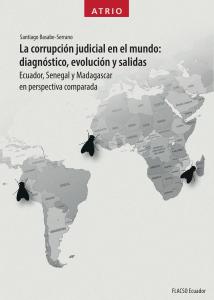
Descargas
Fecha de publicación
18-11-2024
Series
Categorías
Derechos de autor 2024 Editorial FLACSO Ecuador
Detalles sobre esta monografía
Dimensiones físicas
Cómo citar
La corrupción Judicial En El Mundo: Diagnóstico, evolución Y Salidas. Ecuador, Senegal Y Madagascar En Perspectiva Comparada. 2024. Atrio. Editorial FLACSO Ecuador. https://doi.org/10.46546/2024-60atrio.