
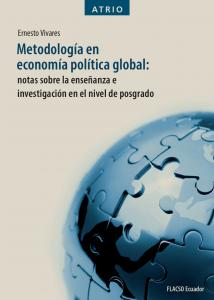
Metodología en economía política global: notas sobre la enseñanza e investigación en el nivel de posgrado
Sinopsis
¿Qué es el conocimiento y cómo se produce en el campo de los estudios internacionales? Sobre esta controversia, recurrente para quienes investigan en tal área, Ernesto Vivares presenta una reflexión novedosa, anclada en una perspectiva didáctica y multidisciplinaria. La novedad radica en que más allá de ofrecer fórmulas para plantear problemas y diseños de investigación, el autor invita a pensar trazados metodológicos coherentes con el lugar de enunciación del sujeto investigador y con la diversidad de enfoques que existen hoy en día. En este libro, Vivares abre las puertas de aquellas “cárceles conceptuales” que durante décadas han sesgado la producción de conocimientos y la pluralidad en la actividad académica. Entrega a docentes y estudiantes una visión integradora de la metodología de la investigación. Se trata de un invaluable aporte a los estudios de posgrado sobre las relaciones internacionales y la economía política en América Latina.
Ernesto Vivares. Docente e investigador argentino, afiliado a la FLACSO Ecuador. PhD en Ciencia Política por la Universidad de Sheffield, Reino Unido, y magíster en Economía Política Internacional por la Universidad de Birmingham, Reino Unido. Sus temas de investigación son la economía política global, el regionalismo latinoamericano y la metodología de la investigación. Entre sus publicaciones recientes se encuentra el artículo “From Latin American International Political Economy to Latin American Global Political Economy”, Estudos Internacionais (2021), en coautoría con Raúl Salgado. En 2020 coordinó el libro Desafíos y dilemas de financiar el desarrollo en Suramérica, Buenos Aires: Teseo.
Forma de citar: Vivares, Ernesto. 2023. Metodología en economía política global: notas sobre la enseñanza e investigación en el nivel de posgrado. Quito: FLACSO Ecuador. https://doi.org/10.46546/2023-47atrio
Referencias
Abbott, Jason, y Owen Worth. 2002. Critical Perspectives on International Political Economy. Londres: Palgrave Macmillan.
Abdih, Yasser, y Leandro Medina. 2013. “Measuring the Informal Economy in the Caucasus and Central Asia”. Working Paper 13/137, International Monetary Fund. https://www.imf.org/external/pubs/ft/wp/2013/wp13137.pdf
Acharya, Amitav. 2011. “Dialogue and Discovery: In Search of International Relations Theories Beyond the West”. Millennium: Journal of International Studies 39 (3): 619-637. https://doi.org/10.1177/0305829811406574
Acharya, Amitav. 2014. “Global International Relations (IR) and Regional Worlds: A New Agenda for International Studies”. International Studies Quarterly 58 (4): 647-659. https://doi.org/10.1111/isqu.12171
Acosta, Alberto. 2011. “Extractivismo y neoextractivismo: dos caras de la misma maldición”. En Más allá del desarrollo, editado por Sofía Jarrín, Miriam Lang y Dunia Mokrani, 84-118. Quito: Abya-Yala / Fundación Rosa Luxemburgo.
Acosta, Alberto. 2020. “Extractivism: The Curse of Plenty”. En The Routledge Handbook to Global Political Economy: Conversations and Inquiries, editado por Ernesto Vivares, 391-407. Nueva York: Routledge.
Acosta, Alberto, y John Cajas Guijarro. 2020. “Ghosts, Pluriverse, and Hopes. From ‘Development’ to Post-Development”. En The Routledge Handbook to Global Political Economy: Conversations and Inquiries, editado por Ernesto Vivares, 292-308. Nueva York: Routledge.
Acosta, Alberto, y Eduardo Gudynas. 2018. “Lecciones del caso Bolsonaro: Lecturas para una nueva izquierda”. Plan V, 5 de noviembre. https://bit.ly/3AyHTKA
Agnew, John. 1994. “The Territorial Trap: The Geographical Assumptions of International Relations Theory”. Review of International Political Economy, 1: 53-80. https://doi.org/10.1080/09692299408434268
Amin, Samir. 1988. La desconexión: hacia un sistema mundial policéntrico. Madrid: IEPALA.
Aron, Raymond. 1967. Las etapas del pensamiento sociológico. Buenos Aires: Siglo XX.
Ashworth, Lucian. 2002. “Did the Realist-Idealist Great Debate Really Happen? A Revisionist History of International Relations”. International Relations 16 (1): 33-51. https://doi.org/10.1177/0047117802016001004
Astorga, Pablo. 2015. “Functional Inequality in Latin America: News from the Twentieth Century”. Working Paper 135, University of Oxford.
Backhouse, Roger E., y Philippe Fontaine. 2010. The History of the Social Sciences Since 1945. Cambridge: Cambridge University Press. https://doi.org/10.1017/CBO9780511845260
Balassa, Bela. 1961a. The Theory of Economic Integration. Londres: Routledge. https://doi.org/10.1111/j.1467-6435.1961.tb02365.x
Balassa, Bela. 1961b. “Towards a Theory of Economic Integration”. Kyklos 14 (1): 1-17. https://doi.org/10.1111/j.1467-6435.1961.tb02365.x
Bates, Robert H. 1997. Open-Economy Politics: The Political Economy of the World Coffee Trade. Princeton: Princeton University Press.
Beck, Ulrich. 1997. The Reinvention of Politics: Rethinking Modernity in the Global Social Order. Cambridge: Polity Press / Blackwell Publishers. Beigel, Fernanda. 2013. “Centros y periferias en la circulación internacional del conocimiento”. Nueva Sociedad 245 (mayo-junio): 110-123. https://bit.ly/3yOcnXv
Belfrage, Claes, y Owen Worth. 2012. “Critical International Political Economy: Renewing Critique and Ontologies”. International Politics 49 (2): 131-135. https://doi.org/10.1057/ip.2011.39
Bergman, Marcelo. 2018. Illegal Drugs, Drug Trafficking and Violence in Latin America. Nueva York: Springer. https://doi.org/10.1007/978-3-319-73153-7
Bértola, Luis, y José Antonio Ocampo. 2012. The Economic Development of Latin America since Independence. Oxford: Oxford University Press.
Bhaskar, Roy. 2008. A Realist Theory of Science. Londres: Routledge. Bilgin, Pinar. 2008. “Thinking Past ‘Western’ IR?” Third World Quarterly 29 (1): 5-23. https://doi.org/10.1080/01436590701726392
Blaikie, Norman W. H. 1993. Approaches to Social Enquiry. Cambridge: Polity Press / Blackwell Publishers.
Blyth, Mark. 2009. Routledge Handbook of International Political Economy (IPE). IPE as a Global Conversation. Nueva York: Routledge. https://doi.org/10.4324/9780203881569
Bøås, Morten, Marianne H. Marchand y Timothy M. Shaw, eds. 2005. The Political Economy of Regions and Regionalisms. International Political Economy Series. Basingstoke: Palgrave Macmillan.
Bøås, Morten, y Desmond McNeill, eds. 2004. Global Institutions and Development: Framing The World? (RIPE Series in Global Political Economy). Londres / Nueva York: Routledge.
Bonilla, Adrián, y Guillaume Long. 2010. “Un nuevo regionalismo sudamericano”. Íconos. Revista de Ciencias Sociales, 38: 23-28. https://doi.org/10.17141/iconos.38.2010.442
Borón, Atilio. 2012. América Latina en la geopolítica del imperialismo. Buenos Aires: Ediciones Luxemburg.
Botto, Mercedes. 2010. “El G-20 y la gobernanza global: ¿un cambio en la arquitectura o en los procedimientos? Una mirada desde América Latina”. Nueva Sociedad 229 (septiembre-octubre): 26-40. https://bit.ly/3nNW4Uy Brawley, Mark. 2020. “The Politics of Trade in an Open Economy: Domestic Competition over Policy”. En The Routledge Handbook to Global Political Economy: Conversations and Inquiries, editado por
Ernesto Vivares, 146-173. Nueva York: Routledge.
Breslin, Shaun, y Richard Higgott. 2000. “Studying Regions: Learning from the Old, Constructing the New”. New Political Economy 5 (3): 333-352. https://doi.org/10.1080/713687784
Breslin, Shaun, y Glenn D. Hook, eds. 2002. Microregionalism and World Order. Londres: Palgrave Macmillan. https://doi.org/10.1057/9781403940155
Breslin, Shaun, Christopher W. Hughes, Nicola Phillips y Ben Rosamond, eds. 2002. New Regionalism in the Global Political Economy. Londres: Routledge. https://doi.org/10.4324/9780203361672
Briceño-Ruiz, José, e Isidro Morales, eds. 2017. Post-Hegemonic Regionalism in the Americas: Toward a Pacific-Atlantic Divide? The International Political Economy of New Regionalisms Series. Londres / Nueva York: Routledge/Taylor & Francis Group.
Brown, Chris, y Kirsten Ainley. 2009. Understanding International Relations, 4.a ed. Basingstoke: Palgrave Macmillan.
Bryman, Alan. 2012. Social Research Methods, 4.a ed. Oxford: Oxford University Press.
Buchanan, James, y Gordon Tullock. 1962. The Calculus of Consent: Logical Foundations of Constitutional Democracy. Michigan: University of Michigan Press. https://doi.org/10.3998/mpub.7687
Burgess, Robert. 1982. “The Role of Theory in Field Research”. En Field Research: A Sourcebook and Field Manual, 209-212. Londres: Routledge. Buzan, Barry. 1991. People, States, and Fear: An Agenda for International Security Studies in the Post-Cold War Era, 2.a ed. Boulder: Lynne Rienner Publishers.
Buzan, Barry. 2003. “Regional Security Complex Theory in the PostCold War World”. En Theories of New Regionalism, editado por Fredrik Söderbaum y Timothy M. Shaw, 140-159. Londres: Palgrave Macmillan. https://doi.org/10.1057/9781403938794_8
Buzan, Barry. 2013. “International Relations Theory and the ‘Social Whole’: Encounters and Gaps Between IR and Sociology”. International Political Sociology, 7: 117-135.
Buzan, Barry, y Richard Little. 2000. International Systems in World History: Remaking the Study of International Relations. Oxford / Nueva York: Oxford University Press.
Cable, Vincent, y David Henderson, eds. 1994. Trade Blocs? The Future of Regional Integration. International Economics Programme. Londres: Royal Instute of International Affairs.
Cafruny, Alan W. 2016. “Introducción”. En The Palgrave Handbook of Critical International Political Economy, editado por Alan Cafruny, Leila Simona Talani y Gonzalo Pozo Martin, 1-8. Londres: Palgrave Macmillan. https://doi.org/10.1057/978-1-137-50018-2_1
Cajas Guijarro, John. 2018. Los capos del comercio. Concentración, poder y acuerdos comerciales en el Ecuador: un preludio. Quito: Plataforma por el Derecho a la Salud / Fundación Donum / FOS.
Canales, Alejandro I. 2018. “Global and Regional Political Economy of Migration”. En Regionalism, Development and the Post-Commodities Boom in South America, editado por Ernesto Vivares, 243-269. Cham: Springer International Publishing. https://doi.org/10.1007/978-3-319-62551-5_11
Carolan, Bruce. 2008. “The Birth of the European Union: US and UK Roles in the Creation of a Unified European Community”. Tulsa Journal of Comparative & International Law 16 (1): 51-65. https://bit.ly/3PsTmzF
Carr, Edward. 2001.The Twenty Years’ Crisis: An Introduction to the Study of International Relations. Nueva York: Perennial.
Ciută, Felix. 2009. “Security and the Problem of Context: A Hermeneutical Critique of Securitisation Theory”. Review of International Studies 35 (2): 301-326. https://doi.org/10.1017/S0260210509008535
Chernoff, Fred. 2002. “Scientific Realism as a Meta-Theory of International Relations”. International Studies Quarterly 46 (2): 189-207. https://www.jstor.org/stable/3096068
Cohen, Benjamin J. 2008. International Political Economy: An Intellectual History. Princeton: Princeton University Press.
Cohen, Benjamin J. 2020. Advanced Introduction to International Political Economy, 22.a ed. Cheltenham / Northampton: Edward Elgar Publishing.
Cox, Robert W. 1981. “Social Forces, States and World Orders: Beyond International Relations Theory”. Millennium: Journal of International Studies 10 (2): 126-155. https://doi.org/10.1177/03058298810100020501
Cox, Robert W. 1983. “Gramsci, Hegemony, and international relations: an essay method”. En Approaches to World Order, editado por Robert Cox y Timothy Sinclair, 124-143 Cambridge, UK: Cambridge University Press.
Cox, Robert W. 2000. “Problems of Power and Knowledge in a Changing Global World Order”. En Political Economy and the Changing Global Order, editado por Richard Stubbs y Geoffrey R. D. Underhill, 3.a ed., 25-37. Ontario / Nueva York: Oxford University Press.
Cox, Robert W. 2009. “The ‘British School’ in the Global Context”. New Political Economy 14 (3): 315-328. https://doi.org/10.1080/13563460903087441
Cox, Robert W., y Michael G. Schechter. 2002. The Political Economy of a Plural World: Critical Reflections on Power, Morals and Civilisation. Londres: Routledge. https://doi.org/10.4324/9780203116036
Cox, Robert W., y Timothy J. Sinclair. 1996. “Beyond International Relations Theory: Robert W. Cox and approaches to world order”. En Approaches to World Order, editado por Robert W. Cox y Timothy J. Sinclair, 3-18. Cambridge: Cambridge University Press. https://bit.ly/3bZVCQ4
Creswell, John W. 2009. Research Design: Qualitative, Quantitative, and Mixed Methods Approaches, 3.a ed. Thousand Oaks: Sage Publications.
Dahl, Robert. 1961. Who govern? Democracy and Power in an American City. New Haven: Yale University Press.
Dabène, Olivier. 2012. “Explaining Latin America’s Fourth Wave of Regionalism. Regional Integration of a Third Kind”. Ponencia presentada en el Congress of the Latin American Studies Association (LASA), “Waves of change in Latin America. History and Politics” San Francisco, del 23 al 26 de mayo.
De Carvalho, Benjamin, Leira Halvard y John Hobson. 2011. “The Big Bangs of IR: The Myths That Your Teachers Still Tell You about 1648 and 1919”. Millennium. Journal of International Studies 39 (3): 735-758.
De Lombaerde, Philippe, Francis Baert y Tânia Felício, eds. 2012. The United Nations and the Regions: Third World Report on Regional Integration. United Nations University Series on Regionalism, vol. 3. Londres: Springer.
De Lombaerde, Philippe, y Fredrik Söderbaum, eds. 2013. Regionalism. Los Ángeles: SAGE.
Deciancio, Melisa. 2016. “El regionalismo latinoamericano en la agenda de la teoría de las Relaciones Internacionales”. Iberoamericana 16 (63): 91-110. https://doi.org/10.18441/IBAM.16.2016.63.91-110
Deciancio, Melisa. 2018. “La Economía Política Internacional en el campo de las Relaciones Internacionales argentinas”. Desafíos 30 (2): 15-42. https://doi.org/10.12804/revistas.urosario.edu.co/desafios/a.6106
Deciancio, Melisa, y Cintia Quiliconi. 2020. “IPE Beyond Western Paradigms: China, Africa, and Latin America in Comparative Perspective”. En The Routledge Handbook to Global Political Economy: Conversations and Inquiries, editado por Ernesto Vivares, 457-471. Nueva York: Routledge.
Delgado, Jaime Ornelas. 2016. “Sociedades posneoliberales en América Latina y persistencia del extractivismo”. Economía Informa 396 (1): 84-95. https://doi.org/10.1016/j.ecin.2016.01.005
Deutsch, Karl W., Sidney A. Burrell y Robert A. Kann. 1958. Political Community and the North Atlantic Area: International Organization in the Light of Historical Experience. Princeton: Princeton University.
Devlin, Robert, y Lucio Castro. 2002. Regional Banks and Regionalism: A New Frontier for Development Financing. Buenos Aires: BID / INTAL / ITD / STA.
Devlin, Robert, y Antoni Estevadeordal. 2001. What’s New in the New Regionalism in the Americas? Buenos Aires: BID / INTAL / ITD / STA. Díaz, Carlos. 1988. “Open Economy, Closed Polity?”. En Trade, Development and the World Economy, editado por Andrés Velasco, 283-309. Oxford: Basil Blackwell.
Dieter, Heribert, y Richard Higgott. 2003. “Exploring Alternative Theories of Economic Regionalism: From Trade to Finance in Asian Co-Operation?”. Review of International Political Economy 10 (3): 430-454. https://doi.org/10.1080/09692290308422
Dornbusch, Rudiger, y Sebastian Edwards, eds. 1992. The Macroeconomics of populism in Latin America. A National Bureau of Economic Research Conference Report. Chicago: University of Chicago Press. https://doi.org/10.7208/chicago/9780226158488.001.0001
Downs, Anthony. 1957. “An Economic Theory of Political Action in a Democracy”. Journal of Political Economy 65 (2): 135-150. https://www.jstor.org/stable/1827369
Dunne, Tim, Lene Hansen y Colin Wight. 2013. “The End of International Relations Theory?”. European Journal of International Relations 19 (3): 405-425. https://doi.org/10.1177/1354066113495485
Duverger, Maurice. 1962. Métodos de las ciencias sociales. Barcelona: Ariel. Edwards, Sebastian. 2010. Left Behind: The False Promise of Populism in Latin America. Chicago: Chicago University Press.
Elias, Juanita, y Adrienne Roberts. 2018. Handbook on the International Political Economy of Gender. Northampton: Edward Elgar Publishing. https://doi.org/10.4337/9781783478842
Epstein, Brian. 2018. “Social Ontology”. En The Stanford Encyclopedia of Philosophy, editado por Edward N. Zalta. Stanford: Stanford University. https://stanford.io/3ygZiV6
Espinosa, Carlos. 2014. “The Origins of the Union of South American Nations: A Multicausal Account of South American Regionalism”. En Exploring the New South American Regionalism (NSAR), editado por Ernesto Vivares, 29-48. Nueva York: Ashgate.
Estay, Jaime. 2018. “Past and Present of Latin American Regionalisms, in the Face of Economic Reprimarization”. En Regionalism, Development and the Post-Commodities Boom in South America, editado por Ernesto Vivares, 47-76. Nueva York: Palgrave Macmillan. https://doi.org/10.1007/978-3-319-62551-5_3
Estay, Jaime, y Germán Sánchez, eds. 2005. El ALCA y sus peligros para América Latina. Buenos Aires: CLACSO.
Estevadeordal, Antoni, y Kati Suominen. 2008. “Sequencing Regional Trade Integration and Cooperation Agreements”. World Economy 31 (1): 112-140. https://doi.org/10.1111/j.1467-9701.2007.01084.x
Farrands, Christopher, y Owen Worth. 2005. “Critical Theory in Global Political Economy: Critique? Knowledge? Emancipation?”. Capital & Class 29 (1): 43-61. https://doi.org/10.1177/030981680508500113
Fawcett, Louise L’Estrange, y Andrew Hurrell, eds. 1995. Regionalism in World Politics: Regional Organization and International Order. Nueva York: Oxford University Press.
Feld, Lars, y Claus Larsen. 2009. Undeclared Work in Germany 2001-2007. Impact of Deterrence, Tax Policy, and Social Norms: An Analysis Based on Survey Data. Berlín: Springer.
Ferguson, Niall. 2009. The Ascent of Money: A Financial History of the World. Londres: Penguin.
Fioramonti, Lorenzo, ed. 2012. Regionalism in a Changing World: Comparative Perspectives in the New Global Order. Londres: Routledge.
Frankema, Ewout. 2010. “Reconstructing Labor Income Shares in Argentina, Brazil and Mexico, 1870-2000”. Revista de Historia Económica 28 (1): 343-374. https://doi.org/10.1017/S0212610910000091
Frenkel, Roberto. 2003. “Globalization and financial crisis in Latin America”. Cepal Review 80. https://hdl.handle.net/11362/10950
Frieden, Jeffry, y David Lake, eds. 2000. International Political Economy: Perspectives on Global Power and Wealth. Nueva York: St. Martin’s Press. Fuentes, Luis, y Gustavo Durán. 2018. “Cities in the South American Development: Bogota, Lima, Quito, and Santiago in Regional Frame”. En Regionalism, Development and the Post-Commodities Boom in South America, editado por Ernesto Vivares, 217-242. Cham: Springer International Publishing. https://doi.org/10.1007/978-3-319-62551-5_10 Galarraga Gortázar, Niara. 2018. “Radiografía del gran éxodo venezolano”. El País, 13 diciembre. https://bit.ly/2pDpWV0
Gallagher, Kevin P. 2016. The China Triangle: Latin America’s China Boom and the Fate of the Washington Consensus. Nueva York: Oxford University Press. Gallagher, Kevin P., y Margaret Myers. 2016. “China-Latin America Finance Database”. The Dialogue. https://bit.ly/3yIMcAz
Gamble, Andrew, y Anthony Payne, eds. 1996. Regionalism and World Order. Londres: Palgrave Macmillan.
Gasparini, Leonardo, y Nora Lustig. 2011. “The Rise and Fall of Income Inequality in Latin America”. En The Oxford Handbook of Latin American Economics, editado por José Antonio Ocampo y Jaime Ros, 691-714. Oxford: Oxford University Press.
Gilpin, Robert. 1987. The Political Economy of International Relations. Princeton: Princeton University Press. https://doi.org/10.1515/9781400882779
Gilpin, Robert. 2001. Global Political Economy: Understanding the International Economic Order. Princeton: Princeton University Press. https://doi.org/10.1515/9781400831272
Glaser, Barney G., y Anselm L. Strauss. 1967. The Discovery of Grounded Theory: Strategies for Qualitative Research. Chicago: Aldine.
Giménez-Peña, Gabriel. 2020. “La distinción entre problem-solving y critical theory: Una reflexión desde las Relaciones Internacionales”. Desafíos 32 (2): 1-21. https://doi.org/10.12804/revistas.urosario.edu.co/desafios/a.7861
Gómez-Mera, Laura. 2008. “How ‘New’ is the ‘New Regionalism’ in the Americas? The Case of MERCOSUR”. Journal of International Relations and Development 11 (3): 279-308. https://doi.org/10.1057/jird.2008.14
Graff, Gerald, y Cathy Birkenstein. 2018. ‘They say / I say’: The Moves that Matter in Academic Writing, 4.a ed. Nueva York: W. W. Norton & Company.
Gray, John. 1997. After Social Democracy Politics, Capitalism and the Common Life. Londres: Demos.
Grieco, Joseph M. 1997. “Systemic Sources of Variation in Regional Institutionalization in Western Europe, East Asia and the Americas”. En The Political Economy of Regionalism, editado por Edward D. Mansfield y Helen V. Milner, 164-188. Nueva York: Columbia University Press.
Grieco, Joseph M., y G. John Ikenberry. 2003. State Power and World Markets: The International Political Economy. Nueva York: W.W. Norton & Co.
Griffin, Susan. 2018.“Women and Nature: The Roar Inside Her”. Hypatia 9 (3): 225-238. https://philpapers.org/rec/GRIWAN-2
Griffith-Jones, Stephany. 1984. International Finance and Latin America. Nueva York: St. Martin’s Press.
Grix, Jonathan. 2002. “Introducing Students to the Generic Terminology of Social Research”. Politics 22 (3): 175-186. https://doi.org/10.1111/1467-9256.00173
Grosfoguel, Ramón. 2009. “A Decolonial Approach to Political-Economy: Transmodernity, Border Thinking and Global Coloniality”. Kult, Special Issue on Latin America, 6: 10-38.
Grosfoguel, Ramón, y Ana Margarita Cervantes-Rodríguez, eds. 2002. The Modern/Colonial/Capitalist World-System in the Twentieth Century: Global Processes, Antisystemic Movements, and the Geopolitics of Knowledge. Westport: Greenwood.
Gross, Leo. 1948. “The Peace of Westphalia, 1648-1948”. American Journal of International Law 42 (1): 20-41. https://doi.org/10.2307/2193560
Gudynas, Eduardo. 2012. “Diez tesis urgentes sobre el nuevo extractivismo. Contextos y demandas bajo el progresismo actual”. En Extractivismo, política y sociedad, editado por el Centro Andino de Acción Popular y el Centro Latinoamericano de Ecología Social, 187-225. Quito: CAAP / CLAES.
Gurr, Ted. 1968. “A Causal Model of Civil Strife: A Comparative Analysis Using New Indices”. American Political Science Review, 62: 1104-1124. https://doi.org/10.2307/1953907
Haas, Ernst B. 1958. The Uniting of Europe: Political, Social and International Organization. Stanford: Stanford University Press.
Haas, Ernst B. 1971. “The Study of Regional Integration: Reflections on the Joy and Anguish of Pretheorizing”. En Regional Integration: Theory and Research, editado por Leon N. Lindberg y Stuart A. Scheingold, 3-42. Cambridge: Harvard University Press.
Haas, Ernst B. 1975. The Obsolescence of Regional Integration Theory. Berkeley: University of California.
Haas, Richard. 2008. “La era de la no polaridad: lo que seguirá al dominio de Estados Unidos”. Foreign Affairs 8 (3): 66-78.
Haggard, Stephan. 1997. “Regionalism in Asia and the Americas”. En The Political Economy of Regionalism, editado por Edward D. Mansfield y Helen V. Milner, 20-49. Nueva York: Columbia University Press.
Haluani, Makram. 2006. “How ‘International’ Are Theories in International Relations? The View from Latin America”. Documento presentado en la Annual Meeting of the International Studies Association, San Diego, del 23 al 26 de marzo.
Hay, Colin. 2002. Political Analysis: A Critical Introduction. Londres: Palgrave. https://doi.org/10.1007/978-0-230-62911-0
Hay, Colin, y Tony Payne. 2013. “The Great Uncertainty”. SPERI Paper 5, The University of Sheffield. https://bit.ly/2FaTfXz
Helleiner, Eric. 2015. “Globalising the Classical Foundations of IPE Thought”. Contexto Internacional 37 (3): 975-1010. https://doi.org/10.1590/S0102-85292015000300007
Helleiner, Eric. 2020. “Globalizing the Historical Roots of IPE”. En The Routledge Handbook to Global Political Economy: Conversations and Inquiries, editado por Ernesto Vivares, 43-57. Londres: Routledge. https://doi.org/10.4324/9781351064545
Helleiner, Eric, y Antulio Rosales. 2017. “Peripheral Thoughts for International Political Economy: Latin American Ideational Innovation and the Diffusion of the Nineteenth Century Free Trade Doctrine”. International Studies Quarterly 61 (4): 924-934. https://doi.org/10.1093/isq/sqx063
Hernández Sampieri, Roberto, Carlos Fernández Collado y Pilar Baptista Lucio. 2011. Metodología de la investigación, 5.a ed. México D.F.: Interamericana Editores.
Hernández Sampieri, Roberto, Carlos Fernández Collado y Pilar Baptista Lucio. 2014. Metodología de la investigación. México D.F.: McGraw Hill Interamericana.
Hettne, Björn. 2003. “The New Regionalism Revisited”. En Theories of New Regionalism, editado por Fredrik Söderbaum y Timothy M. Shaw, 22-42. Londres: Palgrave Macmillan. https://doi.org/10.1057/9781403938794_2
Hettne, Björn. 2005. “Beyond the ‘New’ Regionalism”. New Political Economy 10 (4): 543-571. https://doi.org/10.1080/13563460500344484
Hettne, Björn. 2006. “Beyond the ‘New’ Regionalism”. En Key Debates in New Political Economy, editado por Anthony Payne, 128-160. Londres: Routledge.
Hettne, Björn, András Inotai y Osvaldo Sunkel, eds. 1999. Globalism and the New Regionalism. Londres: Palgrave Macmillan. https://doi.org/10.1007/978-1-349-27268-6
Hettne, Björn, András Inotai y Osvaldo Sunkel, eds. 2000. National Perspectives on the New Regionalism in the South. The New Regionalism 3. Basingstoke: Macmillan.
Hettne, Björn, András Inotai y Osvaldo Sunkel, eds. 2001. Comparing Regionalisms: Implications for Global Development. International Political Economy Series, vol. 5. Basingstoke: Palgrave Macmillan.
Hettne, Björn, y Fredrik Söderbaum. 2000. “Theorising the Rise of Regionness”. New Political Economy 5 (3): 457-472. https://doi.org/10.1080/713687778
Higgott, Richard. 2006. “The Theory and Practice of Region”. En Regional Integration in East Asia and Europe: Convergence or Divergence?, editado por Bertrand Fort y Douglas Webber, 17-38. Londres: Routledge.
Hilgers, Tina, y Laura Macdonald, eds. 2017. Violence in Latin America and the Caribbean: Subnational Structures, Institutions, and Clientelistic Networks. Cambridge: Cambridge University Press. https://doi.org/10.1017/9781108140553
Hiscox, Michael J. 2002. International Trade and Political Conflict: Commerce, Coalitions, and Mobility. Princeton: Princeton University Press. Hobden, Stephen, y John M. Hobson, eds. 2002. Historical Sociology of International Relations. Cambridge: Cambridge University Press.
Hobson, John M. 2013. “Part 1-Revealing the Eurocentric Foundations of IPE: A Critical Historiography of the Discipline from the Classical to the Modern Era”. Review of International Political Economy 20 (5): 1024-1054. https://doi.org/10.1080/09692290.2012.704519
Hoffmann, Stanley. 1991. “Una Ciencia Social Norteamericana: Relaciones Internacionales”. En Jano y Minerva: ensayos sobre la guerra y la paz, 17-36. Buenos Aires: Grupo Editor Latinoamericano.
Hollis, Martin, y Steve Smith. 1990. Explaining and Understanding International Relations. Oxford: Clarendon Press / Oxford University Press. Holsti, Kal J. 1985. The Dividing Discipline: Hegemony and Diversity in International Theory. Boston: Allen & Unwin.
Hook, Glenn, y Ian Kearns, eds. 1999. Subregionalism and World Order. Londres: Palgrave Macmillan. https://doi.org/10.1007/978-1-349-14650-5 Hurrell, Andrew. 1995. “Regionalism in Theoretical Perspective”. En Regionalism in World Politics: Regional Organization and International Order, editado por Louise L’Estrange Fawcett y Andrew Hurrell, 9-73. Nueva York: Oxford University Press.
Jackson, Patrick Thaddeus. 2010. The Conduct of Inquiry in International Relations: Philosophy of Science and Its Implications for the Study of World Politics. Londres: Routledge. https://doi.org/10.4324/9780203843321
Jäger, Johannes. 2020. “From Marx to Critical International Political Economy”. En The Routledge Handbook to Global Political Economy: Conversations and Inquiries, editado por Ernesto Vivares, 247-261. Nueva York: Routledge.
Jatobá, Daniel. 2013. “Los desarrollos académicos de las Relaciones Internacionales en Brasil: elementos sociológicos, institucionales y epistemológicos”. Relaciones Internacionales, 22: 27-46. https://bit.ly/3RjPWRe Jervis, Robert, 1999. “Realism, Neoliberalism, and Cooperation: Understanding the Debate”. International Security 24 (1): 42-63.
Jiménez-Peña, Gabriel, Ralf Leiteritz y Carolina Urrego-Sandoval. 2018. “Dossier, Estado del Arte de la Economía Política Internacional en Latinoamérica”. International Political Economy: Debating the Past, Present and Future 30 (2): 34-46.
Jørgensen, Knud Erik. 2010. International Relations Theory: A New Introduction. Londres: Palgrave Macmillan.
Jørgensen, Knud, Mark Pollack y Ben Rosamond. 2006. Handbook of European Union Politics. Londres: Sage. https://doi.org/10.4135/9781848607903
Joseph, Jonathan. 2007. “Philosophy in International Relations: A Scientific Realist Approach”. Millennium: Journal of International Studies 35 (2): 345-359. https://doi.org/10.1177/03058298070350021401
Katzenstein, Peter J. 1976. “International Relations and Domestic Structures: Foreign Economic Policies of Advanced Industrial States”. International Organization 30 (1): 1-45.
Katzenstein, Peter J. 2009. Civilizations in World Politics: Plural and Pluralist Perspectives. Londres: Routledge. https://doi.org/10.4324/9780203872482 Katzenstein, Peter J., Robert O. Keohane y Stephen D. Krasner. 1998. “Preface: ‘International Organization’ at Its Golden Anniversary”. International Organization 52 (4): 15-18. https://doi.org/10.1017/S0020818300035578
Keohane, Robert. 1984. After Hegemony: Cooperation and Discord in the World Political Economy. Cambridge University Press. https://doi.org/10.1515/9781400820269
Keohane, Robert. 2002. Power and Governance in a Partially Globalized World. Londres: Routledge. https://doi.org/10.4324/9780203218174
Keohane, Robert O., y Joseph S. Nye. 1977. Power and Interdependence: World Politics in Transition. Boston: Little, Brown and Company.
Kindleberger, Charles. 1981. “Dominance and Leadership in the International Economy: Exploitation, Public Goods, and Free Rides”. International Studies Quarterly 25(2): 242-254. https://doi.org/10.2307/2600355
King, Gary, Robert O. Keohane y Sidney Verba. 1994. Designing Social Inquiry: Scientific Inference in Qualitative Research. Princeton University Press. https://doi.org/10.1515/9781400821211
Kissinger, Henry. 2012. On China. Toronto: Penguin.
Klotz, Audie, y Deepa Prakash. 2008. Qualitative Methods in International Relations a Pluralist Guide. Nueva York: Macmillan.
Krasner, Stephen D. 1976. “State Power and the Structure of International Trade”. World Politics 28 (3): 317-347. https://doi.org/10.2307/2009974
Krasner, Stephen D. 1982. “Structural Causes and Regime Consequences: Regimes as Intervening Variables”. International Organization 36 (2): 185-205. https://www.jstor.org/stable/2706520
Krasner, Stephen D. 1994. “International Political Economy: Abiding Discord”. Review of International Political Economy 1 (1): 13-19. https://doi.org/10.1080/09692299408434265
Krasner, Stephen D. 2000. “State Power and the Structure of International Trade”. En International Political Economy: Perspectives on Global Power and Wealth, editado por Jeffry Frieden y David Lake, 19-36. Nueva York: St. Martin’s Press.
Krasner, Stephen D. 2009. Power, the State, and Sovereignty: Essays on International Relations. Londres: Routledge. https://doi.org/10.4324/9780203882139 Krugman, Paul R., y Maurice Obstfeld. 2005. International Economics: Theory and Policy, 7.a ed. Boston: Pearson International Edition.
Kurowska, Xymena. 2020. “Interpretive Scholarship in Contemporary International Relations”. Teoria Polityki, 4: 93-107. https://doi.org/10.4467/25440845TP.19.018.11784
Kuwayama, Mikio. 2005. Latin American South-South Integration and Cooperation: From a Regional Public Goods Perspective. Santiago de Chile: Naciones Unidas / CEPAL.
Kuwayama, Mikio, José Elías Durán Lima y Verónica Silva. 2005. Bilateralism and Regionalism: Re-Establishing the Primacy of Multilateralism, a Latin American and Caribbean Perspective. Santiago de Chile: Naciones Unidas / CEPAL / Division of International Trade and Integration.
Kydd, Andrew. 2008. “Methodological Individualism and Rational Choice”. En The Oxford Handbook of International Relations, editado por Christian Reus-Smit y Duncan Snidal, 425-443. Nueva York: Oxford University Press. https://doi.org/10.1093/oxfordhb/9780199219322.001.0001
Lake, David A. 2009. “Open Economy Politics: A Critical Review”. The Review of International Organizations 4 (3): 219-244. https://doi.org/10.1007/s11558-009-9060-y
Lake, David A.2013. “Theory Is Dead, Long Live Theory: The End of the Great Debates and the Rise of Eclecticism in International Relations”. European Journal of International Relations 19 (3): 567-587. https://doi.org/10.1177/1354066113494330
Lake, David A. 2016. “White Man’s IR: An Intellectual Confession”. Perspectives on Politics 14 (4): 1112-1222. https://doi.org/10.1017/S153759271600308X Lamont, Christopher K. 2015. Research Methods in International Relations. Londres: Sage.
Legler, Thomas. 2013. “Post-Hegemonic Regionalism and Sovereignty in Latin America: Optimists, Skeptics, and an Emerging Research Agenda”. Contexto Internacional 35 (2): 325-352. https://doi.org/10.1590/S0102-85292013000200001
Leitenberg, Milton. 2006. Deaths in Wars Conflicts in the 20th Century. Ithaca: Cornell University.
Leiteritz, Ralf J., y Manuel Riaño. 2018. “Tras el corazón verde: los vaivenes del conflicto en la región esmeraldera de Colombia”. En Diferentes recursos, conflictos diferentes: La economía política del conflicto armado y la criminalidad en las regiones de Colombia, editado por Angelika Rettberg, Ralf J. Leiteritz y Carlo Nasi, 293-340. Bogotá: Uniandes.
Leiva, Fernando Ignacio. 2008. Latin American Neostructuralism: The Contradictions of Post Neoliberal Development. Minneapolis: University of Minnesota.
Llenderrozas, Elsa Esther, ed. 2013. Relaciones internacionales: teorías y debates. Buenos Aires: EUDEBA.
Lubbock, Rowan, y Ernesto Vivares. 2022. The reconfiguration of twenty-first century Latin American regionalisms: actors. Process, contradictions, and projects. Londres: Routledge.
Luhnow, David. 2014. “The Two Latin Americas: A Continental Divide Between One Bloc that Favors State Control and Another that Embraces Free Markets”. The Wall Street Journal, 3 de enero. https://on.wsj.com/3Ip6uTL
Lukas, Michael, y Gustavo Durán. 2020. “The International Political Economy of Cities and Urbanization: Insights from Latin America”. En The Routledge Handbook to Global Political Economy: Conversations and Inquiries, editado por Ernesto Vivares, 775-795. Londres: Routledge.
Luxton, Meg. 2018. “The Production of Life Itself: Gender, Social Reproduction and IPE”. En Handbook on the International Political Economy of Gender, editado por Juanita Elias y Adrienne Roberts, 37-49. Londres: Edward Elgar Publishing. https://doi.org/10.4337/9781783478842
Lynch, Cecelia. 2014. Interpreting International Politics. Routledge Series on Interpretive Methods. Londres: Routledge.
Madhok, Sumi, y Shirin M. Rai. 2012. “Agency, Injury, and Transgressive Politics in Neoliberal Times”. Signs: Journal of Women in Culture and Society 37 (3): 645-669. https://doi.org/10.1086/662939
Mahmood, Saba. 2005. Politics of Piety: The Islamic Revival and the Feminist Subject. Princeton: Princeton University Press.
Maira, Luis. 2013. “Dos Latinoaméricas”. Ponencia presentada en el Foro Regional: El liderazgo de Brasil en la gobernanza regional: desafíos, perspectivas u oportunidades, Quito, mayo.
Malamud, Andrés. 2011. “Conceptos, teorías y debates sobre la integración regional”. Norteamérica 6 (2): 219-249.
Malamud, Andrés. 2013. “Overlapping Regionalism, No Integration: Conceptual Issues and the Latin American Experiences”. Working Paper, European University Institute. https://bit.ly/3yoOk07
Malamud, Andrés, y Gian Luca Gardini. 2012. “Has Regionalism Peaked? The Latin American Quagmire and Its Lessons”. The International Spectator 47 (1): 116-133. https://doi.org/10.1080/03932729.2012.655013
Malik, Kenan. 2014. The Quest for a Moral Compass: A Global History of Ethics. Londres: Atlantic.
Maliniak, Daniel, Amy Oakes, Susan Peterson y Michael J. Tierney. 2011. “International Relations in the US Academy”. International Studies Quarterly 55 (2): 437-464. https://doi.org/10.1111/j.1468-2478.2011.00653.x
Maliniak, Daniel, y Michael J. Tierney. 2009. “The American School of IPE”. Review of International Political Economy 16 (1): 6-33. https://doi.org/10.1080/09692290802524042
Mansfield, Edward D., y Helen V. Milner, eds. 1997. The Political Economy of Regionalism. New Directions in World Politics. Nueva York: Columbia University Press.
Marchand, Marianne H., Morten Bøås y Timothy M. Shaw. 1999. “The Political Economy of New Regionalisms”. Third World Quarterly, New Regionalism in the New Millennium 20 (5): 897-910. https://doi.org/10.1080/01436599913398
Marsh, David, y Paul Furlong. 2002. “A Skin not a Sweater: Ontology and Epistemology in Political Science”. En Theory and Methods in Political Science, editado por David Marsh y Gerry Stoker, 17-41. Londres: Palgrave Macmillan.
Marx, Karl. 1982. El Capital: crítica de la economía política. México D. F.: Fondo de Cultura Económica.
Mattli, Walter. 1999. The Logic of Regional Integration: Europe and Beyond. Cambridge: Cambridge University Press. https://doi.org/10.1017/CBO9780511756238
Medeiros, Marcelo de Almeida, Israel Barnabé, Rodrigo Albuquerque y Rafael Lima. 2016. “What does the Field of International Relations Look Like in South America?”. Revista Brasileira de Política Internacional 59 (1): 1-31. https://doi.org/10.1590/0034-7329201600104
Medina, Leandro, y Friedrich Schneider. 2018. “Shadow Economies Around the World: What Did We Learn Over the Last 20 Years?”. Working Papers, International Monetary Fund. https://doi.org/10.5089/9781484338636.001
Mesquita Moreira, Mauricio, y Eduardo Mendoza. 2007. Regional Integration: What Is in It for CARICOM? Working Paper 29, BID / INTAL / ITD / STA.
Mignolo, Walter. 2007. La idea de América Latina: la herida colonial y la opción decolonial. Barcelona: GEDISA.
Mignolo, Walter. 2016. “Global Coloniality and the World Disorder. Decoloniality After Decolonization and Dewesternization After the Cold War”. Working Paper leído en la 13th Rhodes Forum “Dialogue of Civilizations”.
Mills, C. Wright. 1959. The Sociological Imagination. Nueva York: Oxford University Press.
Mitrany, David. 1966. A Working Peace System. Chicago: Quadrangle Books.
Morales, Isidro. 2017. “The Renewal of U.S. ‘Free Trade’ Diplomacy in the Americas: From Nafta to a Deeper Agenda of Competitive Liberalization for the Region”. En Post-Hegemonic Regionalism in the Americas: Toward a Pacific-Atlantic Divide?, editado por José Briceño-Ruiz e Isidro Morales, 31-56. Londres: Routledge. https://doi.org/10.4324/9781315601663
Moravcsik, Andrew. 2001. “The Liberal Paradigm in International Relations Theory: A Social Scientific Assessment”. Working Paper Series 01, Weatherhead Center Cambridge.
Moravcsik, Andrew. 2010. “Liberal Theories of International Relations: A Primer”. Manuscrito inédito. https://www.princeton.edu/~amoravcs/library/primer.doc
Morgenthau, Hans J. 1946. Scientific Man vs. Power Politics. Chicago: University of Chicago Press.
Morgenthau, Hans J., y Kenneth W. Thompson. 1985. Politics Among Nations: The Struggle for Power and Peace, 6.a ed. Nueva York: A.A. Knopf. Muggah, Robert. 2015. “A Manifesto for the Fragile City”. Journal of International Affairs 68 (2): 19-36. https://gsdrc.org/document-library/a-manifesto-for-the-fragile-city/ Murphy, Craig N., y Douglas R. Nelson. 2001. “International Political Economy: A Tale of Two Heterodoxies”. The British Journal of Politics and International Relations 3 (3): 393-412. https://doi.org/10.1111/1467-856X.00065
Nemiña, Pablo. 2019. “La relación entre el FMI y los gobiernos tomadores de crédito. El aporte de la EPI centrado en la incidencia de los intereses”. Desafíos 31 (2): 341-473. https://doi.org/10.12804/revistas.urosario.edu.co/desafios/a.6140
Nilsson, Manuela, y Jan Gustafsson, eds. 2012. Latin American Responses to Globalization in the 21st Century. Londres: Palgrave Macmillan. https://doi.org/10.1057/9781137003126
Niskanen, William A. 1971. Bureaucracy and Representative Government. Chicago: Aldine-Atherton.
Nolte, Detlef, y Victor Mijares. 2018. “Regionalismo poshegemónico en crisis. ¿Por qué la Unasur se desintegra?”. Foreign Affairs Latinoamérica 18 (3): 105-112.
North, Douglas C. 1990. Institutions, Institutional Change and Economic Performance. Cambridge: Cambridge University Press. https://doi.org/10.1017/CBO9780511808678
Nye, Joseph S. 2003. The Paradox of American Power: Why the World’s Only Superpower Can’t Go It Alone. Oxford: Oxford University Press.
Oatley, Thomas H. 2013. International Political Economy. Nueva York: Routledge.
O’Brien, Robert, y Marc Williams. 2016. Global Political Economy. Nueva York: Palgrave Macmillan.
Oliveira, Gustavo, y Susanna Hecht. 2016. “Sacred Groves, Sacrifice Zones and Soy Production: Globalization, Intensification and Neo-Nature in South America”. The Journal of Peasant Studies 43 (2): 251-285. https://doi.org/10.1080/03066150.2016.1146705
Olson, Mancur. 1982. The Rise and Decline of Nations: Economic Growth, Stagflation, and Social Rigidities. New Haven: Yale University Press.
Palma, José G. 2009. “Why Did the Latin American Critical Tradition in the Social Sciences Become Practically Extinct?” En Routledge Handbook of International Political Economy (IPE): IPE as a Global Conversation, editado por Mark Blyth, 243-265. Londres / Nueva York: Routledge.
Parpart, Jane L., y Swati Parashar, eds. 2019. Rethinking Silence, Voice and Agency in Contested Gendered Terrains. Londres: Routledge. https://doi.org/10.4324/9781315180458
Payne, Anthony. 1996. “The United States and Its Enterprise for the Americas’”. En Regionalism and World Order, editado por Andrew Gamble y Anthony Payne, 93-129. Londres: Macmillan Education.
Payne, Anthony. ed. 2004. The New Regional Politics of Development. Nueva York: Palgrave Macmillan.
Payne, Anthony. 2005. The Global Politics of Unequal Development. Londres: Palgrave Macmillan.
Payne, Anthony, y Nicola Phillips. 2010. Development. Key Concepts in the Social Sciences. Londres: Polity.
Peixoto Batista, Juliana. 2017. “La EPI y las Relaciones Internacionales, ¿dónde está el Derecho?” Relaciones Internacionales 26 (52): 181-194. https://doi.org/10.24215/23142766e009
Pérez-Oviedo, Wilson, John Cajas Guijarro y María Cristina Vallejo. 2018. “South America: Trade and Integration in the New Global Trade Network”. En Regionalism, Development and the Post-Commodities Boom in South America, editado por Ernesto Vivares, 121-145. Nueva York: Palgrave Macmillan. https://doi.org/10.1007/978-3-319-62551-5_6
Petras, James, y Henry Veltmeyer. 2012. “The Rise and Demise of Extractive Capitalism”. The James Petras website, 4 de julio. http://petras.lahaine.org/?p=1895
Phillips, Nicola. 2003a. “Hemispheric Integration and Subregionalism in the Americas”. International Affairs 79 (2): 327-349. https://doi.org/10.1111/1468-2346.00311
Phillips, Nicola. 2003b. “The Rise and Fall of Open Regionalism? Comparative Reflections on Regional Governance in the Southern Cone of Latin America”. Third World Quarterly 24 (2): 217-234. https://doi.org/10.1080/0143659032000074565
Phillips, Nicola. 2004. The Southern Cone Model: The Political Economy of Regional Capitalist Development in Latin America. Londres: Routledge. https://doi.org/10.4324/9780203463338
Phillips, Nicola. ed. 2005. Globalizing International Political Economy. Nueva York: Palgrave Macmillan.
Plano, Jack C., y Roy Olton. 1969. The International Relations Dictionary. Nueva York: Holt, Rinehart and Winston.
Polanyi, Karl. 2001. The Great Transformation: The Political and Economic Origins of Our Time. Boston: Beacon.
Ponce, Juan, Rob Vos, José Rosero y Roberto Castillo. 2018. “Is Latin America’s Rise of the Middle Classes Lasting or Temporary? Evidence from Ecuador”. En Regionalism, Development and the Post-Commodities Boom in South America, editado por Ernesto Vivares, 25-46. Nueva York: Palgrave Macmillan.
Pontón, Daniel. 2018. “Drogas, globalización y castigo: Una aproximación a la gobernanza policial contra las drogas en Ecuador 2011-2016”. Tesis doctoral, Universidad Nacional de Cuyo.
Pontón, Daniel, y Tomás Guayasamín. 2018. “Organized Crime, Security, and Regionalism: The Governance of TOC in LA”. En Regionalism, Development and the Post-Commodities Boom in South America, editado por Ernesto Vivares, 271-289. Cham: Springer International Publishing.
Popper, Karl. 1969. Science: Conjectures and Refutations. Londres: Routledge/ Kegan Paul.
Popper, Karl. 1972. Objective Knowledge: An Evolutionary Approach. Oxford: Clarendon Press.
Prieto, Germán C. 2020. “The Constructivist IPE of Regionalism in South America”. En The Routledge Handbook to Global Political Economy: Conversations and Inquiries, editado por Ernesto Vivares, 600-620. Nueva York: Routledge. https://doi.org/10.4324/9781351064545-40
Quiliconi, Cintia. 2014. “Competitive Diffusion of Trade Agreements in Latin America”. International Studies Review 16 (2): 240-251. https://doi.org/10.1111/misr.12135
Quiliconi, Cintia, Stephen Kingah y Mills Soko. 2015. BRICS Leadership at the Regional and Global Level: Disposition, Capacity and Legitimacy in a Multipolar Era. Londres / Nueva York: Springer.
Quiliconi, Cintia, y Raúl Salgado. 2018. “The South American Regionalisms: A Shift or the Return of Economic Integration?” En Regionalism, Development and the Post-Commodities Boom in South America, editado por Ernesto Vivares, 291-307. Nueva York: Palgrave Macmillan. https://doi.org/10.1007/978-3-319-62551-5_13
Rabello de Castro, Paulo, y Marcio Ronci. 1991. “Sixty Years of Populism in Brazil”. En The Macroeconomics of Populism in Latin America, editado por Rudiger Dornbusch y Sebastian Edwards, 151-173. Chicago: University of Chicago Press.
Ramos, Leonardo, Ana García, Diego Pautasso y Fernanda Rodríguez. 2018. “A Decade of Emergence: The BRICS’ Institutional Densification Process”. Journal of China and International Relations 6 (1): 1-15.
Ravenhill, John, ed. 2017. Global Political Economy, 5.a ed. Oxford: Oxford University Press.
Ray, Rebecca, y Kevin P. Gallagher. 2017. “2017 China-Latin America Economic Bulletin”. Discussion Paper Global Economic Governance Initiative. https://bit.ly/3Pd5jsQ
Reid, Michael. 2009. Forgotten Continent: The Battle for Latin America’s Soul. New Haven: Yale University Press.
Rettberg, Angelika, Ralf Leiteritz, Carlo Nasi y Juan Diego Prieto. 2018. “¿Recursos diferentes, conflictos diferentes? Un marco para comprender la economía política del conflicto armado y la criminalidad en las regiones colombianas”. En ¿Diferentes recursos, conflictos distintos? La economía política regional del conflicto armado y la criminalidad en Colombia, 3-46. Bogotá: Uniandes. https://bit.ly/3ys3KQX
Reus-Smit, Christian, y Duncan Snidal, eds. 2008. The Oxford Handbook of International Relations. Nueva York: Oxford University Press. https://doi.org/10.1093/oxfordhb/9780199219322.001.0001
Riggirozzi, Pía. 2010. “Region, Regionness and Regionalism in Latin America: Towards a New Synthesis”. New Political Economy 17 (4): 421-443. https://doi.org/10.1080/13563467.2011.603827
Riggirozzi, Pía, y Diana Tussie, eds. 2012. The Rise of Post-Hegemonic Regionalism: The Case of Latin America. Londres/Nueva York: Springer. https://doi.org/10.1007/978-94-007-2694-9
Rivera, Fredy. 2014. “Trends, Strategic Tension, and Cooperation in Security and Intelligence in the Andean Region”. En Exploring the New South American regionalism (NSAR), editado por Ernesto Vivares, 197-212. Londres: Ashgate.
Rivera, Fredy, y Lester Cabrera. 2020. “Conceptual Hinges Between International Political Economy and Economic Intelligence”. En The Routledge Handbook to Global Political Economy: Conversations and Inquiries, editado por Ernesto Vivares, 828-842. Nueva York: Routledge. Rivera, Fredy, y Daniel Pontón. 2016. Microtráfico en Quito, rutas, mercados y actores 2000-2012. Quito: IDRC-CRDI / FLACSO Ecuador / Relasedor. https://bit.ly/3PcUsiQ
Rocha de Siqueira, Isabel, Bruno Magalhães, Tatiana Castelo-Branco y Sebastián Granda, eds. 2018. Metodologia e relações internacionais: debates contemporâneos. Río de Janeiro: Editora PUC-Rio. https://bit.ly/3uzxqL8
Rodríguez Suárez, Pedro Manuel, ed. 2013. Tendencias hacia la regionalización mundial en el ámbito del siglo XXI: América, África, Asia, Europa, Eurasia y Medio Oriente. Puebla: Benemérita Universidad Autónoma de Puebla / Universidad Popular Autónoma del Estado de Puebla.
Rojas, Cristina. 2013. “Acts of Indigenship: Historical Struggles for Equality and Colonial Difference in Bolivia”. Citizenship Studies 17 (5): 581-595. https://doi.org/10.1080/13621025.2013.818373
Saguier, Marcelo, y Zoe Brent. 2015. “Regionalismo y Economía Social y Solidaria en Suramérica”. Estudios Internacionales, 48: 133-154.
Saguier, Marcelo, y Lucía Ghiotto. 2018. “Las empresas transnacionales: un punto de encuentro para la economía política internacional de América Latina”. Desafíos 30 (2): 159-190. https://doi.org/10.12804/revistas.urosario.edu.co/desafios/a.6222
Sanahuja, José Antonio. 2010. “La construcción de una región: Suramérica y el regionalismo posliberal. Una región en construcción”. En Una región en construcción: UNASUR y la integración en América del Sur, editado por Manuel Cienfuegos Mateo y José Antonio Sanahuja, 87-136. Madrid: Fundación CIDOB.
Sanahuja, José Antonio. 2012. “Regionalismo post-liberal y multilateralismo en Sudamérica: El caso de UNASUR”. En ¿Fin de ciclo y reconfiguración regional? América Latina y las relaciones entre Cuba y los Estados Unidos, editado por Andrés Serbin, Laneydi Martínez y Haroldo Ramanzini Júnior, 19-72. Buenos Aires: CRIES.
Sautú, Ruth, Paula Boniolo, Pablo Dalle y Rodolfo Elbert, eds. 2005. Manual de metodología: construcción del marco teórico, formulación de los objetivos y elección de la metodología. Buenos Aires: CLACSO. http://bibliotecavirtual.clacso.org.ar/ar/libros/campus/metodo/meto- do.html
Savigny, Heather, y Lee Marsden. 2011. Doing Political Science and International Relations: Theories in Action. Nueva York: Palgrave Macmillan. Seabrooke, Leonard, y Kevin L. Young. 2017. “The Networks and Niches of International Political Economy”. Review of International Political Economy 24 (2): 288-331. https://doi.org/10.1080/09692290.2016.1276949
Shaw, Timothy M. 1988. “Africa Renaissance/African Alliance: Towards New Regionalism and New Realism in the Great Lakes at the Start of the Twenty-First Century”. Politeia: Journal for Political Science and Public Administration 17 (3): 60-74.
Shaw, Timothy M. 2000. “New Regionalisms in Africa in the New Millennium: Comparative Perspectives on Renaissance, Realisms and/or Regressions”. New Political Economy 5 (3): 399-414. https://doi.org/10.1080/713687782
Sil, Rudra, y Peter J. Katzenstein. 2010. “Analytic eclecticism”. En Beyond Paradigms: Analytic Eclecticism in the Study of World Politics, 1-23. Nueva York: Palgrave Macmillan.
Skocpol, Theda. 1979. States and Social Revolutions: A Comparative Analysis of France, Russia and China, 11.a ed. Cambridge: Cambridge University Press. https://doi.org/10.1017/CBO9780511815805
Smith, Karen. 2006. “Can It Be Home-Grown? Challenges to Developing IR Theory in the Global South”. Documento presentado en la 47.th. Annual Conference of the International Studies Association, San Diego. Söderbaum, Fredrik. 2005. “Exploring the Links between Micro-Regionalism and Macro-Regionalism”. En Global Politics of Regionalism: Theory and Practice, editado por Mary Farrell, Björn Hettne y Luk Van Langenhove, 87-103. Londres: Pluto Press. https://doi.org/10.2307/j.ctt18fs9dj
Smith, Karen. 2006. 2012. “Conceptualizing Region, Regionalism and Regionalization”. Manuscrito inédito.
Smith, Karen. 2006. 2013. “What’s Wrong with Regional Integration? The Problem of Eurocentrism”. Working Paper, European University Institute. https://cadmus.eui.eu//handle/1814/27784
Söderbaum, Fredrik, y Timothy M. Shaw, eds. 2003. Theories of New Regionalism. Basingstoke: Palgrave Macmillan. https://doi.org/10.1057/9781403938794
Soto Acosta, Willy, ed. 2015. Ciencias sociales y relaciones internacionales: nuevas perspectivas desde América Latina. Heredia: Escuela de Relaciones Internacionales de la Universidad Nacional. https://bit.ly/3nN2W4A
Stanley, Leonardo E., y José M. Fernández Alonso. 2018. “The Changing Problem of Regional Development Finance in Latin America”. En Regionalism, Development and the Post-Commodities Boom in South America, editado por Ernesto Vivares, 101-120. Cham: Palgrave Macmillan. https://doi.org/10.1007/978-3-319-62551-5_5
Stein, Arthur A. 2008. “Incentive Compatibility and Global Governance: Existential Multilateralism, a Weakly Confederal World, and Hegemon”. En Can the world be governed? Possibilities for Effective Multilateralism, editado por Alan S. Alexandroff, 1-69. Waterloo: Wilfrid Laurier University Press.
Strange, Susan. 1986. Casino Capitalism. Oxford: Blackwell Publishers.
Strange, Susan. 1988. States and Markets. Nueva York: Continuum.
Strange, Susan. 1994. “Wake up, Krasner! The World Has Changed”. Review of International Political Economy 1 (2): 209-219. https://doi.org/10.1080/09692299408434276
Sturzenegger, Federico A. 1991. “Description of a Populist Experience. Argentina, 1973-1976”. En The Macroeconomics of Populism in Latin America, editado por Rudiger Dornbusch y Sebastian Edwards, 77-120. Chicago: University of Chicago Press.
Svampa, Maristella. 2013. “Consenso de los Commodities y lenguajes de valoración en América Latina”. Revista Nueva Sociedad, 244: 30-46.
Taylor, Ian. 2005. “The Logic of Disorder: ‘Malignant Regionalization’ in Central Africa”. En The Political Economy of Regions and Regionalisms, editado por Morten Bøås, Marianne H. Marchand y Timothy M. Shaw, 147-166. Hampshire: Palgrave Macmillan.
Taylor, Ian. 2010. China’s New Role in Africa. Boulder: Lynne Rienner Publishers. The Economist. 2013. “Latin American geoeconomics: A continental divide”, 18 de mayo. https://econ.st/2uEq5Le
Taylor, Ian. 2018. “Shining light on Latin America’s homicide epidemic”, 5 de abril. https://econ.st/2GtPqiq
Thompson, Nicolas. 2020. “Open Economy Monetary Politics”. En The Routledge Handbook to Global Political Economy: Conversations and Inquiries, editado por Ernesto Vivares, 129-145. Nueva York: Routledge. Thorp, Rosemary. 1985. Introducción a Latin America, Economic Imperialism and the State: The Political Economy of the External Connection from Independence to the Present, editado por Christopher Abel y Colin
Lewis, 397-404. Londres: Institute for Latin American Studies.
Thorp, Rosemary. 2012. “A Historical Perspective on the Political Economy of Inequality in Latin America”. En The Oxford Handbook of Latin American Political Economy, editado por Javier Santiso y Jeff Dayton-Johnson, 149-167. Oxford University Press. https://doi.org/10.1093/oxfordhb/9780199747504.001.0001
Tickner, Arlene B. 2003. “Hearing Latin American Voices in International Relations Studies”. International Studies Perspectives 4 (4): 325-350. https://doi.org/10.1111/1528-3577.404001
Tickner, Arlene B. 2013. “Core, Periphery and (Neo)Imperialist International Relations”. European Journal of International Relations 19 (3): 627-646. https://doi.org/10.1177/1354066113494323
Tickner, Arlene B., y Ole Wæver, eds. 2009. International Relations Scholarship Around the World. Londres: Routledge. https://doi.org/10.4324/9780203885451
Torrent, Ramon. 2009. “La ‘Caja de Herramientas’ de las relaciones económicas internacionales y la integración regional: un análisis jurídico desde una perspectiva multidisciplinaria”. Estudio realizado en el marco del proyecto ADAPCCA, Secretaría de Integración Económica Centroamericana (SIECA). https://bit.ly/3ICbyVj
Turzi, Mariano. 2012. The Political Economy of South America’s Soybean Chain. Buenos Aires: FLACSO Argentina / Latin American Network. Tussie, Diana. (2009) 2018. “Rutas, Debates y Desafíos de la Construcción del Campo de la Economía Política Internacional en América Latina”. Manuscrito inédito. https://bit.ly/3bMlTkS
Tickner, Arlene B. 2020. “The Tailoring of IPE in Latin America Lost, Misfit or Merely Misperceived?”. En The Routledge Handbook to Global Political Economy: Conversations and Inquiries, editado por Ernesto Vivares, 92-110. Nueva York: Routledge.
Tussie, Diana, y Pablo Trucco. 2009. La economía política del regionalismo sudamericano. Buenos Aires: FLACSO Argentina.
Tussie, Diana, y Pablo Trucco. eds. 2010. Nación y región en América del Sur: los actores nacionales y la economía política de la integración sudamericana. Buenos Aires: Teseo.
Vadell, Javier. 2018. A expansão econômica e geopolítica da China no século XXI. Belo Horizonte: PUC Minas.
Vadell, Javier. 2020. “The BRICS initiative as a challenge to contemporary IPE”. En The Routledge Handbook to Global Political Economy: Conversations and Inquiries, editado por Ernesto Vivares, 311-327. Nueva York: Routledge.
Vila Seoane, Maximiliano, y Marcelo Saguier. 2020. “Cyberpolitics and IPE: Towards a Research Agenda in the Global South”. En The Routledge Handbook to Global Political Economy: Conversations and Inquiries, editado por Ernesto Vivares, 702-718. Nueva York: Routledge.
Viotti, Paul R., y Mark V. Kauppi. 2012. International Relations Theory, 5.a ed. Boston: Longman.
Vivares, Ernesto. 2013. Financing Regional Growth and the Inter-American Development Bank: The Case of Argentina. Londres: Routledge. https://doi.org/10.4324/9780203073926
Vivares, Ernesto. 2019. Regionalism, Development and the Post-Commodities Boom in South America. Cham: Springer International Publishing/Palgrave Macmillan.
Vivares, Ernesto. 2020a. “Global Conversations and Inquiries”. En The Routledge Handbook to Global Political Economy: Conversations and Inquiries, editado por Ernesto Vivares, 29-42. Nueva York: Routledge.
Vivares, Ernesto. ed. 2020b. The Routledge Handbook to Global Political Economy: Conversations and Inquiries. Nueva York: Routledge.
Vivares, Ernesto, y Cheryl Martens. 2020. “The Global Political Economy of Regionalism: Beyond European and North American Conceptual Cages”. En The Routledge Handbook to Global Political Economy: Conversations and Inquiries, editado por Ernesto Vivares, 343-358. Londres: Routledge. https://doi.org/10.4324/9781351064545
Vivares, Ernesto, y Lorena Herrera-Vinelli. 2020. “Research and Conceptual Cages in the International Political Economy of South American Regionalism”. Sociedade e Cultura, 23. https://doi.org/10.5216/sec.v23i.59744
Vivares, Ernesto, y Michele Dolcetti Marcolini. 2016. “Two regionalisms, Two Latin Americas or beyond Latin America? Contributions from a Critical and Decolonial IPE”. Third World Quarterly 37 (5): 866-882.
Vivares, Ernesto, Paul Torres Lombardo y Kristina Cvetich. 2014. “Enfoques y cárceles conceptuales en el entendimiento de los Nuevos Regionalismos Latinoamericanos”. En Desafíos estratégicos del regionalismo contemporáneo: CELAC e Iberoamérica, editado por Adrián Bonilla Soria y Isabel Álvarez Echandi, 21-47. San José: FLACSO.
Vivares, Ernesto, y Raúl Salgado. 2021. “From Latin America International Political Economy to Latin America Global Political Economy”. Estudos Internationais 9 (2): 7-33. https://doi.org/10.5752/P.2317-773X.2021v9n2p7-33
Wæver, Ole. 1998. “The Sociology of a Not So International Discipline: American and European Developments in International Relations”. International Organization 52 (4): 687-727. https://doi.org/10.1162/002081898550725
Wallerstein, Immanuel M. 1974. The Modern World-System I: Capitalist Agriculture and the Origins of the European World-Economy in the Sixteenth Century. San Diego: Academic Press.
Waltz, Kenneth N. 1979. Theory of International Politics. Reading: Addison-Wesley Pub. Co.
Waltz, Kenneth N. 2001. Man, the State, and War: A Theoretical Analysis. Nueva York: Columbia University Press.
Watson, James D. 1968. The Double Helix: A Personal Account of the Discovery of the Structure of DNA. Nueva York: Atheneum.
Weber, Max. 2012. The Protestant Ethic and the Spirit of Capitalism. Nueva York: Renaissance Classics.
White, Patrick. 2009. Developing Research Questions. Londres: Palgrave Macmillan.
Xing, Li. 2016. “The Expansion of China’s Global Hegemonic Strategy: Implications for Latin America”. Journal of China and International Relations (septiembre). https://doi.org/10.5278/OJS.JCIR.V4I2.1587
Xuetong, Yan, y Xu Jin. 2008. “Sino-U.S. Comparisons of Soft Power”. Contemporary International Relations 18 (2): 1-5. https://bit.ly/3NSEF7s
Descargas
Fecha de publicación
27-10-2023
Series
Categorías
Derechos de autor 2023 Editorial FLACSO Ecuador
Detalles sobre esta monografía
Dimensiones físicas
Cómo citar
Metodología En economía política Global: Notas Sobre La enseñanza E investigación En El Nivel De Posgrado. 2023. Atrio. Editorial FLACSO Ecuador. https://doi.org/10.46546/2023-47atrio.