Multilingüismo en los Andes: políticas lingüísticas, política, poder
Sinopsis
Rosaleen Howard despliega una mirada crítica sobre la política lingüística multicultural y la formulación de políticas al respecto en los países andino-amazónicos de Ecuador, Perú y Bolivia. Su perspectiva sobre las cuestiones de la lengua revela una forma de ejercicio del poder y un modo de relacionamiento entre los pueblos indígenas y el Estado. Las investigaciones que Howard ha realizado por varias décadas en Ecuador, Perú y Bolivia le permiten establecer comparaciones en el tiempo y en el espacio. Con la debida atención al contexto histórico, en esta obra la autora se centra en los años posteriores al cambio de milenio. Se trata de un periodo marcado por la discontinuidad en las políticas lingüísticas oficiales y por las intensas transformaciones de lenguas como el quechua y el aymara. Su análisis profundo de la acción estatal va de la mano con una etnografía sobre las respuestas sociales a las políticas lingüísticas, con lo cual destaca la agencia de la población.
Multilingüismo en los Andes es una lectura clave para quienes estudian la etnografía, la sociolingüística crítica, la historia, la sociedad, la política en la región andina y los estudios latinoamericanos en general.
Rosaleen Howard. Profesora emérita de la Escuela de Lenguas Modernas de la Universidad de Newcastle, especializada en sociolingüística latinoamericana y antropología lingüística. Editora de Creating Context in Andean Cultures (1997) y coeditora de Knowledge and Learning in the Andes: Ethnographic Perspectives (2002). Autora de Por los linderos de la lengua: ideologías lingüísticas en los Andes (2007), “Beyond the lexicon of difference: Discursive Performance of Identity in the Andes”, publicado en Latin American and Caribbean Ethnic Studies (2009) y Kawsay Vida. A Multimedia Quechua Course for Beginners and Beyond (2014), con el sello University of Texas Press.
https://orcid.org/0000-0002-6030-6146
Forma de citar: Howard, Rosaleen. 2025. Multilingüismo en los Andes: políticas lingüísticas, política, poder. Quito: FLACSO Ecuador / Abya-Yala. https://doi.org/10.46546/2025-67atrio
Referencias
Abram, Matthias. 1992. Lengua, cultura e identidad. El proyecto EBI 1985-1990. Quito: Proyecto EBI / Abya-Yala.
Adelaar, Willem. 2004. Languages of the Andes. Con la colaboración de Pieter Muysken. Cambridge: Cambridge University Press.
Adelaar, Willem. 2006. “The Quechua impact in Amuesha”. En Grammars in contact. A cross-linguistic typology, editado por Alexandra Y. Aikhenvald y R. M. W. Dixon, 290-311. Latrobe: Research Centre for Linguistic Typology.
Adorno, Rolena. 2000. Guaman Poma. Writing and Resistance in Colonial Peru. 2.a ed. Austin, TX: University of Texas Press.
Aguilar-Amat, Anna, y Jean-Bosco Botsho. 2005. “Obscured cultures. The case of sub-Saharan Africa”. En Less Translated Languages, editado por Albert Branchadell y Lovell Margaret West, 147-161. Ámsterdam: John Benjamins.
Aikman, Sheila. 1997. “Interculturality and Intercultural Education: A Challenge for Democracy”. Internationale Zeitschrift für Erziehungswissenschaft / Revue internationale de l‘éducation / International Review of Education. Journal of Lifelong Learning 43 (5-6): 463-479. https://doi.org/10.1023/A:1003042105676
Aikman, Sheila. 1999. Intercultural Education and Literacy: An Ethnographic Study of Indigenous Knowledge and Learning in the Peruvian Amazon. Ámsterdam: John Benjamins.
Aikman, Sheila. 2012. “Interrogating discourses of intercultural education: from indigenous Amazon community to global policy forum”. Compare. A Journal of Comparative and International Education 42 (2): 235-257. https://doi.org/10.1080/03057925.2012.647465
Albó, Xavier. 1987a. “From MNRistas to Kataristas to Katari”. En Resistance, Rebellion, and Consciousness in the Andean Peasant World, 18th to 20th Centuries, editado por Steve J. Stern, 379-419. Madison, WI: University of Wisconsin Press.
Albó, Xavier.1987b. “Problemática lingüística y metalingüística de un alfabeto quechua: una reciente experiencia boliviana”. Allpanchis 29-30: 233-262. https://doi.org/10.36901/allpanchis.v19i29/30.983
Albó, Xavier.1991. “El retorno del indio”. Revista Andina 9 (2): 299-366.
Albó, Xavier.1995. “Educar para una Bolivia plurilingüe”. Cuarto Intermedio 35: 4-50.
Albó, Xavier.1999. “Andean People in the Twentieth Century”. En The Cambridge History of the Native Peoples of the Americas. Vol. 3, Parte 2, South America, editado por Frank Salomon y Stuart B. Schwartz, 765-871. Cambridge: Cambridge University Press.
Albó, Xavier.2008. Movimientos y poder indígena en Bolivia, Ecuador y Perú. La Paz: Centro de Investigación y Promoción del Campesinado.
Alim, Samy H., Awad Ibrahim y Alastair Pennycook, eds. 2009. Global Linguistic Flows. Hip Hop Cultures, Youth Identities, and the Politics of Language. Nueva York: Routledge.
Allen, Catherine J. 1997. “When Pebbles Move Mountains: Iconicity and Symbolism in Quechua Ritual”. En Creating Context in Andean Cultures, editado por Rosaleen Howard-Malverde, 73-84. Nueva York: Oxford University Press.
Allen, Catherine J. 2002. The Hold Life Has. Coca and Cultural Identity in an Andean Community. 2.a ed. Washington, DC: Smithsonian Books.
Allen, Catherine J. 2011. Foxboy. Intimacy and Aesthetics in Andean Stories. Con ilustraciones de Julia Meyerson. Austin: University of Texas Press.
Allen, Catherine J. 2014. “A Lettered Countryside: Rethinking Literacy in the Andes”. American Ethnologist 41 (1): 221-224.
Altmann, Philipp. 2014. “Intercambios discursivos. Historia migratoria de los conceptos del movimiento indígena ecuatoriano”. Ecuador Debate 92: 165-176. http://hdl.handle.net/10469/9495
Álvarez de la Fuente, Esther, Raquel Fernández Fuertes y Óscar Arratia García. 2019. “Bilingual children as interpreters in everyday life: how natural interpreting reinforces minority languages”. Journal of Multilingual and Multicultural Development 40 (4): 338-355. https://doi.org/10.1080/01434632.2018.1518985
Álvarez Palomeque, Catalina, y Luis Montaluisa Chasiquiza. 2017. Perfiles de las lenguas y saberes del Ecuador. Quito: IICSAE.
AMLQ (Academia Mayor de la Lengua Quechua [Qhesw Simi
Hamut’ana Kurak Suntur]). 1995. Diccionario quechua-español-quechua. Qheswa-español-qheswa; Simi Taqe. Cuzco: Municipalidad del Qosqo.
Anderson, Benedict. 1991. Imagined Communities. Reflections on the Origin and Spread of Nationalism. Edición revisada y ampliada. Londres: Verso.
Andrade Ciudad, Luis. 2016. The Spanish of the Northern Peruvian Andes. A Sociohistorical and Dialectological Account. Berna: Peter Lang.
Andrade Ciudad, Luis. 2019. “Diez noticias sobre el quechua en el último censo peruano”. Letras. Revista de Investigación de la Facultad de Letras y Ciencias Humanas 90 (132): 41-70. https://doi.org/10.30920/letras.90.132.2
Andrade Ciudad, Luis. 2021. “Políticas lingüísticas después del barullo”. IDEHPUCP (Instituto de Democracia y Derechos Humanos). 31 de agosto. https://idehpucp.pucp.edu.pe/boletin-eventos/politicas-linguisticas-despues-del-barullo-24966/
Andrade Ciudad, Luis, y Martha G. Bell. 2016. “Mapping colonial Quechua through Trial interpretations in 17th-century Cajamarca”. Colonial Latin American Review 25 (4): 445-464.
Andrade Ciudad, Luis, Raquel de Pedro Ricoy y Rosaleen Howard. 2022. Traducir derechos, traducir culturas. Entre el castellano y las lenguas originarias del Perú. Lima: Editorial Universidad Peruana de Ciencias Aplicadas.
Andrade Ciudad, Luis, Franklin Espinoza y Rosaleen Howard. 2023. “Chawpin qichwarayku: acciones recientes a favor del quechua central en el Perú”. En Voces indígenas amenazadas y el despertar de sus lenguas. Colección Desafíos de la diversidad 3, editado por Marleen Haboud Buchamar y Laura Morgenthaler García, 319-354. Quito: Abya-Yala.
Andrade Ciudad, Luis, y Rosaleen Howard. 2021. “Las lenguas quechuas en tres países andino-amazónicos: de las cifras a la acción ciudadana”. Káñina. Revista de Artes y Letras 45 (enero-abril): 7-38. https://doi.org/10.15517/rk.v45i1.45618
Andrade Ciudad Luis, Rosaleen Howard y Raquel de Pedro Ricoy. 2018. “Activismo, derechos lingüísticos e ideologías: la traducción e interpretación en lenguas originarias en el Perú”. Indiana 35 (1): 139-163. https://doi.org/10.18441/ind.v35i1.139-163
ANF (Agencia de Noticias Fides). 2020. “Por falta de traductor suspenden declaración de Quispe y este pide que lo dejen trabajar”. 24 de abril. https://www.noticiasfides.com/nacional/seguridad/por-falta-de-traductor-suspenden-declaracion-de-quispe-y-este-pide-que-lo-dejen-trabajar-404489
Antonini, Rachele. 2016. “Caught in the middle: child language brokering as a form of unrecognised language service”. Journal of Multilingual and Multicultural Development 37 (7): 710-725. https://doi.org/10.1080/01434632.2015.1127931
Arguedas, José María. 1966. Nota preliminar a Mesa redonda sobre el monolingüismo quechua y aymara en la educación en el Perú. Documentos regionales de la etnohistoria andina 2: 7-9. Lima: Ediciones de la Casa de la Cultura del Perú.
Ari, Waskar. 2014. Earth Politics. Religion, Decolonization, and Bolivia’s Indigenous Intellectuals. Durham, NC: Duke University Press.
Armstrong, Nigel, e Ian Mackenzie. 2015. “On prescriptivism and ideology”. Representaciones. Revista de Estudios sobre Representación en Arte Ciencia y Filosofía 11 (2): 27-58. https://revistas.unc.edu.ar/index.php/repr/article/view/13304
Arnold, Denise. 1997. “Making Men in Her Own Image: Gender, Text, and Textile in Qaqachaka”. En Creating Context in Andean Cultures, editado por Rosaleen Howard-Malverde, 99-131. Nueva York: Oxford University Press.
Arnold, Denise. 2021. Situating the Andean Colonial Experience: Ayllu Tales of History and Hagiography in the Time of the Spanish. Ámsterdam: ARC Humanities Press.
Arnold, Denise, Domingo Jiménez Aruquipa y Juan de Dios Yapita. 2014. Hacia un orden andino de las cosas. Tres pistas de los Andes meridionales. 3.a ed. La Paz: ILCA / Fundación Xavier Albó.
Arnold, Denise, y Juan de Dios Yapita. 2000. El rincón de las cabezas. Luchas textuales, educación y tierras en los Andes. La Paz: Universidad Mayor de San Andrés.
Arnold, Denise, y Juan de Dios Yapita. 2003. “Reforma educativa y pueblos indígenas en Bolivia: retórica y práctica”. Guaraguao. Revista de Cultura Latinoamericana 7 (17): 49-70. https://www.jstor.org/stable/25596357
Arnold, Denise, y Juan de Dios Yapita. 2006. The Metamorphosis of Heads. Textual Struggles, Education, and Land in the Andes. Pittsburgh: University of Pittsburgh Press.
Arnold, Denise, Juan de Dios Yapita y Ricardo López G. 1999. “Leer y escribir en aymara bajo la Reforma: Graves fallas a la vista”. T’inkazos. Revista Boliviana de Ciencias Sociales 3: 103-115.
Arrueta, José A., y Helen Avery. 2012. “Education Reform in Bolivia: transitions towards which future?”. Research in Comparative and International Education 7 (4): 419-433. https://journals.sagepub.com/doi/pdf/10.2304/rcie.2012.7.4.419
Assies, Willem. 2000. “Indigenous peoples and reform of the State in Latin America”. En The Challenge of Diversity. Indigenous Peoples and Reform of the State in Latin America, editado por Willem Assies, Gemma van de Haar y André J. Hoekema, 3-21. Ámsterdam: Thela Thesis.
Atuqpa Chupan Riwista. 2021. Página de Facebook. Consultada el 11 de agosto https://www.facebook.com/atuqpachupan
Babel, Anna. 2018. Between the Andes and the Amazon. Language and Social Meaning in Bolivia. Tucson: University of Arizona Press.
Bakhtin, Mikhail. 1981. “Discourse in the novel”. En The Dialogic Imagination. Four Essays by M.M. Bakhtin, editado por Michael Holquist y traducido Caryl Emerson y Michael Holquist, 259-422. Austin, TX: University of Texas Press.
Ball, Stephen J. 1990. Politics and Policy Making in Education. Explorations in Policy Sociology. Londres: Routledge.
Ball, Stephen J. 1993. “What is policy? Texts, trajectories and toolboxes”. The Australian Journal of Education Studies 13 (2): 10-17. https://www.researchgate.net/publication/249913509_What_Is_Policy_Texts_Trajectories_and_Toolboxes
Ball, Stephen J. 1994. Education reform: a critical and post-structural approach. Buckingham: Open University Press.
Ball, Stephen J. 2006. Education Policy and Social Class. The Selected Works of Stephen J. Ball. Londres: Routledge.
Ballard, Alexa. 2021. “Indigenous Adult Illiteracy in the Andean Region of South America”. https://www.ballardbrief.org/our-briefs/indigenous-adult-illiteracy-in-the-andean-region-of-south-america
Ballón Aguirre, Enrique. 2009. “La dentera multilingüe e intercultural en las sociedades andinas (conflictos de lengua, habla y escritura)”. Academia.edu, 1-29. https://www.academia.edu/7713056/La_dentera_multilingüe_e_intercultural_en_las_sociedades_andinas_conflictos_de_lengua_habla_y_escritura_
Barton, David. 2007. Literacy. An Introduction to the Ecology of Written Language. Oxford: Blackwell.
Barton, David, y Mary Hamilton. 1998. Local Literacies. Reading and Writing in One Community. Londres: Routledge.
Barton, David, y Carmen K. M. Lee. 2012. “Redefining Vernacular Literacies in the Age of Web 2.0”. Applied Linguistics 33 (3): 282-298. https://doi.org/10.1093/applin/ams009
Barton, David, y Carmen K. M. Lee. 2013. Language Online. Investigating Digital Texts and Practices. Londres: Routledge.
Barton, David, y Uta Papen, eds. 2010. The Anthropology of Writing. Understanding Textually-Mediated Worlds. Londres: Continuum.
Barton, David, y Karin Tusting. 2005. Beyond Communities of Practice.Language, Power and Social Context. Cambridge: Cambridge University Press.
Baynham, Mike. 1993. “Code switching and mode switching: community interpreters and mediators of literacy”. En Cross-Cultural Approaches to Literacy, editado por Brian V. Street, 294-314. Cambridge: Cambridge University Press.
BBC. 2020. “In pictures: Peru’s most catastrophic natural disaster”. 30 de mayo. https://www.bbc.com/news/world-latin-america-52839770
BBC Trending. 2015. “¿Puede Michael Jackson resucitar un idioma antiguo?”. Video de YouTube, 12 de agosto. https://www.youtube.com/watch?v=hzLu8x3nhLY
Becker, Marc. 2008. Indians and Leftists in the Making of Ecuador’s Modern Indigenous Movements. Durham, NC: Duke University Press.
Bennison, Sara. 2019. “Waqay: A Word about Water and the Andean World in a Twentieth-Century Spanish Manuscript from Huarochirí (Peru)”. Anthropological Linguistics 61 (4): 459-490. https://www.jstor.org/stable/27052293
Berk-Seligson, Susan. 2008. “Judicial systems in contact: access to justice and the right to interpreting/translating services among the Quichua of Ecuador”. Interpreting 10 (1): 9-33. https://doi.org/10.1075/intp.10.1.03ber
Bertonio, P. Ludovico. (1612) 1984. Vocabulario de la lengua aymara. Cochabamba: Centro de Estudios de la Realidad Económica y Social / IFEA (Instituto Francés de Estudios Andinos) / Museo Nacional de Etnografía y Folklore.
Beyersdorff, Margot. 1998. Historia y drama ritual en los Andes bolivianos (siglos XVI-XX). La Paz: Plural.
Blackledge, Adrian, y Angela Creese. 2019. Voices of a City Market. An Ethnography (eBook). Bristol: De Gruyter MultiLingual Matters.
Blommaert, Jan. 2004. “Rights in places. Comments on Linguistic Rights and Wrongs”. En Language Rights and Language Survival, editado por Jane Freeland y Donna Patrick, 55-65. Mánchester: St. Jerome Publishing.
Blommaert, Jan, y Ben Rampton. 2016. “Language and superdiversity”. En Language and Superdiversity, editado por Karel Arnaut, Jan Blommaert, Ben Rampton y Massimiliano Spotti, 21-48. Londres: Routledge.
Bourdieu, Pierre. 1991. Language & Symbolic Power. Cambridge: Polity.
Briggs, Lucy T. 1993. El idioma aymara. Variantes regionales y sociales. La Paz: ILCA.
Burga, Elena. 2020. “Educación intercultural bilingüe para distintos escenarios del Perú diverso”. Servicios de Comunicación Intercultural (Servindi), 25 de enero. https://www.servindi.org/actualidad-opinion/24/01/2020/el-castellano-destruye-las-lenguas-indigenas
Burga, Elena, Iliana Estabridis, Fernando Santos y Alberto Chirif. eds. 2025. Los escritos de Tsirapa. Lucy Trapnell Forero, una vida dedicada a la Educación Intercultural Bilingüe. Selección de artículos 1984-2021. Copenhague: IWGIA.
Buszard-Welcher, Laura. 2001. “Can the Web Help Save My Language?" En The Green Book of Language Revitalization in Practice, editado por Leanne Hinton y Ken Hale, 331-345. San Diego, CA: Academic.
Butler, Judith. 1997. Excitable Speech. A Politics of the Performative. Nueva York: Routledge.
Calla, Pamela, y The Racism Observatory Research Group. 2011. “Epílogo a ‘Transgressions and racism. Making sense of May 24th in Sucre: toward an antiracist legislative agenda’”. En Histories of Race and Racism: The Andes and Mesoamerica from Colonial Times to the Present, editado por Laura Gotkowitz, 311-317. Durham, NC: Duke University Press.
Calvo, Hortensia. 2003. “The Politics of Print: The Historiography of the Book in Early Spanish America”. Book History 6: 277-305. https://www.jstor.org/stable/30227351
Cameron, Deborah. 1995. Verbal Hygiene. Londres: Routledge.
Canessa, Andrew. 2006. “Todos somos indígenas: Towards a new language of national political identity”. Bulletin of Latin American Research 25 (2): 241-263. https://www.jstor.org/stable/27733852
CDH (Comité Permanente por la Defensa de los Derechos Humanos). 2017. “Ser indígena en Guayaquil”. 1 de abril. https://www.cdh.org.ec/actividades/498-ser-indigena-en-guayaquil.html
CENAQ (Consejo Educativo de la Nación Quechua). 2015. Qhichwa Suyup Simi Pirwan. Diccionario de la Nación Quechua. Con Rumi Kancha. Cochabamba: CENAQ. https://www.proeibandes.org/wp-content/uploads/2019/04/4Diccionario.pdf
CENDA (Centro de Comunicación y Desarrollo Andino). 2021a. “Los transgénicos son una amenaza para la agrobiodiversidad (PDF)”. Periódico Conosur 179 (20 de julio). https://www.cenda.org/periodico-conosur/item/871-cn-n-179-los-transgenicos-son-una-amenaza-para-la-agrobiodiversidad-pdf
CENDA (Centro de Comunicación y Desarrollo Andino). 2021b. “Suplemento Infantil, Añaskitu”. 113 (Mujusninchi Kallpachana). https://www.cenda.org/suplemento-infantil-anaskitu/item/850-suplemento-infantil-anaskitu-no-113-mujusninchikta-kallpachana
CEPAL (Comisión Económica para América Latina y el Caribe). 2013. “Illiteracy Affects Almost 38 Million People in Latin America an the Caribbean”, 2 de diciembre. https://www.cepal.org/en/news/illiteracy-affects-almost-38-million-people-latin-america-and-caribbean
Cerrón-Palomino, Rodolfo. 1987. Lingüística quechua. Cusco: CBC (Centro de Estudios Rurales Bartolomé de las Casas).
Cerrón-Palomino, Rodolfo. 1990. “Préstamos, elaboración léxica y defensa idiomática”. Allpanchis 35-36 (2): 361-391. https://dialnet.unirioja.es/servlet/articulo?codigo=8462445
Cerrón-Palomino, Rodolfo. 1992. “Sobre el uso del alfabeto oficial quechua-aimara”. En El quechua en debate. Ideología, normalización y enseñanza, editado por Juan Carlos Godenzzi, 121-155. Cuzco: CBC.
Cerrón-Palomino, Rodolfo.2008. “Quechua”. En Voces del Ande. Ensayos de onomástica andina, editado por Rodolfo Cerrón-Palomino, 33-49. Lima: Fondo Editorial PUCP.
Chato Chango, Vicente. 2018. “Levantamiento indígena Tungurahua, junio 1990. 25 años después”, editado por Darwin Masaquiza. Video de YouTube, 6:02. 25 de mayo.
https://www.youtube.com/watch?v=hHZ7vCH1_UE
Chavarría, María C. 2021. “Tu apellido no vale, tu firma menos. Sobre apellidos, rúbricas y huellas digitales: ignorancia y discriminación letrada en el proceso electoral 2021”. LaMula.pe, 13 de junio. https://redaccion.lamula.pe/2021/06/13/elecciones-peru-voto-rural-firma-huella-digital-educacion-intercultural/redaccionmulera/
Chiodi, Francesco, comp. 1990. La educación indígena en América Latina: México, Ecuador, Perú, Bolivia. Vol. 2. Quito: Proyecto EBI / MEC / GTZ / Abya-Yala.
Chirif, Alberto. 2012. “Identidad, interculturalidad e inclusión en la Amazonía peruana hoy”. En Perú hoy. La gran continuidad, 223-244. Lima: DESCO.
Chirinos, Andrés. 1998. “Las lenguas indígenas peruanas más allá del 2000. Una panorámica histórica”. Revista Andina 32: 453-479. https://red.pucp.edu.pe/ridei/wp-content/uploads/biblioteca/Andres_Chirinos_lenguas_indigenas.pdf
Chirinos, Andrés. 1999. Perumanta Hatun Kamachina. Constitución política del Perú. Lima: Fondo Editorial del Congreso del Perú.
Choque Canqui, Roberto. 1992. “La escuela indigenal: La Paz (1905-1938)”. En Educación indígena: ¿ciudadanía o colonización? Roberto Choque Canqui, Vitaliano Soria, Humberto Mamani, Esteban Ticona y Ramón Conde, editado por Silvia Rivera Cusicanqui 19-40. La Paz: Ediciones Aruwiyiri / Taller de Historia Oral Andina.
Choque Canqui, Roberto. 2010. El Manifiesto de Tiwanaku (1973) y el inicio de la descolonización. Rev. Fuent. Cong. 4 (11): 11-15. http://www.revistasbolivianas.ciencia.bo/scielo.php?script=sci_abstract&pid=S1997-44852010000600004&lng=pt&nrm=iso
Choque Canqui, Roberto, Vitaliano Soria, Humberto Mamani, Esteban Ticona y Ramón Conde. 1992. Educación indígena: ¿ciudadanía o colonización? Editado por Silvia Rivera Cusicanqui. La Paz: Ediciones Aruwiyiri / Taller de Historia Oral Andina.
Chouliaraki, Lilie, y Norman Fairclough. 1999. Discourse in Late Modernity. Rethinking Critical Discourse Analysis. Edimburgo: Edinburgh University Press.
Claure, Karen. 1989. Las escuelas indigenales: otra forma de resistencia comunaria. La Paz: Instituto de Historia Social Boliviana.
Colectivo Quechua Central. 2020. Mama Raywana: Primer Periódico en Quechua Central, 1. 11 de diciembre.
Collins, Dan. 2021. “Leftist teacher takes on dictator’s daughter as Peru picks new president”. The Guardian, 3 de junio. https://www.theguardian.com/world/2021/jun/03/peru-presidential-election-pedro-castillo-keiko-fujimori
Colón-Ríos, Joel. 2011. “Law, Language and Latin American Constitutions”. Victoria University of Wellington Law Review 42: 367-386. https://ojs.victoria.ac.nz/vuwlr/article/view/5126/4561
CONAIE. 2014. “Categoría: nacionalidades-Sierra”. Consultado el 20 de julio de 2024. https://conaie.org/category/nacionalidades-sierra/
CONAMAQ, CSUTCB, CIDOB, APG, CSCB, FNMCE-BS, CEAM, CEPOG, CENAQ y CEA. 2004. Por una educación indígena originaria. Hacia la autodeterminación ideológica, política, territorial y sociocultural. Santa Cruz: Unidad Nacional de las Naciones Indígenas Originarias.
Conejo Arellano, Alberto. 2008. “Educación intercultural bilingüe en el Ecuador. La propuesta educativa y su proceso”. Alteridad: Revista de Educación 3 (2): 64-82. https://www.redalyc.org/pdf/4677/467746251005.pdf
Contreras, Manuel, y María Luisa Talavera Simoni. 2005. Examen parcial. La reforma educativa boliviana 1992-2002. 2.a ed. La Paz: PIEB (Programa de Investigación Estratégica en Bolivia).
Cooke, Michael. 2002. Indigenous Interpreting Issues for Courts. Carlton: Australian Institute of Judicial Administration.
Cornejo Polar, Antonio. 2013. Writing in the Air. Heterogeneity and the Persistence of Oral Tradition in Andean Literatures, traducido por Lynda J. Jentsch, prólogo de Jean Franco. Durham, NC: Duke University Press.
Coronel-Molina, Serafín. M. 2008. “Language Ideologies of the High Academy of the Quechua Language in Cuzco, Peru”. Latin American and Caribbean Ethnic Studies 3 (3): 319-340. https://doi.org/10.1080/17442220802462477
Coronel-Molina, Serafín. M. 2015. Language Ideology, Policy and Planning in Peru. Bristol: Multilingual Matters.
Coronel-Molina, Serafín. 2017. “Introduction: Indigenous language regimes in the Americas”. International Journal of Sociology of Language 246: 1-6. https://doi.org/10.1515/ijsl-2017-0010
Cortina, Regina. 2014a. “Introducción”. En The Education of Indigenous Citizens in Latin America, editado por Regina Cortina, 1-18. Bristol: Multilingual Matters.
Cortina, Regina. 2014b. “Partnerships to promote the education of Indigenous citizens”. En The Education of Indigenous Citizens in Latin America, editado por Regina Cortina, 50-73. Bristol: Multilingual Matters.
Cotacachi, María Mercedes. 1994. Ñucanchi Quichua Rimai Yachai [Aprende a hablar nuestro quichua]. Cuenca: Universidad de Cuenca.
Crabtree, John. 2005. Patterns of Protest. Politics and Social Movements in Bolivia. Londres: Latin American Bureau.
Cru, Josep. 2015. “Language revitalisation from the ground up: promoting Yucatec Maya on Facebook”. Journal of Multilingual and Multicultural Development, 36 (3): 284-296. https://doi.org/10.1080/01434632.2014.921184
Cru, Josep. 2017. “Bilingual rapping in Yucatán, Mexico: strategic choices for Maya language legitimation and revitalisation”. International Journal of Bilingual Education and Bilingualism 20 (5): 481-496. https://doi.org/10.1080/13670050.2015.1051945
Cunliffe, Daniel. 2007. “Minority Languages and the Internet: New Threats, New Opportunities”. En Minority Language Media: Concepts, Critiques and Case Studies, editado por Mike Cormack y Niamh. Hourigan, 133-150. Clevedon: Multilingual Matters.
CVR (Comisión de la Verdad y Reconciliación). 2003. Informe final. Lima: CVR. https://www.cverdad.org.pe/ifinal/
De la Cadena, Marisol. 2000. Indigenous Mestizos. The Politics of Race and Culture in Cuzco, Peru, 1919-1991. Durham NC: Duke University Press.
De la Cadena, Marisol. 2015. Earth Beings. Ecologies of Practice across Andean Worlds. Durham NC: Duke University Press.
De la Cadena, Marisol, y Orin Starn. 2007. Indigenous Experience Today. Oxford: Berg.
De la Piedra, María Teresa. 2006. “Literacies and Quechua oral language: Connecting sociocultural worlds and linguistic resources for biliteracy development”. Journal of Early Childhood Literacy 6 (3): 383-406. https://doi.org/10.1177/1468798406069800
De la Piedra, María Teresa. 2009. “Hybrid Literacies: The Case of a Quechua Community in the Andes”. Anthropology & Education Quarterly 40 (2): 110-128. https://doi.org/10.1111/j.1548-1492.2009.01031.x
De la Puente, José Carlos. 2014. “The Many Tongues of the King: Indigenous Language Interpreters and the Making of the Spanish Empire”. Colonial Latin American Review 23 (2): 143-170. https://doi.org/10.1080/10609164.2014.917545
De Nebrija, Elio Antonio (1492) 1992. Gramática castellana. Introducción y notas de Miguel Ángel Esparza y Ramón Sarmiento. Madrid: Fundación Antonio de Nebrija.
De Pedro Ricoy, Raquel, Luis Andrade Ciudad y Rosaleen Howard. 2018. “The role of indigenous interpreters in the Peruvian intercultural, bilingual justice system”. En Translating and Interpreting Justice in a Postmonolingual Age, editado por Esther Monzó-Nebot y Juan Jiménez-Salcedo, 91-109. Wilmington: Vernon.
De Pedro Ricoy, Raquel, Rosaleen Howard y Luis Andrade Ciudad. 2018a. “Walking the tightrope: The role of Peruvian indigenous interpreters in prior consultation processes”. Target International Journal of Translation Studies 30 (2): 187-211. https://benjamins.com/online/target/articles/target.17009.dep
De Pedro Ricoy, Raquel, Rosaleen Howard, Raquel Reynoso y Luis Andrade Ciudad. 2021. “‘Nosotras le llamamos acompañamiento’: las dirigentas quechuas y aimaras del sur peruano y la interpretación ad hoc”. Latin American and Caribbean Ethnic Studies 16 (1): 63-84. https://doi.org/10.1080/17442222.2020.1770986
De Santo Tomás, Domingo. (1560) 1951. Lexicón o vocabulario de la lengua general del Perú. Edición facsimilar. Lima: Instituto de Historia.
De Santo Tomás, Domingo. (1560) 1995. Grammática o arte de la lengua general de los indios de los reynos del Perú por el maestro fray Domingo de Santo Tomás de la Orden de Santo Domingo, editado por Rodolfo Cerrón-Palomino. Cuzco: CBC.
De Saussure, Ferdinand. (1916) 2013. Course in General Linguistics, editado y traducido por Roy Harris. Londres: Bloomfield.
Dedenbach-Salazar Sáenz, Sabine. 2013. “Muchay – worshipping God and the huacas: The complex usage of a Quechua word in the colonial Andes”. En Translation Right or Wrong, editado por Susana Bayó Belenguer, Eiléan Ní Chuilleanáin y Cormac Ó Cuilleanáin, 173-190. Dublín: Four Courts.
Degregori, Carlos Iván. 1998. “Ethnicity and democratic governability in Latin America: reflections from two central Andean countries”. En Fault Lines of Democracy in Post-Transition Latin America, editado por Felipe Agüero y Jeffrey Stark, 203-234. Miami: North-South Center Press.
Dietz, Gunther. 2009. “Intercultural universities in Mexico: empowering indigenous peoples or mainstreaming multiculturalism?” Intercultural Education 20 (1): 1-4. https://doi.org/10.1080/14675980802700623
DINEIB (Dirección Nacional de Educación Intercultural Bilingüe), Ministerio de Educación, Ecuador. 1993. Modelo para el Sistema de Educación Intercultural Bilingüe.
Dueñas, Alcira. 2010. Indians and Mestizos in the “Lettered City”: Reshaping Justice, Social Hierarchy, and Political Culture in Colonial Peru. Boulder: University Press of Colorado.
Dunkerley, James. 2007. Bolivia: Revolution and the Power of History in the Present: Essays. Londres: Institute for the Study of the Americas.
Durand, Anahí G. 2012. “El costo de lo pendiente: conflictos sociales e impunidad en tiempos de Humala”. En Perú hoy. La gran continuidad, 189-203. Lima: DESCO.
Durston, Alan. 2007. Pastoral Quechua. The History of Christian Translation in Colonial Peru, 1550-1650. Notre Dame, IN: University of Notre Dame Press.
Durston, Alan. 2008. “Native-Language Literacy in Colonial Peru. The Question of Mundane Quechua Writing Revisited”. Hispanic American Historical Review 88 (1): 41-70. https://doi.org/10.1215/00182168-2007-078
Durston, Alan. 2018. “Quechua-Language Government Propaganda in 1920s Peru”. En Indigenous Languages, Politics, and Authority in Latin America. Historical and Ethnographic Perspectives, editado por Alan Durston y Bruce Mannheim, 161-180. Notre Dame, IN: University of Notre Dame Press.
Durston, Alan. 2019. Escritura en quechua y sociedad serrana en transformación: Perú 1920-1960. Lima: IFEA / Instituto de Estudios Peruanos (IEP).
Ecoversidades. 2019. “Yachay Kausay (EC)”. 22 de septiembre. https://ecoversidades.org/2019/09/22/yachay-kausay-ec/
Edwards, Jorge. 2001. “A pesar de la ira”. El País, 11 de agosto. https://elpais.com/diario/2001/08/12/opinion/997567207_850215.html
Eisenlohr, Patrick. 2004. “Language Revitalization and New Technologies: Cultures of Electronic Mediation and the Refiguring of Communities”. Annual Review of Anthropology 33: 21-45. https://www.jstor.org/stable/25064844
Emlen, Nicholas Q. 2020. Language, Coffee, and Migration on an Andean-Amazonian Frontier. Tucson: University of Arizona Press.
Ennis, Georgia. 2019. “Multimodal Chronotopes: Embodying Ancestral Time on Quichua Morning Radio”. Signs and Society 7 (1): 6-37. https://doi.org/10.1086/700641
Errington, Joseph. 2008. Linguistics in a Colonial World. A Story of Language, Meaning, and Power. Malden, MA: Blackwell.
Escobar, Ana M. 2000. Contacto social y lingüístico: El español en contacto con el quechua en el Perú. Lima: Fondo Editorial de la PUCP.
Escobar, Arturo. 2010. “Latin America at a crossroads: Alternative modernizations, post-liberalism, or post-development?”. Cultural Studies 24 (1): 1-65. https://doi.org/10.1080/09502380903424208
Evans, Nicholas. 2010. Dying words: endangered languages and what they have to tell Us. Malden, MA: Wiley-Blackwell.
Femia, Joseph. V. 1988. Gramsci’s Political Thought. Hegemony, Consciousness, and the Revolutionary Process. Oxford: Clarendon.
Field, Les. 2007. Ecuador’s Pan-Indian Uprising. NACLA (North American Congress on Latin America). Informe, 25 de septiembre 2007. https://nacla.org/article/ecuador%27s-pan-indian-uprising.
Flemmer, Riccarda. 2018. “Stuck in the Middle: Indigenous Interpreters and the Politics of Vernacularizing Prior Consultation in Peru”. The Journal of Latin American and Caribbean Anthropology 23 (3): 521-540. https://doi.org/10.1111/jlca.12365
Foucault, Michel. 1971. L’ordre du discours. París: Gallimard.
Foucault, Michel. 1978. The History of Sexuality. An Introduction. Vol. 1. Editado por Roberto Hurley. Londres: Penguin.
Foucault, Michel. 1980. Power/Knowledge: Selected Interviews and Other Writings, 1972-1977. Nueva York: Pantheon.
Foucault, Michel. 1982. “The Subject and Power”. Critical Inquiry 8 (4): 777-795. https://www.jstor.org/stable/1343197
Foucault, Michel. 1991. Discipline and Punish. The Birth of the Prison. Traducido por Alan Sheridan. Londres: Penguin Books.
Freire, Paulo. 1972. Pedagogy of the Oppressed. Harmondsworth: Penguin Books.
Freire, Paulo. 2002. Education for Critical Consciousness. Nueva York: Continuum.
Fuller, Norma. 2003. Introducción a Interculturalidad y política. Desafíos y posibilidades, editado por Norma Fuller, 9-29. Lima: Red para el Desarrollo de las Ciencias Sociales en el Perú.
Gal, Susan. 1989. “Language and Political Economy”. Annual Review of Anthropology 18: 345-367. https://doi.org/10.1146/annurev.an.18.100189.002021
Gal, Susan. 2016. “Language and political economy: an afterword”. HAU: Journal of Ethnographic Theory 6 (3): 331-335. https://www.journals.uchicago.edu/doi/full/10.14318/hau6.3.021
Gal, Susan, y Judith Irvine. 1995. “The boundaries of languages and disciplines: how ideologies construct difference”. Social Research 62 (4): 967-1001. https://www.jstor.org/stable/40971131
Gal, Susan, y Judith Irvine. 2019. Signs of difference. Language and Ideology in Social Life. Cambridge: Cambridge University Press.
Garcés, Fernando. 2005. De la voz al papel. La escritura quechua del periódico CONOSUR Ñawpaqman. Cochabamba: CENDA / Plural.
Garcés, Fernando. 2006. “La EIB en Ecuador”. En La EIB en América Latina bajo examen, editado por Luis Enrique López y Carlos Rojas, 111-183. La Paz: Banco Mundial / GTZ / Plural.
Garcés, Fernando. 2017. Escrituras andinas de ayer y de hoy. Cochabamba: INIAM / UMSS.
Garcés, Fernando. 2020. “Revitalizar desde ‘prácticas coloniales’: los rezos de la doctrina timpu de San Lucas”. En Desplazamiento lingüístico y revitalización. Reflexiones y metodologías emergentes, editado por Marleen Haboud, Carlos Sánchez Avendaño y Fernando Garcés, 273-292. Quito: Abya-Yala / PUCE / Oralidad Modernidad / DIPALICORI.
García, Alan. 2007. “El síndrome del perro del hortelano”. El Comercio. 28 de octubre. https://elcomercio.pe/185-aniversario/2007-l-el-sindrome-del-perro-del-hortelano-l-bicentenario-noticia/
García, María Elena. 2003. “The Politics of Community. Education, Indigenous Rights, and Ethnic Mobilization in Peru”. Latin American Perspectives Issue 128, 30 (1): 70-95. https://doi.org/10.1177/0094582X02239145
García, María Elena. 2005. Making Indigenous Citizens: Identities, Education, and Multicultural Development in Peru. Stanford: Stanford University Press.
García, Gerardo, Marleen Haboud, Rosaleen Howard, Antonia Manresa y Julieta Zurita. 2020. “Miscommunication in the COVID-19 era”. Bulletin of Latin American Research 39 (S1): 39-46. https://doi.org/10.1111/blar.13179
García, Gerardo, y Claudia Sánchez. 2021. “La implementación del Centro de Interpretación y Traducción en Lenguas Indígenas del Perú como una estrategia de cumplimiento de derechos lingüísticos en el sistema de salud peruano durante la pandemia de Covid-19”. Presentación en el Simposio Los idiomas del Covid-19: Implicaciones para la atención médica global. Instituto de Investigación de Lenguas Modernas, Universidad de Londres, del 21 al 22 de junio.
García, Ofelia, y Li Wei. 2014. Translanguaging. Language, Bilingualism and Education. Basingstoke: Palgrave Macmillan.
Gee, James. 1996. Social Linguistics and Literacies. Ideology in Discourses. 2.a ed. Londres: Routledge.
Georgakopoulou, Alexandra, y Tereza Spilioti. 2016. Introducción a The Routledge Handbook of Language and Digital Communication, editado por Alexandra Georgakopoulou, y Tereza Spilioti, 1-16. Londres: Routledge.
Gilbert, Helen, y Charlotte Gleghorn. 2014. Recasting commodity and spectacle in the indigenous Americas. Londres: Institute of Latin American Studies.
Gledhill, John. 2000. Power and Its Disguises. Anthropological Perspectives on Politics. 2.a ed. Londres: Pluto.
Gnerre, Mauricio. 1984. “Shuar de contacto y español de contacto: dos reflejos lingüísticos de las relaciones interétnicas”. En Relaciones interétnicas y adaptación cultural entre shuar, achuar, aguaruna y canelos quichua. Colección Mundo Shuar. Proceedings of 44th International Congress of Americanists, Mánchester, 1982. Quito: Abya-Yala.
Gobernación Cañar. 2018. Posesión Pedro Solano, director distrital de Educación-Cañar. Video de YouTube, 3 de abril. https://www.youtube.com/watch?v=QQQgOIISUe4
Góngora Choque, Judith. 2017. “Articulación de currículos base y regionalizado: un desafío en la elaboración de planes curriculares”. En Gestión educativa intra e intercultural: ¿Un desafío, un tejido que avanza o un sueño inalcanzable?, editado por C. Mónica Navarro Vásquez, 55-88. Cochabamba: FUNPROEIB Andes.
González Holguín, Diego. (1608) 1989. Vocabulario de la lengua general de todo el Peru llamada lengua qqichua o del Inca... Facsímil de la edición de 1952; presentado por R. Matos Mendieta; prólogo de R. Porras Barrenechea. Lima: UNMSM.
González Terreros, María Isabel. 2011. Movimiento indígena y educación intercultural en Ecuador. México D. F.: UNAM / CLACSO.
Gorter, Durk. 2006. “Introduction: The Study of the Linguistic Landscape as a New Approach to Multilingualism”. International Journal of Multilingualism 3 (1): 1-6. https://doi.org/10.1080/14790710608668382
Gotkowitz, Laura. 2011. Introducción a Histories of Race and Racism: The Andes and Mesoamerica from Colonial Times to the Present, editado por Laura Gotkowitz, 1-53. Durham, NC: Duke University Press.
Gramsci, Antonio. 1971. Selections from the Prison Notebooks of Antonio Gramsci, editado y traducido por Quintin Hoare and Geoffrey Nowell Smith. Londres: Lawrence and Wishart.
Granda, Sebastián. 2019. “La revolución ciudadana y la apuesta por una educación intercultural y bilingüe para todos”. Pueblos Indígenas y Educación 66: 153-173. https://www.researchgate.net/publication/340511346_La_Revolucion_Ciudadana_y_la_apuesta_por_una_educacion_intercultural_y_bilingue_para_todos
Grzech, Karolina, Anne Schwarz y Georgia Ennis. 2019. “Divided we stand, unified we fall? The impact of standardisation on oral language varieties: a case study of Amazonian Kichwa”. Revista de Llengua i Dret 71: 123-145. http://dx.doi.org/10.2436/rld.i71.2019.3253
Guamán Poma de Ayala, Felipe. (1615) 1980. Nueva corónica y buen gobierno del Perú. Tomo II, editado por John Murra y Rolena Adorno, traducido por Jorge L. Urioste. México D. F.: Siglo XXI.
Gumperz, John, y Dell Hymes, eds. 1991. Directions in Sociolinguistics.The Ethnography of Communication. Nueva York: Wiley-Blackwell.
Gustafson, Bret. 2009. New Languages of the State: Indigenous Resurgence and the Politics of Knowledge in Bolivia. Durham, NC: Duke University Press.
Gustafson, Bret. 2014. “Intercultural Bilingual Education in the Andes: Political Change, New Challenges and Future Directions”. En The Education of Indigenous Citizens in Latin America, editado por Regina Cortina, 74-97. Bristol: Multilingual Matters.
Gustafson, Bret. 2017. “Oppressed no more? Indigenous language regimentation in plurinational Bolivia”. International Journal of the Sociology of Language 246: 31-57. https://doi.org/10.1515/ijsl-2017-0012
Haboud, Marleen. 1998. Quichua y castellano en los Andes ecuatorianos: Los efectos de un contacto prolongado. Quito: Abya-Yala.
Haboud, Marleen. 2019. “Educación intercultural bilingüe en el Ecuador: Entre la contradicción, la fragmentación y la esperanza”. ELAD-SILDA 3 (noviembre). https://publications-prairial.fr/elad-silda/index.php?id=579
Hale, Charles R. 2002. “Does Multiculturalism Menace? Governance, Cultural Rights and the Politics of Identity in Guatemala”. Journal of Latin American Studies 34 (3): 485-524. https://www.jstor.org/stable/3875459
Hale, Charles R. 2005. “Neoliberal Multiculturalism: The Remaking of Cultural Rights and Racial Dominance in Central America”. Political and Legal Anthropology Review 28 (1): 10-28. https://www.jstor.org/stable/24497680
Hale, Charles R. 2008. Engaging Contradictions: Theory, Politics, and Methods of Activist Scholarship. Berkeley: University of California Press.
Hall, Stuart. 1996. “Introduction. Who needs identity?” En Questions of Cultural Identity, editado por Stuart Hall y Paul du Gay, 1-17. Londres: Sage.
Hanks, William F. 2014. “The space of translation”. HAU: Journal of Ethnographic Theory 4 (2): 17-39. https://doi.org/10.14318/hau4.2.002
Hardman, Martha J., Juana Vásquez y Juan de Dios Yapita. 1988. Aymara: Compendio de estructura fonológica y gramatical. Con Lucy Therina Briggs, Nora Clearman England y Laura Martin. La Paz: ILCA.
Harrison, Regina. 1989. Signs, Songs, and Memory in the Andes. Translating Quechua Language and Culture. Austin: University of Texas Press.
Harrison, Regina. 1995. “The Language and Rhetoric of Conversion in the Viceroyalty of Peru”. Poetics Today 16 (1): 1-27. https://doi.org/10.2307/1773221
Hauck, Jan, y Guilherme Orlandini. 2018. “Language in the Amerindian imagination: an inquiry into linguistic natures”. Language and Communication 63: 1-8. https://doi.org/10.1016/j.langcom.2018.03.005
Heller, Monica. 1985. “Language choice, social institutions and symbolic domination”. Language in Society 24 (3): 373-405. https://www.jstor.org/stable/4168625
Heller, Monica, y Bonnie McElhinny. 2017. Language, Capitalism, Colonialism: Toward a Critical History. Toronto: University of Toronto Press.
Hernández, Sergio. 2016. “Educación comunitaria y EIB en el Ecuador contemporáneo”. Ecuador Debate 98: 51-67. https://www.academia.edu/33218010/2016_Educacion_comunitaria_y_EIB_en_el_Ecuador_contemporáneo_pdf
Hilder, Thomas R., Henry Stobart y Shzr Ee Tan. 2017. Music, Indigeneity, Digital Media. Rochester: University of Rochester Press.
Hill Boone, Elizabeth. 1994. “Introduction: writing and recording knowledge”. En Writing without Words: Alternative Literacies in Mesoamerica and the Andes, editado por Elizabeth Hill Boone y Walter D. Mignolo, 3-26. Durham, NC: Duke University Press.
Hill Boone, Elizabeth, y Walter D. Mignolo, eds. 1994. Writing without Words. Alternative Literacies in Mesoamerica and the Andes. Durham, NC: Duke University Press.
Hornberger, Nancy H. 1987. “Bilingual Education Success, But Policy failure”. Language in Society 16 (2): 205-226. https://www.jstor.org/stable/4167836
Hornberger, Nancy H. 1988. “Language Ideology in Quechua Communities of Puno, Peru”. Anthropological Linguistics 30 (2): 214-235. https://www.jstor.org/stable/30027980
Hornberger, Nancy H. 1989a. “Can Peru’s rural schools be agents for Quechua language maintenance?”. Journal of Multilingual and Multicultural Development 10: 145-159.
Hornberger, Nancy H. 1989b. “Pupil participation and teacher techniques: criteria for success in a Peruvian bilingual-education program for Quechua children”. International Journal of Sociology of Language 77: 35-53. https://doi.org/10.1515/ijsl.1989.77.35
Hornberger, Nancy H. 1995. “Five vowels or three? Linguistics and politics in Quechua language planning in Peru”. En Power and Inequality in Language Education, editado por James W. Tollefson, 187-205. Cambridge: Cambridge University Press.
Hornberger, Nancy H. 2000. “Bilingual Education Policy and Practice in the Andes: Ideological Paradox and Intercultural Possibility”. Anthropology & Education Quarterly 31 (2): 173-201. https://www.jstor.org/stable/3196261
Hornberger, Nancy H. (1988) 2011. Bilingual Education and Language Maintenance: A Southern Peruvian Quechua Case. Berlín: De Gruyter Mouton.
Hornberger, Nancy H., y David Cassels Johnson. 2007. “Slicing the Onion Ethnographically: Layers and Spaces in Multilingual Language Education Policy and Practice”. TESOL Quarterly 41 (3): 509-532.
Hornberger, Nancy H., y Kendall A. King. 1998. “Authenticity and unification in Quechua language planning”. Language, Culture and Curriculum 11 (3): 390-410. https://doi.org/10.1080/07908319808666564
Hornberger, Nancy H., y Karl F. Swinehart. 2012. “Bilingual intercultural education and Andean hip hop: Transnational sites for indigenous language and identity”. Language in Society 41: 499-525. https://www.jstor.org/stable/41682225
Howard, Rosaleen. 2002. “Yachay. The Tragedia del fin de Atahuallpa as evidence of the colonisation of knowledge in the Andes”. En Knowledge and Learning in the Andes: Ethnographic Perspectives, editado por Henry Stobart y Rosaleen Howard, 17-39. Liverpool: Liverpool University Press.
Howard, Rosaleen. 2003. “Papel de viento: procesos semióticos en el discurso literario quechua”. En Heterogeneidad y literatura en el Perú, editado por James Higgins, 127-155. Lima: Centro de Estudios Literarios Antonio Cornejo Polar.
Howard, Rosaleen. 2004. “Quechua in Tantamayo (Peru): toward a ‘social archaeology’ of language”. International Journal of the Sociology of Language 167: 95-118.
Howard, Rosaleen. 2005. “Translating hybridity: a case from the Peruvian Andes”. En Studies in Latin American Literature and Culture in Honour of James Higgins. Bulletin of Hispanic Studies Special Issue, editado por Stephen Hart y William Rowe, 159-172. Liverpool: Liverpool University Press.
Howard, Rosaleen. 2007. Por los linderos de la lengua. Ideologías lingüísticas en los Andes. Lima: IEP / IFEA / Fondo Editorial de la PUCP.
Howard, Rosaleen. 2009a. “Beyond the Lexicon of Difference: Discursive Performance of Identity in the Andes”. Latin American and Caribbean Ethnic Studies 4 (1): 17-46. https://doi.org/10.1080/17442220802681415
Howard, Rosaleen. 2009b. “Education reform, indigenous politics, and decolonisation in the Bolivia of Evo Morales”. International Journal of Educational Development 29 (6) 583-593. https://doi.org/10.1016/j.ijedudev.2008.11.003
Howard, Rosaleen. 2010a. “‘Why do they steal our phonemes?’ Inventing the survival of the Cañari language (Ecuador)”. En Linguistics and Archaeology in the Americas: The Historicization of Language and Society. Serie Studies in the Indigenous Languages of the Americas, editado por Eithne B. Carlin y Simon van de Kerke, 123-146. Leiden: Brill.
Howard, Rosaleen. 2010b. “Language, Signs, and the Performance of Power: The Discursive Struggle over Decolonization in the Bolivia of Evo Morales”. Latin American Perspectives 37 (3): 176-194. https://www.jstor.org/stable/25700523
Howard, Rosaleen. 2024. “Language ideologies and the Quechuan family”. En The Oxford Guide to the Languages of the Central Andes, editado por Matthias Urban. Oxford: Oxford University Press.
Howard, Rosaleen, Luis Andrade Ciudad y Raquel de Pedro Ricoy. 2018. “Translating rights: the Peruvian Languages Act in Quechua and Aymara”. Amerindia. Revue d´Ethnolinguistique Amérindienne 40: 219-245. https://dspace.stir.ac.uk/bitstream/1893/26954/1/40_7_HowardCo.pdf
Howard, Rosaleen, Raquel de Pedro Ricoy y Luis Andrade Ciudad. 2018. “Translation policy and indigenous languages in Hispanic Latin America”. International Journal of Sociology of Language 251: 19-36. https://doi.org/10.1515/ijsl-2018-0002
Howard-Malverde, Rosaleen. 1981. Dioses y diablos: tradición oral de Cañar, Ecuador. Textos quichuas recogidos y traducidos por Rosaleen Howard-Malverde. París: Association d’Ethnolinguistique Amérindienne.
Howard-Malverde, Rosaleen. 1989. “Storytelling Strategies in Quechua Narrative Performance”. Journal of Latin American Lore 15 (2): 3-71. https://www.academia.edu/7647160/Storytelling_Strategies_in_Quechua_Narrative_Performance
Howard-Malverde, Rosaleen. 1990. The Speaking of History. “Willapaakushayki” or Quechua Ways of Telling the Past. Research Papers 21, Institute of Latin American Studies, University of London Press.
Howard-Malverde, Rosaleen. 1995. “‘Pachamama is a Spanish word’: linguistic tension between Aymara, Quechua and Spanish in Northern Potosí (Bolivia)”. Anthropological Linguistics 37 (2): 141-168. https://www.jstor.org/stable/30028309
Howard-Malverde, Rosaleen. 1996. “La interculturalidad vivida: testimonios de mujeres desde el Norte de Potosí”. En Educación e interculturalidad en los Andes y la Amazonía, editado por Juan Carlos Godenzzi, 115-137. Cuzco: CBC.
Howard-Malverde, Rosaleen. 1998. “‘Grasping awareness’: Mother-tongue literacy for Quechua speaking women in highland Bolivia”. International Journal of Educational Development 18 (3): 181-196. https://doi.org/10.1016/S0738-0593(98)00004-2
Howard-Malverde, Rosaleen, y Andrew Canessa. 1995. “The school in the Quechua and Aymara communities of highland Bolivia”. International Journal of Educational Development 15 (3): 231-243. https://doi.org/10.1016/0738-0593(95)00012-R
Huayhua, Margarita. 2018. “Labeling and linguistic discrimination”. En The Andean World, editado por Linda J. Seligmann y Kathleen S. Fine-Dare, 418-435. Londres: Routledge.
Hyland, Sabine. 2017. “Writing with Twisted Cords: The Inscriptive Capacity of Andean Khipus”. Current Anthropology 58 (3): 412-419. https://www.journals.uchicago.edu/doi/abs/10.1086/691682
Illicachi, Juan. 2015. “La educación intercultural bilingüe como proyecto epistémico de los movimientos indígenas en el Ecuador”. Sophia, Colección de Filosofía de la Educación 18: 211-229. https://www.redalyc.org/pdf/4418/441846095012.pdf
Illich, Ivan. 1987. “A Plea for Research on Lay Literacy”. The North American Review 272 (3): 10-17. https://www.jstor.org/stable/25124860
IMDb. 2013. “The Secret Nation (1989)”. Camilomgm, User Reviews. 29 de enero https://www.imdb.com/title/tt0097951/reviews?ref_=tt_ov_rt
Indexmundi. 2021. “South America”. Consultado el 4 de julio. https://www.indexmundi.com/map/?v=39&r=sa&l=en
INE (Instituto Nacional de Estadística). 2019a. Bolivia: Censo nacional de población y vivienda 1992. Catálogo del Archivo Nacional de Datos (ANDA). 9 de julio. https://anda.ine.gob.bo/index.php/catalog/47
INE (Instituto Nacional de Estadística). 2019b. Bolivia: Censo nacional de población y vivienda 2001. Catálogo ANDA. 9 de julio. https://anda.ine.gob.bo/index.php/catalog/10
INE (Instituto Nacional de Estadística). 2019c. Bolivia: Censo nacional de población y vivienda 2012. Catálogo ANDA. 9 de julio https://anda.ine.gob.bo/index.php/catalog/8
INEC (Instituto Nacional de Estadística y Censos). 2001. VI Censo de población y V de vivienda 2001. Resultados definitivos; resumen nacional. https://www.ecuadorencifras.gob.ec/documentos/web-inec/Bibliotecas/Libros/Libros_Censos/20.%20VI_Censo_de_Pobl_y_V_de_Viv_2001_Resumen_Nac.pdf
INEC (Instituto Nacional de Estadística y Censos). 2010. Base de Datos. Censo de Población y Vivienda 2010.
INEI (Instituto Nacional de Estadística e Informática). 2018. Perú: perfil sociodemográfico del Perú. Censos nacionales 2017: XII de población y VII de vivienda y III de comunidades indígenas. Lima: INEI. https://www.inei.gob.pe/media/MenuRecursivo/publicaciones_digitales/Est/Lib1539/libro.pdf
INEI, UNFPA (Fondo de Población de las Naciones Unidas) y PNUD (Programa de las Naciones Unidas para el Desarrollo). 2008. Perfil sociodemográfico del Perú. Censos nacionales 2007: XI de población y VI de vivienda. 2.ª ed. Lima: INEI.
Ingold, Tim. 2000. The Perception of the Environment. Essays on Livelihood, dwelling and skill. Londres: Routledge.
Irvine, Judith, y Susan Gal. 2000. “Language ideology and linguistic
differentiation”. En Regimes of Language: Ideologies, Polities, and Identities, editado por Paul V. Kroskrity, 35-84. Santa Fe: School of American Research Press.
Itier, César. 1992. “‘Cuzqueñistas’ y ‘foráneos’: las resistencias a la normalización de la escritura del quechua”. En El quechua en debate: ideología, normalización y enseñanza, editado por Juan Carlos Godenzzi, 85-93. Cuzco: CBC.
Itier, César. 1995. El teatro quechua en el Cuzco. Tomo I: Dramas y comedias de Nemesio Zúñiga Cazorla. Cuzco: IFEA / CBC.
Itier, César. 2000. El teatro quechua en el Cuzco. Tomo II: Indigenismo, lengua y literatura en el Perú moderno. Cuzco: IFEA / CBC.
Itier, César. 2015. “‘Quechua’ y el sistema inca de denominación de las lenguas”. Mélanges de la Casa de Velázquez 45 (1 [Special issue: Langues indiennes et empire dans l”Amérique de Sud coloniale]): 37-56. https://journals.openedition.org/mcv/6113
Ives, Peter. 2004. Language and Hegemony in Gramsci. Londres: Pluto.
Iza, Rosa. 2019. “Análisis de la metodología de enseñanza-aprendizaje de la lengua kichwa en la carrera de Educación Intercultural Bilingüe de la Universidad Politécnica Salesiana”. Tesis de maestría, UASB, Sede Ecuador. http://hdl.handle.net/10644/6602
Jaffe, Alexandra. 1999. Ideologies in Action: Language Politics on Corsica. Berlín: De Gruyter Mouton.
Jaffe, Alexandra, Jannis Androutsopoulos, Mark Sebba y Sally Johnson, eds. 2012. Orthography as Social Action. Scripts, Spelling, Identity and Power. Berlín: De Gruyter Mouton.
Jiménez, Carmen. 1998. “Los presidentes de Perú y Ecuador firman la paz en Brasilia y delimitan su frontera”. 27 de octubre. El País. https://elpais.com/diario/1998/10/27/internacional/909442811_850215.html
Jiménez Quispe, Luis. 2013. “Indians Weaving in Cyberspace. Indigenous Urban Youth Cultures, Identities and Politics of Language”. Tesis doctoral, University of Arizona. https://repository.arizona.edu/handle/10150/311535
Jiménez Quispe, Luis. 2014. “Indigenous Leaders and the Challenges of Decolonization in Bolivia”. En The Education of Indigenous Citizens in Latin America, editado por Regina Cortina, 169-186. Bristol: Multilingual Matters.
Johnson, David Cassels. 2013. Language Policy. Basingstoke: Palgrave Macmillan.
Jones, Mari, ed. 2015. Endangered Languages and New Technologies. Cambridge: Cambridge University Press.
Joseph, John E. 1982. “Dialect, language and ‘synecdoche’”. Linguistics 20 (7-8): 473-491. https://doi.org/10.1515/ling.1982.20.7-8.473
Joseph, John E. 1987. Eloquence and Power. The Rise of Language Standards and Standard Languages. Londres: Frances Pinter.
Joseph, John E. 2004. Language and Identity. National, Ethnic, Religious. Londres: Palgrave Macmillan.
Joseph, John E. 2006. Language and Politics. Edimburgo: Edinburgh University Press.
Kalman, Judy, y Brian V. Street, eds. 2013. Literacy and Numeracy in Latin America. Local Perspectives and Beyond. Nueva York: Routledge.
Karakras, Ampam. 1990. Las nacionalidades indias y el estado ecuatoriano. Quito: Tincui-CONAIE.
Karttunen, Frances. 1994. Between Worlds. Interpreters, Guides, and Survivors. Brunswick, NJ: Rutgers University Press.
King, Kendall A. 2001. Language Revitalization Processes and Prospects. Quichua in the Ecuadorian Andes. Clevedon: Multilingual Matters.
King, Kendall A. y Marleen Haboud. 2007. “Language Planning and Policy in Ecuador”. En Language Planning and Policy. Latin America. Vol 1. Ecuador, Mexico and Paraguay, editado por Richard B. Baldauf Jr. y Robert B. Kaplan, 39-104. Clevedon: Multilingual Matters.
King, Kendall A. y Marleen Haboud. 2010. “International Migration and Quichua Language Shift in the Ecuadorian Andes”. En Ethnography as Language Policy, editado por Teresa L. McCarty, 139-159. Nueva York: Routledge.
Kirkpatrick, Rebecca. 2021. “Indigenous Peoples in Bolivia Walk Over 300 Miles to Demand Respect for their Lands and Cultures”. 8 de diciembre. Cultural Survival Newsletter. https://www.culturalsurvival.org/news/indigenous-peoples-bolivia-walk-over-300-miles-demand-respect-their-lands-and-cultures
Knapp, Gregory. 2019. “The Changing Kichwa Language Map in Ecuador”. En Handbook of the Changing World Language Map, editado por Stanley D. Brunn, Roland Kehrein, 1-12. Berlín: Springer.
Kowii, Ariruma. 2000. Tsaitsik. Poemas para construir el futuro. Quito: Abya-Yala.
Krainer, Anita. 2010. “La educación intercultural en Ecuador: logros, desafíos y situación actual”. En Fortalecimiento de organizaciones indígenas en América Latina: Construyendo interculturalidad; pueblos indígenas, educación y políticas de identidad en América Latina, editado por Juliana Ströbele-Gregor, Olaf Kaltmeier y Cornelia Giebeler, 25-30. Eschborn: GTZ.
Krögel, Alison. 2021. Musuq illa. Poética del harawi en runasimi (2000-2020). Lima: Pakarina.
Kroskrity, Paul, ed. 2000. Regimes of Language. Ideologies, Polities, and Identities. Santa Fe: School of American Research Press.
Kroskrity, Paul. 2017. “Indigenous Tewa language regimes across time: Persistence and transformation”. International Journal of the Sociology of Language 246: 7-30. https://doi.org/10.1515/ijsl-2017-0011
Kvietok Dueñas, Frances. 2021. “Bilingüismo e identidad juvenil: aportes etnográficos para la enseñanza del quechua en secundarias urbanas”. Revista Peruana de Investigación Educativa 13 (14): 25-52. https://doi.org/10.34236/rpie.v13i14.292
La Razón. 2020. “Postergan audiencia de Quispe, quería declarar en aymara”. 24 de abril. https://www.la-razon.com/nacional/2020/04/24/postergan-audiencia-quispe-declarar-aymara/
Laime, Teófilo. 2011. Trilingüismo en regiones andinas de Bolivia. La Paz: Plural.
Laime, Teófilo. 2017. “Escribir el aymara, ¿de acuerdo con la comunidad o según el sistema lingüístico?” Americanía: Revista de Estudios Latinoamericanos (número especial): 177-187. https://www.upo.es/revistas/index.php/americania/article/view/2868
Laime, Teófilo. 2021. Kunjams aymarat qillqt’añäni. Cómo escribir en aymara. 5.a ed. La Paz: Plural.
Landaburu, Jon. 1997. “Historia de la traducción de la Constitución de Colombia a siete lenguas indígenas (1992-1994)”. Amerindia 22: 109-118.
Landeo Muñoz, Pablo. 2016. Aqupampa. Lima: Pakarina.
Lane, Pia, James Costa y Haley De Korne, eds. 2018. Standardizing Minority Languages. Competing Ideologies of Authority and Authenticity in the Global Periphery. Londres: Routledge.
Lara, Jesús. 1989. Tragedia del fin de Atahuallpa. Cochabamba: Los Amigos del Libro.
Larson, Brooke. 2004. Trials of Nation Making. Liberalism, Race, and Ethnicity in the Andes, 1810-1910. Cambridge: Cambridge University Press.
Larson, Brooke. 2011. “Forging the Unlettered Indian: The Pedagogy of Race in the Bolivian Andes”. En Histories of Race and Racism: The Andes and Mesoamerica from Colonial Times to the Present, editado por Laura Gotkowitz, 134-156. Durham, NC: Duke University Press.
Lave, Jean, y Etienne Wenger. 1991. Situated Learning. Peripheral Legitimate Participation. Cambridge: Cambridge University Press.
Lee, Jerry, y Sender Dovchin, eds. 2020. Translinguistics. Negotiating Innovation and Ordinariness. Nueva York: Routledge.
Lehmann, David. 2013. “Intercultural Universities in Mexico: Identity and Inclusion”. Journal of Latin American Studies 45 (4): 779-811. https://www.jstor.org/stable/24544506
Lema Otavalo, Yana. 2018. Tamyawan shamukupani. Ciudad de Guatemala: Tujaal.
Levinson, Bradley, Douglas Foley y Dorothy Holland, eds. 1996. The Cultural Production of the Educated Person: Critical Ethnographies of Schooling and Local Practice. Albany, NY: State University of New York.
Lienhard, Martin. 1992. La voz y su huella: Escritura y conflicto étnico-social en América Latina, 1492-1988. Lima: Horizonte.
Limerick, Nicholas. 2018. “Kichwa or Quichua? Competing Alphabets, Political Histories, and Complicated Reading in Indigenous Languages”. Comparative Education Review 62 (1): 103-124. https://www.journals.uchicago.edu/doi/10.1086/695487
Limerick, Nicholas. 2020. “What’s the Linguistic Variety of Audit Culture? Administering an Indigenous Language Proficiency Exam in Ecuador’s Intercultural Bilingual Education”. Anthropology & Education Quarterly 51 (3): 282-303. https://doi.org/10.1111/aeq.12343
Limerick, Nicholas, y Nancy H. Hornberger. 2021. “Teachers, textbooks, and orthographic choices in Quechua: comparing bilingual intercultural education in Peru and Ecuador across decades”. Compare. A Journal of Comparative and International Education 51 (3): 319-336. https://doi.org/10.1080/03057925.2019.1613149
Llanes Ortiz, Genner. 2017. “Investigando proyectos digitales en torno a las lenguas indígenas de América Latina”. En Digital Media and Language Revitalisation: Els mitjans digitals i la revitalització lingüística, editado por Josep Cru, 98-38. Barcelona: Linguapax.
Lockhart, James. 1972. The men of Cajamarca. A social and biographical study of the first conquerors of Peru. Austin: University of Texas Press.
Lopes Cardozo, Mieke. 2012. “Transforming pre-service teacher education in Bolivia: from indigenous denial to decolonisation?” Compare. A Journal of Comparative and International Education 42 (5: Indigenous Knowledges and Education): 751-772. https://doi.org/10.1080/03057925.2012.696040
López, Luis Enrique. 1987. “Balance y perspectivas de la educación en Puno”. En Educación en poblaciones indígenas. Políticas y estrategias en América Latina, editado por Madeleine Zúñiga, Juan Ansión y Luis Cueva, 239-256. Santiago de Chile: UNESCO / OREALC.
López, Luis Enrique. 1988. “La escuela en Puno y el problema de la lengua: excurso histórico (1900-1970)”. En Pesquisas en lingüística andina, editado por Luis Enrique López, 265-332. Lima: Concytec (Consejo Nacional de Ciencias y Tecnología) / GTZ / Universidad Nacional del Altiplano.
López, Luis Enrique. 2005. De resquicios a boquerones. La educación intercultural bilingüe en Bolivia. La Paz: PROEIB Andes / Plural.
López, Luis Enrique. 2014. “Indigenous Intercultural Bilingual Education in Latin America: Widening Gaps Between Policy and Practice”. En The Education of Indigenous Citizens in Latin America, editado por Regina Cortina, 19-49. Bristol: Multilingual Matters.
López, Luis Enrique. 2017. “Decolonization and bilingual/intercultural education”. En Language Policy and Political Issues in Education. 3.a ed. Encyclopedia of Language and Education, editado por Teresa L. McCarty y Stephen May, 297-313. Berlín: Springer.
López, Luis Enrique. 2020. “Memoria histórica, sanación y revitalización cultural y lingüística. Reflexiones iniciales”. En Experiencias en revitalización y fortalecimiento de lenguas indígenas en Latinoamérica. Argentina - Bolivia - Chile - Ecuador - Guatemala - México - Perú, editado por Carlos Callapa, 15-26. Cochabamba: FUNPROEIB Andes / SAIH.
López, Luis Enrique. 2021a. “What is educación intercultural bilingüe in Latin America nowadays: results and challenges”. Journal of Multilingual and Multicultural Development 42 (10, New Frameworks for Language Revitalisation in the 21st Century: Case Studies from the Americas and Europe): 955-968. https://doi.org/10.1080/01434632.2020.1827646
López, Luis Enrique. 2021b. Otra peste más: la subalternidad de las lenguas originarias en tiempos de pandemia. Lima: TAREA Asociación de Publicaciones Educativas.
López, Luis Enrique, Ariel Carlos Guarayo y Isabel Condori Chiri. 2021. Interculturalidad, ciudadanía y multilingüismo. Cochabamba: FUNPROEIB Andes / SAIH.
Lucero, José Antonio. 2008. Struggles of Voice. The Politics of Indigenous Representation in the Andes. Pittsburgh: University of Pittsburgh Press.
Lund, Sara. 1997. “On the margin: letter exchange among Andean non-literates”. En Creating Context in Andean Cultures, editado por Rosaleen Howard-Malverde, 185-195. Nueva York: Oxford University Press.
Luykx, Aurolyn. 1999. The Citizen Factory. Schooling and Cultural Production in Bolivia. Prefacio de Douglas Foley. Albany, NY: SUNY.
Makoni, Sinfree, y Alastair Pennycook, eds. 2007. Disinventing and Reconstituting Languages. Bristol: Multilingual Matters.
Mannheim, Bruce. 1991a. The Language of the Inka since the European Invasion. Prefacio de Paul Friedrich. Austin: University of Texas Press.
Mannheim, Bruce. 1991b. “After Dreaming: Image and Interpretation in Southern Peruvian Quechua”. Etnofoor 4 (2): 43-79.
Mannheim, Bruce, y Krista van Vleet. 1998. “The Dialogics of Southern Quechua Narrative”. American Anthropologist 100 (2): 326-246. https://www.jstor.org/stable/683114
Manresa, María Antonia. 2018. “Intercultural bilingual education in Ecuador as a site of negotiation and struggle over difference: A case study of an Amazonian Kichwa school system”. Tesis doctoral, Newcastle University. http://theses.ncl.ac.uk/jspui/handle/10443/4280
Marr, Tim. 2002. “Language ideology, ownership and maintenance: the discourse of the Academia Mayor de la Lengua Quechua”. En Opportunities and Challenges of Bilingualism, editado por Li Wei, Jean-Marc Dewaele y Alex Housen, 199-219. Berlín: De Gruyter Mouton.
Martín Rojo, Luisa. 2017. “Language and power”. En The Oxford Handbook of Language and Society, editado por Ofelia García, Nelson Flores y Massimiliano Spotti, 77-102. Oxford: Oxford University Press.
Martín-Díaz, Emma. 2017. “Are universities ready for interculturality? The case of the Intercultural University ‘Amawtay Wasi’ (Ecuador)”. Journal of Latin American Cultural Studies 26 (1): 73-90. https://doi.org/10.1080/13569325.2016.1272443
Martin-Jones, Marilyn. 1989. “Language, power and linguistic minorities: The need for an alternative approach to bilingualism, language maintenance and shift”. En Social Anthropology and the Politics of Language, editado por Ralph Grillo, 106-125. Londres: Routledge.
Martin-Jones, Marilyn, y Monica Heller. 1996. “Introduction to the special issues on education in multilingual settings: Discourse, identities, and power. Part I: Constructing legitimacy”. Linguistics and Education 8 (1): 3-16.
Martin-Jones, Marilyn, y Kathryn E. Jones, eds. 2000. Multilingual Literacies. Reading and Writing Different Worlds. Ámsterdam: John Benjamins.
Martínez Novo, Carmen. 2014. “Managing diversity in postneoliberal Ecuador”. The Journal of Latin American and Caribbean Anthropology 19 (1): 103-125. https://doi.org/10.1111/jlca.12062
Martínez Novo, Carmen. 2016. “El desmantelamiento del Estado multicultural en el Ecuador”. Ecuador Debate 98: 35-50. http://hdl.handle.net/10469/12168
May, Stephen. 2011. “Language Rights: The ‘Cinderella’ Human Right”. Journal of Human Rights 10 (3): 265-289. https://doi.org/10.1080/14754835.2011.596073
May, Stephen. 2012. Language and Minority Rights: Ethnicity, Nationalism and the Politics of Language. 2.a ed. Londres: Routledge.
McCarty, Teresa L. 2011. “Entry into conversation. Introducing Ethnography and Language Policy”. En Ethnography and Language Policy, editado por Teresa L. McCarty, 1-28. Nueva York: Routledge.
McCarty, Teresa L. 2013. Language Planning and Policy in Native America. History, Theory, Praxis. Blue Ridge Summit: Multilingual Matters.
Mignolo, Walter D. 1992a. “Nebrija in the New World: The Question of the Letter, the Colonization of American Languages, and the Discontinuity of the Classical Tradition”. L’Homme 122-124 (32): 187-207. https://www.persee.fr/doc/hom_0439-4216_1992_num_32_122_369532
Mignolo, Walter D. 1992b. “On the Colonization of Amerindian Languages and Memories: Renaissance Theories of Writing and the Discontinuity of the Classical Tradition”. Comparative Studies in Society and History 34 (2): 301-330. https://www.jstor.org/stable/178948
Mignolo, Walter D. 1994. “Afterword: Writing and Recorded Knowledge in Colonial and Postcolonial Situations”. En Writing without Words: Alternative Literacies in Mesoamerica and the Andes, editado por Elizabeth Hill Boone y Walter D. Mignolo, 293-313. Durham, NC: Duke University Press.
Mignolo, Walter D. 2012. Local Histories/Global Designs. Coloniality, Subaltern Knowledges, and Border Thinking; With a new preface by Walter D. Mignolo. Durham, NC: Duke University Press.
Mincul (Ministerio de Cultura del Perú). 2020. “Base de Datos de Pueblos Indígenas u Originarios”. Consultado el 20 de julio de 2024. https://bdpi.cultura.gob.pe/
Mincul (Ministerio de Cultura del Perú). 2021a. “Mapa Etnolingüístico del Perú”. https://geoportal.cultura.gob.pe/mapa_etnolinguistico/
Mincul (Ministerio de Cultura del Perú). 2021b. “Ministerio de Cultura: Actualización del Mapa Etnolingüístico permitirá que entidades implementen servicios públicos en lenguas indígenas”. Nota de prensa. 21 de abril. https://bit.ly/4ffVB6S
Mincul (Ministerio de Cultura del Perú). 2023. Registro Nacional de Lenguas Indígenas u Originarias del Perú. Lima: Ministerio de Cultura.
Minedu (Ministerio de Educación del Perú). 2013. “Documento nacional de lenguas originarias del Perú”. Lima: Ministerio de Educación. https://centroderecursos.cultura.pe/sites/default/files/rb/pdf/Documento%20Nacional%20de%20Lenguas%20Originarias%20del%20Peru.pdf
Minedu (Ministerio de Educación del Perú). 2016. “Plan Nacional de Educación Intercultural Bilingüe al 2021”. https://repositorio.minedu.gob.pe/handle/20.500.12799/5105
Minedu (Ministerio de Educación del Perú). 2019. “Perú tiene más de 26 mil escuelas de Educación Intercultural Bilingüe”. 27 de setiembre. https://www.gob.pe/institucion/minedu/noticias/51929-peru-tiene-mas-de-26-mil-escuelas-de-educacion-intercultural-bilingue
Minedu (Ministerio de Educación del Perú). 2020a. “Las 48 lenguas originarias del Perú ya tienen alfabetos oficiales”. Noticias. 27 de mayo. http://umc.minedu.gob.pe/las-48-lenguas-originarias-del-peru-ya-tienen-alfabetos-oficiales/
Minedu (Ministerio de Educación del Perú). 2020b. Yachachinapaq shimikuna chawpin qichwa [Vocabulario pedagógico quechua central / Central Quechua Pedagogical Vocabulary]. Lima: Minedu.
Minedu (Ministerio de Educación del Perú). 2021. Chapwin qichwata alli qillqanapaq maytu [Manual de escritura quechua central / Central Quechua Writing Manual]. Lima: Minedu.
Ministerio de Educación del Ecuador. 2018. “Secretaría de Educación Intercultural Bilingüe asume competencias”. 6 de noviembre. https://educacion.gob.ec/secretaria-de-educacion-intercultural-bilingue-asume-competencias/
Ministerio de Educación del Ecuador. 2020. “Currículos Nacionales Interculturales Bilingües”. Ministerio de Educación. Consultado el 5 de marzo. https://educacion.gob.ec/curriculos-nacionales-interculturales-bilingues
Ministerio de Educación del Ecuador. 2021. “Zonas, distritos y circuitos”. Consultado el 22 de octubre. https://educacion.gob.ec/zonas-distritos-y-circuitos/
Molina B. Ramiro, y Xavier Albó. 2006. Gama étnica y lingüística de la población boliviana. La Paz: PNUD.
Montaluisa Chasiquiza, Luis O. 1980. “Historia de la escritura del quichua”. Revista de La Universidad Católica 28: 121-145.
Montaluisa Chasiquiza, Luis O. 2008. “Trayectoria histórica de la educación intercultural bilingüe en el Ecuador”. En Educación intercultural bilingüe y participación social, editado por Catalina Vélez, 47-77. Quito: CARE Internacional Ecuador / Contrato Social por la Educación Ecuador.
Montaluisa Chasiquiza, Luis O. 2019. La estandarización ortográfica del quichua ecuatoriano. Consideraciones históricas, dialectológicas y sociolingüísticas. Quito: Abya-Yala / UPS.
Montoya, Rodrigo. 1990. Por una educación bilingüe en el Perú: Reflexiones sobre cultura y socialismo. Lima: CEPES / Mosca Azul.
Moreno Figueroa, Mónica y Peter Wade, eds. 2022. Against Racism. Organizing for Social Change in Latin America. Pittsburgh: University of Pittsburgh Press.
Mortimer, Katherine S. 2013. “Communicative event chains in an ethnography of Paraguayan language policy”. International Journal of the Sociology of Language 219: 67 - 99. https://doi.org/10.1515/ijsl-2013-0005
Mortimer, Katherine S. 2016. “Language Policy as Metapragmatic Discourse: A Focus on The Intersection of Language Policy and Social Identification”. En Discursive Approaches to Language Policy, editado por Elizabeth Barakos y Johann W. Unger, 71-96. Basingstoke: Palgrave Macmillan.
Mosonyi, Esteban, y Francisco Rengifo. 1983. “Fundamentos teóricos y programáticos de la educación bilingüe intercultural”. En Educación, etnias y descolonización en América Latina: una guía para la educación bilingüe intercultural, editado por Nemesio J. Rodríguez, Elio Masferrer y Raúl Vargas Vega, 209-230. Mexico D. F.: UNESCO / OREALC.
Moya, Ruth. 1987. “Educación bilingüe en el Ecuador: retos y alternativas”. Indiana 11: 387-406. https://doi.org/10.18441/ind.v11i0.387-406
Moya, Ruth. 1988. “Educación bilingüe en el Ecuador: retos y alternativas”. En Pesquisas en lingüística andina, editado por Luis Enrique López, 367-386. Lima: Concytec / GTZ.
Moya, Ruth. 1989. “Políticas educativo-culturales y autogestión: el caso de Ecuador”. En Pueblos indios, estados y educación, editado por Luis Enrique López y Ruth Moya, 107-132. Lima: PEB-Puno / Proyecto EBI / MEC / GTZ / Programa ERA.
Moya, Ruth. 2009. “La interculturalidad para todos en América Latina”. En Interculturalidad, educación y ciudadanía. Perspectivas latinoamericanas, editado por Luis Enrique López, 21-56. La Paz: FUNPROEIB Andes / Plural.
Muysken, Pieter. 2019. El kichwa ecuatoriano. Orígenes, riqueza, contactos. Quito: Abya-Yala.
Muysken, Pieter, y Mily Crevels. 2009. Lenguas de Bolivia. Vol. I. Ámbito andino. La Paz: Plural.
Niño-Murcia, Mercedes. 1997. “Linguistic Purism in Cuzco, Peru: A Historical Perspective”. Language Problems and Language Planning 21 (2): 134-161. https://doi.org/10.1075/lplp.21.2.03nin
Noriega, Julio. 2016a. Poesía quechua en el Perú. 2.a ed. Cuzco: Mincul.
Noriega, Julio. 2016b. Poesía quechua en Bolivia. Lima: UNMSM / Pakarina.
Nucinkis, Nicole. 2006a. “La educación en peligro”. 9 de enero. http://www.bolivia.com/noticias/Autonoticias/DetalleNoticia30767.asp
Nucinkis, Nicole. 2006b. “La EIB en Bolivia”. En La EIB en América Latina bajo examen, editado por Luis Enrique López y Carlos Rojas, 25-110. La Paz: Banco Mundial / GTZ / Plural.
Oesterreicher, Wulf. 1997. “Cajamarca 1532 - diálogo y violencia. Los cronistas y la elaboración de una historia andina”. Lexis 21 (2): 211-270. https://doi.org/10.18800/lexis.199702.003
Olbertz, Hella, y Pieter Muysken. 2005. Encuentros y conflictos: bilingüismo y contacto de lenguas en el mundo andino. Frankfurt Am Main: Vervuert.
Oliart, Patricia. 2011. Políticas educativas y la cultura del sistema escolar en el Perú. Lima: IEP / Tarea.
Oliart, Patricia. 2014a. “Fusion Rock Bands and the ‘New Peru’ on Stage”. En Music and Youth Culture in Latin America: Identity Construction Processes from New York to Buenos Aires, editado por Pablo Vila, 174-203. Oxford: Oxford University Press.
Oliart, Patricia. 2014b. Educar en tiempos de cambio, 1968-1975. Colección Pensamiento Educativo Peruano, 13. Lima: Derrama Magisterial.
Osio, Alessia. 2021. “The challenges of primary education in Bolivia. A case study of rural areas in Cochabamba”. Visioni LatinoAmericane 13 (24): 139-162. https://doi.org/10.13137/2035-6633/31200
Pagden, Anthony. 1992. The Fall of Natural Man. The American Indian and the Origins of Comparative Ethnology. 2.a ed. Cambridge: Cambridge University Press.
Pajuelo Teves, Ramón. 2007. Reinventando comunidades imaginadas. Movimientos indígenas, nación y procesos sociopolíticos en los países centroandinos. Lima: IFEA / IEP.
Paris, Django. 2012. “Culturally Sustaining Pedagogy: A Needed Change in Stance, Terminology, and Practice”. Educational Researcher 41 (3): 93-97. https://www.jstor.org/stable/41477769
Paris, Django, y Husni Salim Alim. 2014. “What Are We Seeking to Sustain Through Culturally Sustaining Pedagogy? A Loving Critique Forward”. Harvard Educational Review 84 (1, spring): 85-100. https://doi.org/10.17763/haer.84.1.982l873k2ht16m77
Parker, Gary. 2013. Trabajos de lingüística histórica quechua. Editado por Rodolfo Cerrón-Palomino. Lima: Fondo Editorial de la PUCP.
Patzi, Félix. 2000. Etnofagia estatal. Modernas formas de violencia simbólica; análisis de la Reforma Educativa en Bolivia. La Paz: Instituto de Investigaciones Sociológicas “Mauricio Lefebvre”.
Patzi, Félix. 2013. “Dos concepciones contrapuestas de la Ley Avelino Siñani-Elizardo Pérez”. Ciencia y Cultura 30: 57-85. https://www.redalyc.org/pdf/4258/425839843004.pdf
Peirce, Charles S. 1974. Collected Papers of Charles Sanders Peirce, Volumes I and II. Principles of Philosophy and Elements of Logic. Editado por Charles Hartshorne y Paul Weiss. Cambridge, MA: Harvard University Press.
Pennycook, Alastair. 2006. “Postmodernism in language policy”. En An Introduction to Language Policy: Theory and Method, editado por Thomas Ricento, 60-76. Malden: Blackwell.
Pennycook, Alastair. 2018. Posthumanist Applied Linguistics. Abingdon: Routledge.
Pennycook, Alastair, y Sinfree Makoni. 2020. Innovations and Challenges in Applied Linguistics from the Global South. Londres: Routledge.
Pérez, Elizardo. 1962. Warisata: la escuela-ayllu. La Paz: Burillo.
Piller, Ingrid. 2016. Linguistic Diversity and Social Justice. An Introduction to Applied Sociolinguistics. Nueva York: Oxford University Press.
Piller, Ingrid. 2020. “Covid-19 forces us to take linguistic diversity seriously”. En 12 Perspectives on the Pandemic: International social science thought leaders reflect on Covid-19. A De Gruyter Social Sciencies Pamphlet, editado por Gerhard Boomgaarden, 12-17. Consultado el 20 de agosto. https://blog.degruyter.com/wp-content/uploads/2021/02/DG_12perspectives_socialsciences.pdf
Pitarch, Pedro. 2008. “The Labyrinth of Translation: a Tzeltal Version of the Universal Declaration of Human Rights”. En Human Rights in the Maya Region. Global Politics, Cultural Contentions, and Moral Engagements, editado por Pedro Pitarch, Shannon Speed y Xochitl Leyva Solano, 91-121. Durham, NC: Duke University Press.
Platt, Tristan. 2018. “De mediación sin intérpretes a escribanos bilingües. Diglosia, bilingüismo y escritura en la provincia de Chayanta (Potosí) durante la República boliviana (1830-1950)”. Anthropologica 36 (41): 145-193. https://doi.org/10.18800/anthropologica.201802.006
Platt, Tristan, y Gonzalo Molina Echeverría. 2018. Defendiendo el techo fiscal: Curacas, ayllus y sindicatos en el gran Ayllu Macha norte de Potosí, Bolivia, 1930-1994. Catálogo del Archivo del Curacazgo de Macha Alasaya (ACMA). Documentos de la familia Carbajal. La Paz: Vicepresidencia del Estado Plurinacional de Bolivia.
Plaza, Pedro. 2004. “Normalización de la escritura quechua en Bolivia”. Pueblos indígenas y educación 54 (ene.-jun.): 31-50. https://repositoriointerculturalidad.ec/xmlui/bitstream/handle/123456789/9651/PIE%2054%20%2865%29.pdf?sequence=1&isAllowed=y
Plaza, Pedro. 2014. “Epistemologías de la vida cotidiana: la experiencia de los escritores quechuas”. En Pluralismo epistemológico. Reflexiones sobre la educación superior en el Estado Plurinacional de Bolivia, editado por Amílcar Zambrana, 93-115. Cochabamba: FUNPROEIB Andes.
Plaza, Pedro, y Xavier Albó. 1989. “Educación bilingüe y planificación lingüística en Bolivia”. International Journal of Sociology of Language 77: 69-92. https://doi.org/10.1515/ijsl.1989.77.69
Poole, Deborah, y Gerardo Rénique. 1992. Peru: Time of Fear. Londres: Latin American Bureau.
Postero, Nancy. 2007. “Andean utopias in Evo Morales’s Bolivia”. Latin American and Caribbean Ethnic Studies 2 (1): 1-28. https://doi.org/10.1080/17442220601167269
Postero, Nancy. 2013. “Bolivia’s challenge to ‘post-neoliberalism’”. En Neoliberalism, Interrupted, editado por Mark Goodale y Nancy Postero, 25-52. Stanford, CA: Stanford University Press.
Postero, Nancy, y Leon Zamosc. 2004. The Struggle for Indigenous Rights in Latin America. Brighton: Sussex Academic Press.
Pozzi-Escot, Inés. 1988. “La incomunicación verbal en el Perú”. En Pesquisas en lingüística andina, editado por Luis Enrique López, 109-120. Lima: Concytec / GTZ.
Pratt, Mary Louise 1994. “Transculturation and autoethnography: Peru 1615-1980”. En Colonial Discourse/postcolonial theory, editado por Francis Barker, Peter Hulme y Margaret Iverson, 24-46. Mánchester: Manchester University Press.
Pratt, Mary Louise. (1992) 2008. Imperial Eyes. Travel Writing and Transculturation. Nueva York: Routledge.
Purizaca, Gloria. 2021. “El quechua, la lengua oficial discriminada por el Estado y la Sociedad” La República, 28 de agosto. https://larepublica.pe/sociedad/2021/08/28/el-quechua-la-lengua-oficial-discriminada-por-el-estado-y-la-sociedad-atmp
Pym, Anthony. 2000. Negotiating the Frontier. Translators and Intercultures in Hispanic History. Mánchester: St Jerome.
Quijano, Aníbal. 2000. “Coloniality of power and eurocentrism in Latin America”. International Sociology 15 (2): 215-232. https://doi.org/10.1177/0268580900015002005
Quilter, Jeffrey, y Gary Urton, eds. 2002. Narrative Threads. Accounting and Recounting in Andean Khipu. Austin: University of Texas Press.
Quiroz Meléndez, Lourdes, y Carolina Astete Podkopaeva. 2018. “Documentación de la experiencia de los traductores e intérpretes de lenguas originarias en el Perú”. Sendebar. Revista de Traducción e Interpretación 29: 253-275. https://doi.org/10.30827/sendebar.v29i0.6280
Quiroz Villarroel, Alfredo. 2008. Waylluymanta arawikuna. Cochabamba: Autopublicado.
Radio IDECA. 2020. “Kawsayninchismanta Rimarisun”, “Sarnaqawinakasata Aruskipt´añani” [“Hablemos de Nuestro Mundo” / “Let us talk about our world”]. Programa radial IDECA, Pachamama Radio, 850 AM, Puno (Perú). Conducido por Julio César Aroquipa Vilca y Ximena Málaga Sabogal. 6 de marzo. https://idecaperu.org/hnm-225-plan-nacional-de-educacion-intercultural-bilingue-al-2021/
Rafael, Vicente L. 1988. Contracting Colonialism. Translation and Christian Conversion in Tagalog Society under Early Spanish Rule. Ithaca: Cornell University Press.
Ramírez Ballivián, Rocío, y Linda Herrera. 2012. “Schools of the street: hip-hop as youth pedagogy in Bolivia”. International Journal of Critical Pedagogy 4 (1): 172-184. https://res2.weblium.site/res/5fe40a3e4360cf0021845259/602c243000e08f00222d1ac6
Rampton, Martha. 1990. “Displacing the ‘native speaker’: Expertise, affiliation and inheritance”. ELT Journal 44 (2): 97-101. https://doi.org/10.1093/eltj/44.2.97
Rappaport, Joanne. 1997. “The Art of Ethnic Militancy: Theatre and Indigenous Consciousness in Colombia”. En Creating Context in Andean Cultures, editado por Rosaleen Howard-Malverde, 55-69. Oxford: Oxford University Press.
Rappaport, Joanne. 2005. Intercultural Utopias. Public Intellectuals, Cultural Experimentation, and Ethnic Pluralism in Colombia. Durham, NC: Duke University Press.
Rappaport, Joanne, y Tom Cummins. 2012. Beyond the Lettered City. Indigenous Literacies in the Andes. Durham, NC: Duke University Press.
Reyna Izaguirre, Carlos. 2021. “De cómo el quechua salvó al gabinete Bellido”. Revista IDEELE 299 (Agosto-Septiembre). https://www.revistaideele.com/2021/09/04/de-como-el-quechua-salvo-al-gabinete-bellido/
Ricento, Thomas. 2002. “Historical and theoretical perspectives in language policy and planning”. Journal of Sociolinguistics 4 (2): 196-213. https://doi.org/10.1111/1467-9481.00111
Robinson, W. Andrew. 2007. The Story of Writing. Alphabets, Hieroglyphs and Pictograms. 2.a ed. Londres: Thames and Hudson.
Robinson, Douglas. 1997. Translation and Empire. Postcolonial Theories Explained. Mánchester: St Jerome.
Roca Basadre, David. 2014. “Ensayo de interpretación. En torno al doloroso desencuentro lingüístico entre el Perú oficial y los acusados de las etnias awajún y wampís del juicio en Bagua”. Hildebrandt en sus Trece, semana de 11-17 julio.
Rodas, Raquel. 2007. Dolores Cacuango. Pionera en la lucha por los derechos indígenas. Quito: Comisión Nacional Permanente de Conmemoraciones Cívicas.
Rodríguez Cruz, Marta. 2018a. Educación intercultural bilingüe, interculturalidad y plurinacionalidad en el Ecuador. Luchas y experiencias del movimiento indígena: desde Dolores Cacuango hasta la revolución ciudadana. Vol. 1. Quito: Abya-Yala / Fundación Pueblo Indio del Ecuador / Fortalecimiento del Sistema de Educación Intercultural Bilingüe / Ministerio de Educación.
Rodríguez Cruz, Marta. 2018b. Educación intercultural bilingüe, interculturalidad y plurinacionalidad en el Ecuador. Políticas educativas de la revolución ciudadana: teorías y realidades; escuelas comunitarias y unidades del Milenio. Vol. 2. Quito: Abya-Yala / Fundación Pueblo Indio del Ecuador / Fortalecimiento / Ministerio de Educación.
Roitman, Karem. 2008. “Hybridity, Mestizaje, and Montubios in Ecuador”. Documento de trabajo, 165. QEH Working Paper Series – QEHWPS165. Queen Elizabeth House, University of Oxford. http://workingpapers.qeh.ox.ac.uk/RePEc/qeh/qehwps/qehwps165.pdf
Romero, Raúl. R. 2001. Debating the Past. Music, Memory, and Identity in the Andes. Nueva York: Oxford University Press.
Rosa, Jonathan, y Christa Burdick. 2017. “Language ideologies”. En The Oxford Handbook of Language and Society, editado por Ofelia García, Nelson Flores, y Massimiliano Spotti, 103-123. Oxford: Oxford University Press.
Rousseau, Stéphanie, y Eduardo Dargent. 2019. “The Construction of Indigenous Language Rights in Peru: A Language Regime Approach”. Journal of Politics in Latin America 11 (2): 161-180. https://doi.org/10.1177/1866802X19866527
Rubin, Joan. 1970. National Bilingualism in Paraguay. Janua Linguarum Series Practica, 60. La Haya: Mouton.
Said, Edward. 1978. Orientalism. Londres: Routledge Kegan Paul.
Salomon, Frank. 2004. The Cord Keepers. Khipus and Cultural Life in a Peruvian Village. Durham, NC: Duke University Press.
Salomon, Frank, y Emilio Chambi Apaza. 2006. “Vernacular literacy on the Lake Titicaca high plains, Peru”. Reading Research Quarterly 41 (3): 304-326. https://doi.org/10.1598/RRQ.41.3.1
Salomon, Frank, y Mercedes Niño-Murcia. 2011. The Lettered Mountain: A Peruvian Village’s Way with Writing. Durham NC: Duke University Press.
Salomon, Frank, y George L. Urioste, eds. 1991. The Huarochirí Manuscript. A Testament of Ancient and Colonial Andean Religion. Austin: University of Texas Press.
Sanjinés, Jorge. 1989. La nación clandestina. Largometraje. Bolivia: Fundación Grupo Ukamau / Televisión Española / Channel Four.
Schieffelin, Bambi, Kathryn Woolard y Paul V. Kroskrity, eds. 1998. Language Ideologies. Practice and Theory. Oxford: Oxford University Press.
Schiffman, Harold. 1996. Linguistic Culture and Language Policy. Londres: Routledge.
Schrader-Kniffki, Martina. 2019. “Diversidad de normas en espacios comunicativos de traducción e interpretación jurídicas de lenguas indígenas”. Revista de Llengua i Dret, Journal of Language and Law 71: 158-170. https://doi.org/10.2436/rld.i71.2019.3270
Sebba, Mark. 2007. Spelling and Society. The Culture and Politics of Orthography around the World. Cambridge: Cambridge University Press.
Sebba, Mark. 2012. “Orthography as social action: scripts, spelling, identity and power”. En Orthography as Social Action: Scripts, Spelling, Identity and Power, editado Alexandra Jaffe, Jannis Androutsopoulos, Mark Sebba y Sally Johnson, 1-20. Boston: De Gruyter Mouton.
Secretaría de Gestión y Desarrollo de Pueblos y Nacionalidades. 2024. “Plan decenal de revitalización y revalorización del uso de las lenguas de las nacionalidades del Ecuador”. Quito: Secretaría de Gestión y Desarrollo de Pueblos y Nacionalidades. https://www.secretariapueblosynacionalidades.gob.ec/wp-content/uploads/2024/07/EPF-Sintesis-de-plan-decenal-correccion3-final-18-junio-2024.pdf
Selverston-Scher, Melina. 2001. Ethnopolitics in Ecuador. Indigenous Rights and the Strengthening of Democracy. Boulder, CO: North-South Center Press.
Senescyt (Secretaría de Educación Superior, Ciencia, Tecnología e Innovación). 2019. “Juan Illicachi, electo presidente de la Comisión Gestora de la Universidad Amawtay Wasi”. 21 de febrero. https://www.educacionsuperior.gob.ec/juan-illicachi-electo-presidente-de-la-comision-gestora-de-la-universidad-amawtay-wasi/
Senplades (Secretaría Nacional de Planificación y Desarrollo). 2021. “Zonas, distritos y circuitos”. Consultado el 22 de octubre. http://www.planificacion.gob.ec/zonas-distritos-y-circuitos/
Servindi, 2010. “Ecuador: CONAIE protesta modificación de DINEIB y se reavivan diferencias con el gobierno”. 9 de marzo. https://www.servindi.org/actualidad/23194
Sherzer, Joel. 1983. Kuna Ways of Speaking. An Ethnographic Perspective. Austin: University of Texas Press.
Shohamy, Elana. 2006. Language Policy: Hidden Agendas and New Approaches. Londres: Routledge.
Sichra, Inge. 2006. Enseñanza de lengua indígena e interculturalidad: ¿entre la realidad y el deseo? Investigación sobre la enseñanza del quechua en dos colegios particulares en Cochabamba. Cochabamba: PROEIB Andes.
Sichra, Inge. 2019. “Papel quemado: cuando las políticas lingüísticas las dicta la ‘realidad’”. Ponencia presentada en el 3.er Simposio Internacional Desafíos en la diversidad. Lenguas indígenas vivas: múltiples contextos, diversas miradas. PUCE, Quito, 26-29 noviembre 2019.
Sieder, Rachel, ed. 2002. Multiculturalism in Latin America. Indigenous Rights, Diversity and Democracy. Londres: Palgrave Macmillan.
Silverstein, Michael. 1979. “Language structure and linguistic ideology”. En The Elements: A Parasession on Linguistic Units and Levels. Including Papers from the Conference on Non Slavic Languages of the USSR, editado por Paul R. Clyne, William F. Hanks y Carol L. Hofbauer, 193-248. Chicago: Chicago Linguistic Society.
Silverstein, Michael. 2003. “Indexical order and the dialectics of sociolinguistic life”. Language & Communication 23 (3-4 [jul-oct.]): 193-229. https://doi.org/10.1016/S0271-5309(03)00013-2
Siñani de Willca, Tomasa. 1992. “Breve biografía del fundador de la ‘Escuela Ayllu’: un testimonio escrito sobre Avelino Siñani”. En Educación indígena: ¿ciudadanía o colonización?, editado por Silvia Rivera Cusicanqui, 125-134. La Paz: Ediciones Aruwiyiri.
Skutnabb-Kangas, Tove. 2006. “Language Policy and Linguistic Human Rights”. En An Introduction to Language Policy: Theory and Method, editado por Thomas Ricento, 273-291. Malden: Blackwell.
Soria Choque, Vitaliano. 1992. “Los caciques-apoderados y la lucha por la escuela (1900-1952)”. En Educación indígena: ¿ciudadanía o colonización?, editado por Silvia Rivera Cusicanqui, 41-78. La Paz: Ediciones Aruwiyiri / Taller de Historia Oral Andina.
Soria, Claudia. 2017. What is digital language diversity and why should we care? En Digital Media and Language Revitalisation Els mitjans digitals i la revitalització lingüística, editado por Josep Cru, 13-28. Barcelona: Linguapax.
Spolsky, Bernard. 2004. Language Policy. Cambridge: Cambridge University Press.
Stern, Steve, ed. 1998. Shining and Other Paths: War and Society in Peru, 1980-1995. Durham, NC: Duke University Press.
Stobart, Henry. 2006. Music and the Poetics of Production in the Bolivian Andes. Aldershot, VT: Ashgate.
Stobart, Henry. 2019. “Bolivia’s anti-racism law: transforming a culture?” En Cultures of anti-racism in Latin America and the Caribbean, editado por Peter Wade, James Scorer y Ignacio Aguiló, 191-212. Londres: University of London Press.
Stoll, David. 1984. Fishers of Men or Founders of Empire? The Wycliffe Bible Translators in Latin America. Londres: Zed Books.
Stolz, Thomas, Dik Bakker y Rosa Salas Palomo. 2008. Hispanisation. The Impact of Spanish on the Lexicon and Grammar of the Indigenous Languages of Austronesia and the Americas. Berlín: De Gruyter Mouton.
Street, Brian V. 1984. Literacy in theory and practice. Cambridge: Cambridge University Press.
Street, Brian V. 1993. “Introduction: the new literacy studies”. En Cross-Cultural Approaches to Literacy, editado por Brian V. Street, 1-21. Cambridge: Cambridge University Press.
Street, Brian V. 2013. Social literacies. Critical Approaches to Literacy in Development, Ethnography and Education. Abingdon: Routledge.
Swinehart, Karl. 2012. “Tupac in their veins: hip-hop alteño and the semiotics of urban indigeneity”. Arizona Journal of Hispanic Cultural Studies 16: 79-96.
Tamburini, Leonardo. 2013. “Bolivia censo 2012: algunas claves para entender la variable indígena”. https://red.pucp.edu.pe/ridei/politica/bolivia-censo-2012-algunas-claves-para-entender-la-variable-indigena/
Taylor, Gerald. 1980. “Supay”. Amerindia 5: 47-63.
Taylor, Gerald. 1987. Ritos y tradiciones de Huarochirí: Manuscrito quechua de comienzos del siglo XVII; versión paleográfica, interpretación fonológica y traducción al castellano. Lima: IEP / IFEA.
Taylor, Gerald. 2008. Ritos y tradiciones de Huarochirí: edición bilingüe quechua normalizado-castellano. En anexo: transcripción paleográfica del manuscrito quechua del inicios del siglo XVII y léxicos temáticos. Lima: IFEA / IEP / UNMSM.
Todorov, Tzvetan. 1984. The Conquest of America. The Question of the Other. Nueva York: Harper Perennial.
Tollefson, James. 1991. Planning Language, Planning Inequality: Language Policy in the Community. Londres: Longman.
Torero, Alfredo. 1964. “Los dialectos quechuas”. Anales Científicos 2 (4): 446-478.
Torero, Alfredo. 1989. “Áreas toponímicas e idiomas en la sierra norte peruana. Un trabajo de recuperación lingüística”. Revista Andina 13: 217-257.
Torero, Alfredo. 2002. Idiomas de los Andes. Lingüística e historia. Lima: IFEA / Horizonte.
Trapnell, Lucy. 2013. “Avances y dilemas de la educación intercultural bilingüe en el Perú”. Ponencia al Seminario Internacional Paradigms of diversity and social inclusion: language and education planning among Latin American indigenous peoples in the 2000-2012 period. British Academy UK-Latin America and the Caribbean Link Programme, Quito, 19 de octubre de 2011. Inédito.
Trapnell, Lucy, y Eloy Neira. 2006. “La EIB en el Perú”. En La EIB en América Latina bajo examen, editado por Luis Enrique López y Carlos Rojas, 253-355. La Paz: Plural / Banco Mundial / GTZ.
Trapnell, Lucy, y Virginia Zavala. 2013. Dilemas educativos ante la diversidad, siglos XX-XXI. Colección Pensamiento Educativo Peruano, 14. Lima: Derrama Magisterial.
Tribunal Constitucional. 2020. “En audiencia TC supervisó cumplimiento de sentencia del caso de una quechuahablante de Carhuaz”. Nota de prensa. 15 de julio. https://www.tc.gob.pe/institucional/notas-de-prensa/en-audiencia-tc-superviso-cumplimiento-de-sentencia-del-caso-de-una-quechuahablante-de-carhuaz/
Tubino, Fidel. 2003. “Entre el multiculturalismo y la interculturalidad: más allá de la discriminación positiva”. En Interculturalidad y política. Desafíos y posibilidades, editado por Norma Fuller, 51-76. Lima: Red para el Desarrollo de las Ciencias Sociales en el Perú.
Tubino, Fidel. 2015. La interculturalidad en cuestión. Lima: Fondo Editorial de la PUCP.
Turino, Thomas. 1993. Moving Away from Silence. Music of the Peruvian Altiplano and the Experience of Urban Migration. Chicago: University of Chicago.
TvPerú Noticias. 2021. “Congreso: ¿Qué dijo el premier Guido Bellido en quechua y aimara durante su discurso inicial?”. Video de YouTube. 26 de agosto. https://www.youtube.com/watch?v=JRgddVcF6LU
UNESCO. 2003. Language vitality and endangerment. Document adopted by the International Expert Meeting on UNESCO Programme of Safeguarding Endangered Languages. CLT/CEI/DCE/ELP/PI/2003/1. París, 10-12 de marzo.
UNICEF y FUNPROEIB Andes. 2009. Atlas sociolingüístico de pueblos indígenas en América Latina. 2 Vols. Cochabamba: UNICEF / FUNPROEIB Andes.
UNMSM (Universidad Nacional Mayor de San Marcos). 2019. “Roxana Quispe Collantes obtiene grado de doctor tras sustentar tesis en lengua quechua”. 15 de octubre. https://letras.unmsm.edu.pe/noticias/roxana-quispe-collantes-obtiene-grado-de-doctor-tras-sustentar-tesis-en-lengua-quechua/
Urban, Matthias. ed. 2024. The Oxford Guide to the Languages of the Central Andes. Oxford: Oxford University Press.
Uturunkucha. 2012. “Racismo y etnocidio lingüístico en Perú”. 31 de marzo. https://youtu.be/5JL4A9N5IC0
Valdeón, Roberto A. 2014. Translation and the Spanish Empire in the Americas. Ámsterdam: John Benjamins.
Valderrama, Ricardo, y Carmen Escalante. 1982. Gregorio Condori Mamani. Autobiografía. 2.a ed. Cusco: CBC.
Valdiviezo, Laura A. 2009. “Bilingual intercultural education in indigenous schools: an ethnography of teacher interpretations of government policy”. International Journal of Bilingual Education and Bilingualism 12 (1): 61-79. https://doi.org/10.1080/13670050802149515
Valdiviezo, Laura A. 2013. “Vertical and horizontal approaches to ethnography of language policy in Peru”. International Journal of the Sociology of Language 219: 23 - 46. https://doi.org/10.1515/ijsl-2013-0003
Valiente Catter, Teresa. 2019. “Experiencia(s) extrema(s) andina(s). Rumita, yakuta, allpata ima qachachiyaspam purin. ¡Lliwta!”. Indiana 36 (1): 109-140. https://doi.org/10.18441/ind.v36i1.109-140
Valiente Catter, Teresa, y Wolfgang Küper. 1998. Lengua, cultura y educación en el Ecuador: un proyecto de educación bilingüe intercultural en el Ecuador (1990-1993). Quito: Abya-Yala.
Viveiros de Castro, Eduardo. 2004. “Perspectival anthropology and the method of controlled equivocation”. Tipití: Journal of the Society for the Anthropology of Lowland South America 2 (1): 3-22. https://www.researchgate.net/publication/265072215_Perspectival_Anthropology_and_the_Method_of_Controlled_Equivocation_in_Tipiti
Voloshinov, V. N. (1930) 1996. Marxism and the Philosophy of Language. 6.a impresión. Traducido por Ladislav Matejka y I. R. Titunik. Cambridge, MA: Harvard University Press.
vom Hau, Matthias. 2009. “Unpacking the School: Textbooks, Teachers, and the Construction of Nationhood in Mexico, Argentina, and Peru”. Latin American Research Review 44 (3): 127-154. https://doi.org/10.1353/lar.0.0105
von Gleich, Utta. 2004. “El impacto lingüístico de la migración: del monolingüismo en quechua por el bilingüismo quechua-castellano al monolingüismo en castellano”. Pueblos Indígenas y Educación 54 (ene.-jun.): 51-71. https://www.repositoriointerculturalidad.ec/jspui/bitstream/123456789/9651/1/PIE%2054%20%2865%29.pdf
von Gleich, Utta. 2006. “La lucha de ideologías lingüísticas en sistemas educativos: Tres décadas (1975-2005) de observación y análisis en los países andinos Bolivia, Ecuador y Perú”. Revista Pueblos Indígenas y Educación 59 (jul.-dic.): 39-64. https://repositoriointerculturalidad.ec/xmlui/bitstream/handle/123456789/9655/PIE%2059%20%2870%29.pdf?sequence=1&isAllowed=y
Wade, Peter. 1997. Race and Ethnicity in Latin America. Londres: Pluto.
Wade, Peter. 2005. “Rethinking Mestizaje: Ideology and Lived Experience”. Journal of Latin American Studies 37 (2): 239-257. https://doi.org/10.1017/S0022216X05008990
Wade, Peter. 2022. “Anti-racism in mestizo societies”. En Against Racism. Organizing for Social Change in Latin America, editado por Mónica Moreno Figueroa y Peter Wade, 167-188. Pittsburgh: University of Pittsburgh Press.
Wade, Peter, James Scorer y Ignacio Aguiló, eds. 2019. Cultures of Anti-racism in Latin America. Londres: University of London Press.
Ward, Tara. 2011. “The Right to Free, Prior, and Informed Consent: Indigenous Peoples” Participation Rights within International Law”. Northwestern Journal of International Human Rights 10 (2): 54-84. https://scholarlycommons.law.northwestern.edu/cgi/viewcontent.cgi?article=1125&context=njihr
Weber, David. J., Félix Cayco Zambrano, Teodoro Cayco Villar y Marlene Ballena Dávila. 1998. Rimaycuna. Quechua de Huánuco. Diccionario del quechua del Huallaga con índices castellano e inglés. Serie Lingüística Peruana, 48. Lima: ILV.
Wikipedia. 2024. “The Citizens’ Revolution”. Última modificación el 16 de abril. Consultado el 20 de julio de 2024. https://en.wikipedia.org/wiki/The_Citizens%27_Revolution
Williams, Raymond. 1988. Keywords: A Vocabulary of Culture and Society. Londres: Fontana.
Wood, David. M. J. 2017. El espectador pensante: el cine de Jorge Sanjinés y el grupo Ukamau. Ciudad de México: UNAM / Instituto de Investigaciones Estéticas / La Carreta.
Woolard, Kathryn A. 1985. “Language variation and cultural hegemony: toward an integration of sociolinguistic and social theory”. American Ethnologist 12 (4): 738-748. https://www.jstor.org/stable/644180
Woolard, Kathryn A. 1989. “Language convergence and language death as social processes”. En Investigating Obsolescence. Studies in Language Contraction and Death, editado por Nancy C. Dorian, 355-367. Cambridge: Cambridge University Press.
Woolard, Kathryn A. 1998. “Introduction: Language ideology as a field of enquiry”. En Language Ideologies: Practice and Theory, editado por Bambi B. Schieffelin, Kathryn A. Woolard y Paul V. Kroskrity, 3-47. Oxford: Oxford University Press.
Woolard, Kathryn A. 2016. Singular and Plural. Ideologies of Linguistic Authority in 21st Catalonia. Nueva York: Oxford University Press.
Woolard, Kathryn A. 2021. “Language ideology”. The International Encyclopedia of Linguistic Anthropology, editado por James Stanlaw, 1-21. John Wiley & Sons.
Woolard, Kathryn. A., y Bambi B. Schieffelin. 1994. “Language ideology”. Annual Review of Anthropology 23: 55-82. https://www.jstor.org/stable/2156006
Wroblewski, Michael. 2014. “Public Indigeneity, Language Revitalization, and Intercultural Planning in a Native Amazonian Beauty Pageant”. American Anthropologist 116 (1): 65-80. https://doi.org/10.1111/aman.12067
Wyman, Leisy T., Teresa L. McCarty y Sheilah E. Nicholas, eds. 2013. Indigenous Youth and Multilingualism. Language Identity, Ideology, and Practice in Dynamic Cultural Worlds. Nueva York: Routledge.
Yánez, Consuelo. 1998. La educación indígena en el Ecuador. Quito: Ediciones de la UPS.
Yapita, Juan de Dios. 1994. “Hacia una educación bilingüe en Bolivia: un repaso actual”. Revista Unitas 13-14: 49-60.
Yashar, Deborah. 1998. “Contesting Citizenship: Indigenous Movements and Democracy in Latin America”. Comparative Politics 31 (1): 23-42. https://www.jstor.org/stable/422104
Young, Robert. 2003. Postcolonialism. A Very Short Introduction. Oxford: Oxford University Press.
Yucra Calle, Angelino. 2019. “Programa PROFOCOM: Evaluación de los avances y efectos en la formación y práctica en aula en maestros del distrito 7 en la ciudad de El Alto”. Tesis de grado, UMSA. https://repositorio.umsa.bo/handle/123456789/22683
Zamorano Villarreal, Gabriela. 2017. Indigenous Media and Political Imaginaries in Contemporary Bolivia. Lincoln: University of Nebraska Press.
Zamorano Villarreal, Gabriela. 2020. “Indigeneity, Race, and the Media from the Perspective of the 2019 Political Crisis in Bolivia”. Journal of Latin American Cultural Studies 29 (1): 151-174. https://doi.org/10.1080/13569325.2020.1785406
Zamosc, Leon. 2013. “Popular impeachments: Ecuador in comparative perspective”. En Shifting Frontiers of Citizenship. The Latin American Experience, editado por Mario Sznajder, Luis Roniger y Carlos Forment, 237-265. Leiden: Brill.
Zavala, Virginia. 2002. (Des)encuentros con la escritura. Escuela y comunidad en los Andes peruanos. Lima: Red para el Desarrollo de las Ciencias Sociales en el Perú.
Zavala, Virginia. 2007. Avances y desafíos de la educación intercultural bilingüe en Bolivia, Ecuador y Perú: Estudio de casos. Equipo de investigación: Perú, Ana María Robles, Lucy Trapnell, Roberto Zariquiey; Bolivia, Nancy Ventiades; Ecuador, Ángel Ramírez. Lima: Ibis / CARE.
Zavala, Virginia. 2012. “Dilemas ideológicos en torno a la educación intercultural bilingüe: el caso de la lectura en quechua”. Revista Peruana de Investigación Educativa 4 (4): 77-104. https://doi.org/10.34236/rpie.v4i4.27
Zavala, Virginia. 2014. “An ancestral language to speak with the ‘Other’: closing down ideological spaces of a language policy in the Peruvian Andes”. Language Policy 13: 1-20. https://doi.org/10.1007/s10993-013-9297-4
Zavala, Virginia. 2019. “Youth and the repoliticization of Quechua”. Language, Culture and Society 1: 59-82. https://doi.org/10.1075/lcs.00004.zav
Zavala, Virginia. 2020. “Tactics of Intersubjectivity and Boundary Construction: An Andean Case”. Journal of Language, Identity and Education 19 (2): 95-110. https://doi.org/10.1080/15348458.2019.1649982
Zavala, Virginia, y Gavina Córdova. 2010. Decir y callar. Lenguaje, equidad y poder en la universidad peruana. Lima: Fondo Editorial de la PUCP.
Zavala, Virginia, Luis Mujica, Gavina Córdova y Wilfredo Ardito. 2014. Qichwasimirayku: Batallas por el quechua. Lima: Fondo Editorial de la PUCP.
Zúñiga, Madeleine. 1987. “Sobre los alfabetos oficiales del quechua y el aimara”. Allpanchis 19 (29-30): 469-481. https://revistas.ucsp.edu.pe/index.php/Allpanchis/article/view/984/1082
Zúñiga, Madeleine, y Juan Ansión Mallet. 1997. Interculturalidad y educación en el Perú. Lima: Foro Educativo.
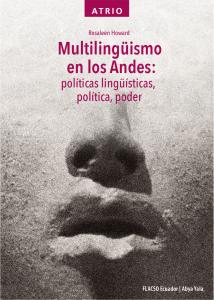
Fecha de publicación
28-08-2025
Series
Categorías
Derechos de autor 2025 Editorial FLACSO Ecuador
Detalles sobre esta monografía
Dimensiones físicas
Cómo citar
Multilingüismo En Los Andes: Políticas lingüísticas, política, Poder. 2025. Atrio. Editorial FLACSO Ecuador. https://doi.org/10.46546/2025-67atrio.