
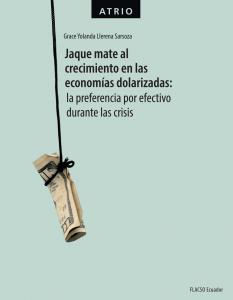
Jaque mate al crecimiento en las economías dolarizadas: la preferencia por efectivo durante las crisis
Sinopsis
A lo largo de la historia del pensamiento, muchos economistas han olvidado la lección de F. A. von Hayek, quien en su obra The Pure Theory of Capital (1941) escribía: It is self-contradictory to discuss a process which admittedly could not take place without money, and at the same time to assume that money is absent or has no effects. Grace Yolanda Llerena Sarsoza, al contrario, toma muy en serio esta lección y nos ofrece un ensayo profundo sobre el dinero, si quieren sobre "el dinero de los demás". ¿Qué significa "dolarización" en un mundo de dinero endógeno, o sea, un mundo donde el monopolio del banco central no es la única forma de creación monetaria? ¿Cómo adaptar las enseñanzas de J. M. Keynes sobre las consecuencias de la preferencia por liquidez al caso de una economía dolarizada en la que preferir efectivo es completamente distinto a preferir depósitos bancarios? ¿Tiene sentido creer que esas consecuencias solo se manifiestan en el corto plazo? En esta magnífica reflexión, lectores y lectoras encuentran las respuestas a tales interrogantes, fundamentales para entender la mecánica de esta expresión crucial del poder estatal y sus limitaciones.
Marco Missaglia
Universidad de Pavia, Italia
Grace Yolanda Llerena Sarsoza. Quito. Doctora en Economía del Desarrollo y máster en Economía del Desarrollo (FLACSO Ecuador). Máster en Estadística Aplicada (ESPOL), con Diplomado en Ciencia de Datos (CEC-EPN). Ingeniera en Ciencias Económicas y Financieras (EPN) y abogada (UTPL). Experta en política económica de economías dolarizadas, con veinte años de trayectoria en el sector público y la academia. Ha sido profesora e investigadora en la EPN, la FLACSO, la UCE, la PUCE, la UDLA y otras universidades. Ha impartido Macroeconomía, Política Económica, Modelos de Equilibrio General Computable, Estadística Multivariante, Muestreo y Metodología de la Investigación. Se desempeñó como asesora en el Banco Central del Ecuador y consultora del Ministerio Coordinador de la Política Económica en temas macroeconómicos. Ha sido consultora para el Banco Mundial, la OIM, el ACNUR y World Vision Ecuador en evaluación de programas, políticas sociales, migración y mercados laborales. En 2025 está coordinando el proyecto emblemático de la FLACSO Ecuador “Modelo Stock-Flow Consistent de transición ecológica para el Ecuador”. En sus publicaciones se reflejan sus líneas de investigación: economía monetaria, dolarización y finanzas con enfoque de ciencia de datos, crecimiento económico, estabilización macroeconómica, finanzas públicas, distribución del ingreso y modelos Stock-Flow Consistent.
https://orcid.org/0000-0001-8342-3321
Forma de citar: Llerena Sarzosa, Grace Yolanda. 2025. Jaque mate al crecimiento en las economías dolarizadas: la preferencia por efectivo durante las crisis. Quito: FLACSO Ecuador. https://doi.org/10.46546/2025-75atrio
Referencias
Arestis, Philip, y Malcom Sawyer. 2006. “The Natures and Role of Monetary Policy when Money is Endogenus”. Cambridge Journal Economics 30 (6): 847-860. https://doi.org/10.1093/cje/bel023
Asensio, Angel. 2017. “Insights on Endogenous Money and the Liquidity Preference Theory of Interest”. Journal of Post Keynesian Economics 40 (3): 327-348. https://doi.org/10.1080/01603477.2017.1319248
Asimakopulos, Athanasios. 1983. “Kalecki and Keynes on Finance, Investment and Saving”. Cambridge Journal of Economics 7 (3-4): 221-233.
Berg, Andrew, y Eduardo Borensztein. 2000. Full Dollarization: The Pros and Cons. Washington DC: FMI (Fondo Monetario Internacional).
Bernanke, Ben, y Alan Blinder. 1988. “Credit, Money, and Aggregate Demand”. American Economic Review, Papers and Proceedings 78 (2): 435-439. https://www. jstor.org /stable/1818164
Bernanke, Ben, Mark Gertler y Simon Gilchrist. 1996. “The Financial Accelerator and the Flight in Quality”. Review of Economics and Statistics 78 (1): 1-15. https://doi.org/10.2307/2109844
Bertocco, Giancarlo. 2006. Some observations about the endogenous money theory. Varese: Università degli Studi dell’Insubria.
Bezemer, Dirk. 2010. “Understanding Financial Crisis through Accounting Models”. Accounting, Organizations and Society 35 (7): 676-688. https://doi.org/10.1016/j.aos.2010.07.002
Black, Lamont, y Richard Rosen. 2007. “How the Credit Channel Works: Differentiating the Bank Lending Channel and Balance Sheet Channel”. Working Paper, Federal Reserve Bank of Chicago.
Blecker, Robert. 1999. “Kaleckian Macro Models for Open Economies”. En Foundations of International Economics: Post Keynesian Perspectives, editado por Johan Deprez y John T. Harvey, 116-149. Londres: Routledge.
Blecker, Robert. 2010. “Open economy models of distribution and growth”. Documento presentado en la Reunión Anual de la Asociación Económica del Este, Filadelfia, PA, 28 de febrero. http://fs2.american.edu/blecker/www/research/bleckeropeneconomymodels.pdf
Blecker, Robert. 2011. “Open Economy Models of Distribution and Growth”. En A Modern Guide to Keynesian Macroeconomics and Economic Policies, editado por Eckhard Hein y Engelbert Stockhammer, 215-239. Cheltenham: Edward Elgar Publishing Ltd.
Blinder, Alan S., y Robert Solow. 1974. “Analytical Foundations of Fiscal Policy”. En The Economics of Public Finance: Essays, 3-115. Washington DC: Brookings Institution.
Branson, William H. 1989. Macroeconomic Theory and Policy. Nueva York: Harper and Row.
Burgess, Stephen, Oliver Burrows, Antoine Godin, Stephen Kinsella y Stephen Millard. 2016. “A Dynamic Model of Financial Balances for the United Kingdom”. Working Paper, Bank of England Staff.
Calvo, Guillermo. 1999a. On Dollarization. Maryland: University of Maryland.
Calvo, Guillermo. 1999b. Testimony on Full Dollarization. Washington: Subcommittees on Economic Policy and International Trade and Finance.
Calvo, Guillermo, y Carlos Alfredo Rodríguez. 1977. “A Model of Exchange Rate Determination under Currency Substitution and Rational Expectations”. Journal of Political Economy 85 (3): 617-625. https://doi.org/10.1086/260586
Calvo, Guillermo, y Carlos Vegh. 1992. “Currency Substitution in Developing Countries: An Introduction”. Revista de Análisis Económico, 7: 3-27. https://doi.org/10.5089/9781451845884.001
Calvo, Guillermo, y Carlos Vegh. 1995. “From Currency Substitution to Dollarization and Beyond: Analytical and Policy Issues”. En Essays on Money. Inflation, and Output, editado por Guillermo Calvo, 45-76. Cambridge: MIT Press.
Calvo, Guillermo, y Carmen Reinhart. 1999. “When Capital Inflows Come to a Sudden Stop: Consequences and Policy Options”. Document MRA, University Library of Munich.
Carlin, Wendy, y David Soskice. 2005. The 3-Equation New Keynesian Model: A Graphical Exposition. Contributions to Macroeconomics 5 (1): 1-36.
Carlin, Wendy, y David Soskice. 2006. Macroeconomics: Imperfections, Institutions and Policies. Oxford: Oxford University Press.
Caverzasi, Eugenio, y Antoine Godin. 2013. “Stock-Flow Consistent Modeling Through the Ages”. Working Paper n.° 745, Levy Economics Institute of Bard College.
Cooper, Richard. 1972. “Currency Devaluation in Developing Countries”. En Economic Theory, Econometrics, and Mathematical Economics, editado por John M. Letiche, 742-770. Cambridge: Academic Press.
Cripps, Francis, y Wynne Godley. 1976. “A formal analysis of the Cambridge Economic Policy Group Model”. Económica 43 (172): 335-348. https://doi.org/10.2307/2553270
Davidson, Paul. 2003. “¿Cuáles son los elementos esenciales de la Teoría Monetaria Post¬Keynesiana?”. En Théories Monétaires Post Keynésiennes, editado por Pierre Piégay y Louis-Philippe Rochon, 27-45. París: Ediciones Económicas.
Deleplace, Ghislain, y Edward Nell. 1996. “Introduction: Monetary Circulation y Effective Demand”. En Money in Motion. The Post Keynesian and Circulation Approaches, editado por Ghislain Deleplace y Edward Nell, 3-41. Londres: Palgrave Macmillan.
Díaz-Alejandro, Carlos. 1963. Exchange Rate Devaluation in a Semi-Industrialized Country: The Experience of Argentina, 1955-1961. Cambridge: MIT Press.
Dos Santos, Claudio. 2003. “Three Essays on Stock-Flow Consistent Macroeconomic Modeling”. Tesis de doctorado, New School for Social Research.
Dos Santos, Claudio H., y Gennaro Zezza. 2004. A Post-Keynesian Stock-Flow Consistent Macroeconomic Growth Model: Preliminary Results. Working Paper No. 402. The Levy Economics Institute of Bard College.
Dos Santos, Claudio H., y Gennaro Zezza. 2005. A Simplified Stock-Flow Consistent Post-Keynesian Growth Model. Working Paper Nro. 421, Levy Economics Institute of Bard College. http://dx.doi.org/10.2139/ssrn.696242.
Dos Santos, Claudio H., y Gennaro Zezza. 2008. “A Simplified, ‘Benchmark,’ Stock-Flow Consistent Post-Keynesian Growth Model”. Metroeconomica 59 (3): 441-478. https://doi.org/10.1111/j.1467-999X.2008.00316.x
Dos Santos, Claudio, y Antonio Macedo e Silva. 2009. “Revisiting (and Connecting) Marglin Bhaduri and Minsky: An SFC Look at Financialization and Profit-Led Growth”. Working Paper 567, Levy Economics Institute of Bard College.
Dow, Alexander, y Dow Sheila. 1989. “Endogenous Money Creation and Idle Balances”. En New Directions in Post-Keynesian Economics, editado por John Pheby, 147-164. Aldershot, Brookfield, Vt: Edward Elgar.
Dow, Alexander, y Dow Sheila. 2006. The History of Scottish Economic Thought. Londres: Routledge.
Duncan, Roberto. 2003. “Exploring the Implications of Official Dollarization on Macroeconomic Volatility”. Working Paper, Banco Central de Chile.
Dullien, Sebastian. 2011. “The New Consensus from a Traditional Keynesian and post¬Keynesian Perspective: A Worthwhile Foundation for Research or Just a Waste of Time?”. Économie Allpiguée, 64: 173-200.
Dutt, Amitava. 1990. Growth, Distribution, and Uneven Development. Cambridge: Cambridge University Press.
Duwicquet, Vincent, y Jacques Mazier. 2010. “Financial Integration and Macroeconomic Adjustments in a Monetary Union”. Journal of Post Keynesian Economics 33 (2): 333-370.
Duwicquet, Vincent, Jacques Mazier y Jamel Saadaoui. 2012. “Exchange Rate Misalignments, Fiscal Federalism and Redistribution: How to Adjust in a Monetary Union”. Working Paper, Conference on Economic Policy Issues in the European Union.
Edwards, Sebastian. 2001a. “Dollarization Myths and Realities”. Journal of Policy Modeling 23 (3): 249-266. https://doi.org/10.1016/S0161-8938(01)00045-X
Edwards, Sebastian. 2001b. “Dollarization and Economic Performance: An Empirical Investigation”. Working Paper, National Bureau of Economic Research.
Edwards, Sebastian, e Igal Magendzo. 2001. “Dollarization, Inflation and Growth”. Working Paper, National Bureau of Economic Research.
Eichner, Alfred. 1987. The Macrodynamics of Advanced Market Economies. Nueva York: M.E. Sharpe.
Epstein, Gerald. 2003. “Alternatives to inflation targeting monetary policy for stable and egalitarian growth: a brief research summary”. Working Paper, University of Massachusetts.
Escobar-Espinoza, Andrés. 2016. “Stock-Flow Consistent models for developing countries: the case of Colombia”. Working Paper, Annual Conference on Global Economic Analysis.
Foley, Duncan, y Lance Taylor. 2004. “A Heterodox Growth and Distribution Model”. Working Paper presentado en la conferencia The Growth and Distribution Conference, University of Pisa, del 16 al 19 de junio.
FMI (Fondo Monetario Internacional). 2009. Manual de Balanza de Pagos y Posición de Inversión. Sexta edición. Washington DC: FMI.
Fontana, Giuseppe. 2004. “Rethinking Endogenous Money: A Constructive Interpretation of the Debate Between Horizontalists and Structuralists”. En Money, Credit, and the Role of the State: Essays in Honour of Augusto Graziani, editado por Richard Arena y Nira Salvadori, 371-393. Aldershot, Hsnyd: Ashgate.
Fontana, Giuseppe. 2006. “Telling Better Stories in Macroeconomic Textbooks: Monetary Policy, Endogenous Money and Aggregate Demand”. En Complexity, Endogenous Money and Macroeconomic Theory: Essays in Honour of Basil J. Moore, editado por Mark Setterfield, 353-367. Cheltenham: Edward Elgar.
Fontana, Giuseppe, y Alfonso Palacio-Vera. 2007. “Are long-run price stability and short-run output stabilization all that monetary policy can aim for?”. Metroeconomica 58 (2): 269-298. https://doi.org/10.1111/j.1467-999X.2007.00268.x
Fontana, Giuseppe, y Mark Setterfield. 2009. Macroeconomic Theory and Macroeconomic Pedagogy. Londres: Palgrave Macmillan.
Frenkel, Roberto. 2008. “From the Boom in Capital Inflows to Financial Traps”. En Capital Market Liberalization and Development, editado por José Antonio Ocampo y Joseph E. Stiglitz, 101-120. Nueva York: Oxford University Press.
Galí, Jordi. 2008. Monetary Policy, Inflation and Business Cycle. An Introduction to the New Keynesian Framework. Nueva Jersey: Princeton University Press.
Gehrels, Franz. 1957. “Government Debt as a Generator of Economic Growth”. The Review of Economics and Statistics 39 (2): 183-192.
Godley, Wynne. 1996. “Money, Finance and National Income Determination: An Integrated Approach”. Working Paper n.° 167, Levy Economics Institute of Bard College.
Godley, Wynne. 1999a. “Seven Unsustainable Processes: Medium¬Term Prospects and Policies for the United States and the World”. Special Report, Levy Economics Institute.
Godley, Wynne. 1999b. “Money and Credit in a Keynesian Model of Income Determination”. Cambridge Journal of Economics 23 (4): 393-411. https://doi.org/10.1093/cje/23.4.393
Godley, Wynne. 2004. “Weaving Cloth from Graziani’s Thread: Endogenous Money in a Simple (but complete) Model”. En Money, Credit and the Role of the State: Essays in Honour of Augusto Graziani, editado por Richard Arena y Neri Salvadori, 127-135. Farnham: Ashgate Publishing, Ltd.
Godley, Wynne. 2007. Monetary Economics: An Integrated Approach to Credit, Money, Income, Production, and Wealth. Palgrave Macmillan.
Godley, Wynne. 2012. “Macroeconomics without Equilibrium or Disequilibrium”. En The Stock-Flow Consistent Approach: Selected Writings of Wynne Godley, editado por Marc Lavoie y Gennaro Zezza, 90-122. Basingstoke: Palgrave Macmillan.
Godley, Wynne, y Francis Cripps. 1983. Macroeconomics. Londres: Oxford University Press.
Godley, Wynne, y Marc Lavoie. 2003. Monetary Economics: An Integrated Approach to Credit, Money, Income, Production and Wealth. Londres: Palgrave Macmillan.
Godley, Wynne, y Marc Lavoie. 2006. “Comprehensive accounting in simple open economy macroeconomics with endogenous sterilization or flexible exchange rates”. Journal of Post Keynesian Economics 28 (2): 241-276. https://www.tandfonline.com/doi/abs/10.2753/PKE0160-3477280205
Godley, Wynne, y Marc Lavoie. 2007. Monetary Economics: An Integrated Approach to Credit, Money, Income, Production and Wealth. Basingstoke: Palgrave Macmillan.
Godley, Wynne, y Gennaro Zezza. 1992. “A Simple Stock Flow Model of the Danish Economy”. En Themes in Modern Macroeconomics, editado por Helge Bring, 140¬-179. Londres: Palgrave Macmillan.
Godley, Wynne, y Gennaro Zezza. 2006. “Debt And Lending: A Cri De Coeur”. Economics Policy Note Archive 06-4.
Goldfajn, Ilan, y Gino Olivares. 2000. “Is Adopting Full Dollarization the Solution? Looking at the Evidence”. Working Paper, Pontifícia Universidade Católica do Rio de Janeiro.
Graziani, Augusto. 1990. “La teoría del circuito monetario”. Coyuntura Colombiana 14 (3): 67-96.
Hausmann, Ricardo. 1999. “Should There Be Five Currencies or One Hundred and Five?”. Foreign Policy, 116: 65-79. https://doi.org/10.2307/1149644
Hein, Eckhard. 2010. The Rate of Interest as a Macroeconomic Distribution Parameter: Horizontalism and Post-Keynesian Models of Distribution of Growth. Berlín: Institute for International Political Economy Berlín.
Hirschman, Albert. O. 1949. “Devaluation and the Trade Balance: A Note”. The Review of Economics and Statistics 31 (1): 50-53.
Howells, Peter. 2009. “Money and Banking in a Realistic Macro Model”. En Macroeconomics Theory and Macroeconomic Pedagogy, editado por Giuseppe Fontana y Mark Setterfield, 160-187. Palgrave Macmillan.
Izurieta, Alex. 2002. “Dollarization: A Dead End”. Working Paper, Levy Institute of Economics.
Izurieta, Alex. 2003. “Dollarization as a Tight Rein on the Fiscal Stance”. En Dollarization: Lessons from Europe and the Americas, editado por Louis-Philippe Rochon y Mario Seccareccia, 143-164. Londres: Routledge.
Juniper, James, y William Mitchell. 2007. “Towards a Spatial Keynesian Economics”. En Advances in Monetary Policy and Macroeconomics, editado por Philip Arestis y Gennaro Zezza, 192-211. Nueva York: Palgrave Macmillan.
Kacef, Osvaldo, y Sandra Manuelito. 2008. El ingreso nacional bruto disponible en América Latina: una perspectiva de largo plazo. Santiago de Chile: CEPAL.
Kaldor, Nicolás. 1970. “The New Monetarism”. Lloyds Bank Review, 97: 1-17.
Kalecki, Michal. 1971. Selected Essays in the Dynamics of Capitalist Economy. Cambridge: Cambridge University Press.
Kalecki, Michal. 1973. Estudios sobre la Teoría de los Ciclos Económicos. Barcelona: Editorial Ariel.
Keen, Steve. 2014. “Endogenous Money and Effective Demand”. Review of Keynesian Economics 2 (3): 271-291. https://doi.org/10.4337/roke.2014.03.01
Keynes, John Maynard. 1933. A Monetary Theory Production. Múnich: Festschrift für Spiethoff.
Keynes, John Maynard. 1936. The General Theory of Employment, Interest and Money. Londres: Palgrave Macmillan.
Keynes, John Maynard. (1937) 2017. “Teorías alternativas de la tasa de interés”. Revista de Economía Institucional 19(36): 335-346.
Keynes, John Maynard. 1943. Teoría general de la ocupación, el interés y el dinero. Traducido por Eduardo Hornedo. Ciudad de México / Buenos Aires: Fondo de Cultura Económica.
Khalil, Saed, y Stephen Kinsella. 2010. “Simulating Financial Integration: A Stock-Flow Consistent Perspective”. Eastern Economic Association 36 (1): 11-49.
Kiel, Frederik. 2018. “A Stock-Flow Consistent Empirical Model of the Danish Economy”. Tesis de maestría, Aalborg University.
Kinsella, Stephen, y Tiou-Tagba Aliti. 2013. “Modeling Moments of Crisis: The Case of Ireland”. Journal of Economic Issues 47 (2): 561-566. http://doi.org/10.2139/ssrn.2241593
Kinsella, Stephen, y Saed Khalil. 2011. “Debt-deflation in a Stock-Flow Consistent macromodel”. En Contributions in Stock-flow Consistent Modeling: Essays in Honor of Wynne Godley, editado por Dimitri Papadimitriou y Gennaro Zezza, 235-265. Basingstoke: Palgrave Macmillan.
Krugman, Paul. 2000. “How Complicated Does the Model Have to Be?”. Oxford Review of Economic Policy 16 (4): 33-42. https://doi.org/10.1093/oxrep/16.4.33
Krugman, Paul, y Lance Taylor. 1978. “Contractionary Effects of Devaluations”. Journal of International Economics 8 (3): 445-456. https://doi.org/10.1016/0022-1996(78)90007-7
Lainà, Patrizio. 2018. “Money Creation Under Full-Reserve Banking: A Stock-Flow Consistent Model”. Working Paper, Levy Economics Institute.
Larraín, Felipe, y Jeffrey Sachs. 2004. Macroeconomía en la economía global. Buenos Aires: Pearson Education.
Lavoie, Marc. 1986. L’endogénéité de la monnaie chez Keynes. Recherches Économiques de Louvain 52 (1): 67-84.
Lavoie, Marc. 1992. Foundations of Post-Keynesian Economic Analysis. Cheltenham: Edward Elgar Publishing.
Lavoie, Marc. 1995. “The Kaleckian Model of Growth and Distribution and its Neo-Ricardian and Neo-Marxian Critiques”. Cambridge Journal of Economics 19 (6) 789-818. https://doi.org/10.1093/oxfordjournals.cje.a035341
Lavoie, Marc. 1996a. Foundations of Post-Keynesian Economic Analysis. Edward Elgar Publishing.
Lavoie, Marc. 1996b. “Monetary Policy in an Economy with Endogenous Credit Money”. En Money in Motion: The Post Keynesian and Circulation Approaches, G. Deplace & E. J. Nell, 532-545. Londres: Macmillan.
Lavoie, Marc. 1996c. “Horizontalism, structuralism, preference for liquidity and the principle of increasing risk”. Scottish Journal of Political Economy 43(3): 275-300. (Reimpreso en Post-Keynesian Economics, Volume II: Credit, Money and Production, The International Library of Critical Writings in Economics, editado por Louis-Philippe Rochon y Sergio Rossi, Cheltenham, UK y Northampton, MA: Edward Elgar Publishing, 2017; y en Post-Keynesian Monetary Theory: Selected Essays, Marc Lavoie, Cheltenham, UK y Northampton, MA: Edward Elgar Publishing, 2020).
Lavoie, Marc. 1999. “The Credit-Led Supply of Deposits and the Demand for Money: Kaldor’s Reflux Mechanism as Previously Endorsed by Joan Robinson”. Cambridge Journal of Economics 23 (1): 103-114. https://doi.org/10.1093/cje/23.1.103
Lavoie, Marc. 2014. Post-Keynesian Economics: New Foundations. Cheltenham: Edward Elgar Publishing Ltd.
Lavoie, Marc, y Gauthier Daigle. 2011. “A Behavioural Finance Model of Exchange Rate Expectations within a Stock-Flow Consistent Framework”. Metroeconomica 62 (3): 434-458. https://doi.org/10.1111/j.1467-999X.2010.04116.x
Lavoie, Marc, y Wynne Godley. 2001. “Kaleckian Growth Models in a Stock and Flow Monetary Framework: A Kaldorian View”. Journal of Post Keynesian Economics 24 (2): 277-311. https://doi.org/10.1080/01603477.2001.11490327
Lavoie, Marc, y Jun Zhao. 2010. “A Study of the Diversification of China’s Foreign Reserves within a Three-Country Stock-Flow Consistent Model”. Metroeconomica 61 (3): 558-592. https://doi.org/10.1111/j.1467-999X.2009.04082.x
Lavoie, Marc, y Mario Seccareccia. 1999. “Interest rate: fair”. En Encyclopedia of Political Economy, vol. 1, editado por Phillip O’Hara, 543-565. Londres: Routledge.
Lavoie, Marc, y Severin Reissl. 2019. “Further Insights on Endogenous Money and the Liquidity Preference Theory of Interest”. Journal of Post Keynesian Economics 42 (4): 503-526. https://doi.org/10.1080/01603477.2018.1548286
Le Heron, Edwin, y Nicolás Yol. 2019. “The Macroeconomic Effects of Migrants’ Remittances in Moldova: A Stock-Flow Consistent Model”. European Journal of Economics and Economic Policies: Intervention 16 (1): 31-54. https://doi.org/10.4337/ejeep.2018.0039
Lizano, Eduardo. 2000. “Dolarización es inevitable para las economías más pequeñas de la región”. El Diario, 14 de diciembre.
Llerena-Sarsoza, Grace. 2009. “Soberanía monetaria y crecimiento económico: análisis del caso ecuatoriano período 1990-2006. Una aproximación institucional a los efectos de la política monetaria en el crecimiento económico”. Tesis de grado, Escuela Politécnica Nacional. https://bibdigital.epn.edu.ec/handle/15000/1112
Llerena-Sarsoza, Grace. 2016. “Vínculos monetarios y fiscales con las políticas de estabilización”. Revista Economía 68 (108): 35-58. https://doi.org/10.29166/economia.v68i108.2020
Lucas, Robert E. 1976. “Econometric Policy Evaluation: A Critique”. Carnegie-Rochester Conference Series on Public Policy 1, 19-46. https://doi.org/10.1016/S0167-2231(76)80003-6
Makrelov, Konstantin, Channing Arndt, Rob Davies y Laurence Harris. 2018. “Stock-and-Flow-Consistent Macroeconomic Model for South Africa”. Working Paper, World Institute for Development Economic Research.
Marx, Karl. (1867) 1996. El Capital. Crítica de la economía política. Tomo I. México D.F.: Siglo XXI.
Mazier, Jacques, y Gnanonobodom Tiou-Tagba Aliti. 2012. “World Imbalances and Macroeconomic Adjustments: A Three-Country Stock-Flow Consistent model with fixed or flexible prices”. Metroeconomica 63 (2): 358-388. https://doi.org/10.1111/j.1467-999X.2011.04141.x
Mendoza, Enrique. 2001. “The Benefits of Dollarization when Stabilization Policy Lacks Credibility and Financial Markets are Imperfect”. Journal of Money, Credit, and Banking 33 (2): 440-474. https://doi.org/10.2307/2673910
Mendoza, Enrique. 2002. “Why Should Emerging Economies Give Up National Currencies: A Case for ‘Institutions Substitutions’”. Working Paper, National Bureau of Economic Research.
Meyer, Laurence. 2001. “Does Money Matter?”. Federal Reserve Bank of St. Louis Review 83 (4): 1-15. https://bit.ly/3rjFTPJ
Miess, Michael y Stefan Schmelzer. 2016a. “Extension of the Empirical Stock-Flow Consistent (SFC) Model for Austria, Vienna”. Working Paper, Institute for Advanced Studies.
Miess, Michael y Stefan Schmelzer. 2016b. “Stock-Flow Consistent Modelling of Real-Financial Cycles and Balance Sheet Dynamics”. Working Paper para la 13th EUROFRAME Conference.
Minsky, Hyman. 1957. “Central Banking and Money Market Changes”. Quarterly Journal of Economics 71 (2): 171-187.
Minsky, Hyman. 1975. John Maynard Keynes. Nueva York: Columbia University Press.
Minsky, Hyman. 1986. Stabilizing an Unstable Economy. New Haven: Yale University Press.
Modigliani, Franco, y Richard Brumberg. 1954. “Utility Analysis and the Consumption Function”. En Post-Keynesian Economics, editado por Keneth Kurihara, 388-436. Rutgers University Press.
Moore, Basil. 1988. Horizontalist and Verticalists. The Macroeconomics of Credit Money. Cambridge: Cambridge University Press.
Moore, Basil. 1994. “The Demise of the Keynesian Multiplier: A Reply to Cottrell”. Journal of Post-Keynesian Economics 17 (1): 121-134. https://www.jstor.org/stable/4538425
Mosler, Warren, y Mathew Forstater. 2004. “The Natural Rate of Interest Is Zero”. Working Paper, University of Missouri.
Moudud, Jamee. 1998. “Endogenous Growth Cycles and Money in an Open Economy: A Social Accounting Matrix Approach”. Tesis de doctorado, New School for Social Research.
Nikiforos, Michalis, y Gennaro Zezza. 2017. “Stock-Flow Consistent Macroeconomic Models: A Survey”. Journal of Economic Surveys 31 (5): 1204-1239. https://doi.org/10.1111/joes.12221
Ocampo, José Antonio. 2011. “Macroeconomía para el desarrollo: políticas anticíclicas y transformación productiva”. Revista de la CEPAL, 104: 7-35. https://hdl.handle.net/11362/11457
Palley, Thomas. 2006. “A Post-Keynesian Framework for Monetary Policy: Why Interest Rate Operating Procedures Are Not Enough”. En Post-Keynesian Principles of Economic Policy, editado por Claude Gnos y Louis-Philippe Rochon, 78-98. Cheltenham: Edward Elgar Publishing Ltd.
Palley, Thomas. 2013. “Horizontalists, Verticalists, and Structuralists: The Theory of Endogenous Money Reassessed”. Review of Keynesian Economics 1 (4): 406-424. https://doi.org/10.4337/roke.2013.04.03
Panizza, Ugo, Ernesto Stein y Ernesto Talvi. 2000. “Measuring Costs and Benefits of Dollarization: An Application to Central American and Caribbean Countries”. Working Paper, Inter-American Development Bank.
Papadimitriou, Dimitri, Michalis Nikiforos y Gennaro Zezza. 2013a. “A Levy Institute Model for Greece”. Working Paper, Levy Economics Institute.
Papadimitriou, Dimitri, Michalis Nikiforos y Gennaro Zezza. 2013b. “The Greek Economic Crisis and the Experience of Austerity”. Strategic Analysis, Levy Economics Institute.
Parguez, Alain, y Mario Seccareccia. 2000. “The Credit Theory of Money: The Monetary Circuit Approach”. En What is Money?, editado por John Smithin, 101-123. Londres: Routledge.
Passarella, Marco Veronese. 2019. “From Abstract to Concrete: Some Tips for Developing an Empirical Stock-Flow Consistent”. European Journal of Economics and Economic Policies: Intervention 16 (1): 55-93. https://doi.org/10.4337/ejeep.2019.0044
Pasinetti, Luigi. 1981. Structural Change and Economic Growth. Cambridge: Cambridge University Press.
Pasinetti, Luigi. 1993. Structural Economic Dynamics: A Theoretical Essay on the Dynamics of the Wealth of Nations. Cambridge: Cambridge University Press.
Patinkin, Don. 1965. Money, Interest and Prices: An integration of Monetary and Value Theory. Nueva York: Harper and Row.
Piégay, Pierre, y Louis-Philippe Rochon. 2005. “Teorías monetarias post-keynesianas: una aproximación de la escuela francesa”. Problemas del Desarrollo. Revista Latinoamericana de Economía 36 (143): 1-25. https://bit.ly/36JFw7D
Pigou, Arthur C. 1947. “Economic Progress in a Stable Environment”. Economica 14 (55): 180-188.
Pollin, R. 1991. “Two Theories of Money Supply Endogeneity: Some Empirical Evidence”. Journal of Post Keynesian Economics 13 (3): 366-396.
Ratna, Sahay, y Carlos A. Végh Gramont. 1995. “Dollarization in Transition Economies: Evidence and Policy Implications”. Working Paper, FMI. https://doi.org/10.5089/9781451950083.001
Raza, Hamid, Bjorn Runar Gudmundsson, Gylfi Zoega y Mikael Randrup Byrialsen. 2019. “Crises and Capital Controls in Small Open Economies: A Stock-Flow Consistent Approach”. European Journal of Economics and Economic Policies: Intervention 16 (1): 94-133. https://doi.org/10.4337/ejeep.2019.0042
Robinson, Joan. 1956. The Accumulation of Capital. Londres: Palgrave Macmillan.
Robinson, Joan. 1962. Essays in the Theory of Economic Growth. Londres: Macmillan.
Rochon, Louis-Philippe. 1999. Credit, Money and Production. An Alternative Post-Keynesian Approach. Cheltenham: Edward Elgar Publishing Ltd.
Rochon, Louis-Philippe, y Mark Setterfield. 2007a. “The Political Economy of Interest¬Rate Setting, Inflation, and Income Distribution”. International Journal of Political Economy 37 (2): 5-25.
Rochon, Louis-Philippe, y Mark Setterfield. 2007b. “Post Keynesian Interest Rate Rules and Macroeconomic Performance: A Comparative Evaluation”. Journal of Post Keynesian Economics 30 (1): 13-41.
Rochon, Louis-Philippe, y Mark Setterfield. 2008. “The Political Economy of Interest-Rate Setting, Inflation, and Income Distribution”. International Journal of Political Economy 37 (2): 5-25. https://doi.org/10.2753/IJP0891-1916370201
Rochon, Louis-Philippe, y Mario Seccareccia. 2003. Dollarization: Lesson from Europe and the Americas. Londres: Routledge.
Rogers, C. 1989. Money, Interest and Capital: A Study in the Foundations of Monetary Theory. Cambridge: Cambridge University Press.
Romer, David. 2012. Advanced Macroeconomics. Nueva York: McGraw-Hill.
Rousseas, Stephen. 1986. Post Keynesian Monetary Economics. Nueva York: Sharpe.
Rowthorn, Robert. 1977. “Conflict, Inflation and Money”. Cambridge Journal of Economics 1 (3): 215-239.
Savastano, Miguel. 1999. “Fondo Monetario Internacional”. En Conferencias. Dolarizar la economía peruana: riesgos y oportunidades, editado por Fritz Du Bois y Eduardo Morón, 43-56. Lima: Instituto Peruano de Economía.
Schlicht, Ekkehart. 2005. Isolation and Aggregation in Economics. Cheltenham, Berlín, Nueva York, Tokio: Springer-Verlag.
Schmitt-Grohé, Stephanie, y Martín Uribe. 2001a. “Stabilization Policy and the Costs of Dollarization”. Journal of Money, Credit, and Banking 33 (2): 482-509. https://doi.org/10.2139/ssrn.224056
Schmitt-Grohé, Stephanie, y Martín Uribe. 2001b. “Optimal Fiscal and Monetary Policy Under Sticky Prices”. Working Paper 9220, National Bureau of Economic Research.
Schuler, Kurt. 1999. “La alternativa de dolarizar”. En Conferencias. Dolarizar la economía peruana: riesgos y oportunidades, editado por Fritz Du Bois y Eduardo Morón, 18¬36. Lima: Instituto Peruano de Economía.
Schumpeter, Joseph. A. 1934. The Theory of Economic Development: An Inquiry into Profits, Capital, Credit, Interest, and the Business Cycle. Cambridge, Mass: Harvard University Press.
Sidrauski, Miguel. 1967. “Rational Choice and Patterns of Growth in a Monetary Economy”. American Economic Review 57 (2): 534-544.
Skott, Peter, y Soon Ryoo. 2008. “Macroeconomic Implications of Financialization”. Cambridge Journal of Economics 32 (6): 827-862. https://doi.org/10.1093/cje/ben012
Smithin, John. 1994. Controversies in Monetary Economics: Ideas, Issues and Policy. Cheltenham: Edward Elgar Publishing Ltd.
Smithin, John. 1996. Macroeconomic Policy and the Future of Capitalism: The Revenge of the Rentiers and Threat to Prosperity. Cheltenham: Edward Elgar.
Smithin, John. 2007. “A Real Interest Rate Rule for Monetary Policy?”. Journal of Post Keynesian Economics 30 (1): 101-118. https://doi.org/10.2753/PKE0160-3477300105
Sraffa, Piero. 1960. Production of Commodities by Means of Commodities: Prelude to a Critique of Economic Theory. Cambridge: Cambridge University Press.
Taylor, Lance. 1983. Structuralist Macroeconomics: Applicable Models for the Third World. Nueva York: Basic Books.
Taylor, Lance. 1990. Socially Releevant Policy Analysis. Structuralist Computable General Equilibrium Models for the Developing World. Cambridge, Mass, Londres: MIT Press.
Taylor, Lance. 1991. Income Distribution, Inflation and Growth: Lectures on Structuralist Macroeconomic Theory. Cambridge, MA: MIT Press.
Taylor, Lance. 2004. “Exchange Rate Indeterminacy in Portfolio Balance, Mundell-Fleming and Uncovered Interest Rate Parity Models”. Cambridge Journal of Economics 28 (2): 205-227. https://doi.org/10.1093/cje/28.2.205
Tcherneva, Pavlina. 2013. “Reorienting Fiscal Policy: A Critical Assessment of Fiscal Fine-Tuning”. Working Paper, Levy Economics Institute.
Tobin, James. 1980. Asset Accumulation and Economic Activity. Chicago: University of Chicago Press.
Tobin, James. 1982. “Money and the Macroeconomic Process”. Journal of Money, Credit and Banking 14 (2): 171-204. https://doi.org/10.2307/1991638
Turnovsky, Stephen J. 2000. Methods of Macroeconomic Dynamics. Cambridge, Mass: MIT Press.
Tymoigne, Éric, y Randal Wray. 2013. “Modern Money Theory 101: A Reply to Critics”. Working Paper, Levy Economics Institute.
Valdecantos, Sebastián. 2012. “Macroeconomic Dynamics in Argentina in the Light of a Structuralist post Keynesian Stock-Flow Consistent Model”. Working Paper, V Jornadas de Economía Crítica.
Vianello, Fernando. 1985. “The Pace of Accumulation”. Political Economy 1 (1): 69-87.
Walsh, Carl. 2010. Monetary Theory and Policy. 3.a ed. Cambridge: The MIT Press.
Weintraub, Sidney. 1958. An Approach to the Theory of Income Distribution. Filadelfia: Chilton.
Weintraub, Sidney. 1978. Capitalism’s Inflation and Unemployment Crisis: Beyond Monetarism and Keynesianism. Reading, Mass: Addison-Wesley.
Wicksell, Knut. 1898. Interest and Prices. Londres: Royal Economic Society.
Wolfson, Martin. 1996. “A Post Keynesian Theory of Credit Rationing”. Journal of Post-Keynesian Economics 18 (3): 443-470. https://doi.org/10.1080/01603477.1996.11490081
Woodford, Michael. 2003. Interest and Prices: Foundations of a Theory of Monetary Policy. Nueva Jersey: Princeton University Press.
Wray, Randall. 1992. “Alternative Theories of the Rate of Interest”. Cambridge Journal of Economics 16 (1): 69-91.
Wray, Randall. 1997. “Deficits, inflation, and monetary policy”. Journal of Post Keynesian Economics 19(4): 543-572.
Wray, Randall. 1998. Understanding Modern Money. Cheltenham, UK, Northampton, MA: Edward Elgar.
Wray, Randall. 2000. “Modern Money”. En What is Money?, editado por John Smithin, 42-66. Londres: Routledge.
Zezza, Francesco. 2017. “Stock-Flow Consistent Macroeconomic Models: From Theory to Practice”. Working Paper, Levy Economics Institute.
Wray, Randall. 2018. “Stock-Flow Consistent Macroeconomic Models: Theory, Practice and Applications”. Tesis doctoral, University of Siena.
Zezza, Gennaro, y Francesco Zezza. 2019. “On the Design of Empirical Stock-Flow Consistent Models”. Working Paper, Levy Economics Institute.
Fecha de publicación
18-12-2025
Series
Categorías
Derechos de autor 2025 Editorial FLACSO Ecuador
Detalles sobre esta monografía
Dimensiones físicas
Cómo citar
Jaque Mate Al Crecimiento En Las economías Dolarizadas: La Preferencia Por Efectivo Durante Las Crisis. 2025. Atrio. Editorial FLACSO Ecuador. https://doi.org/10.46546/2025-75atrio.