
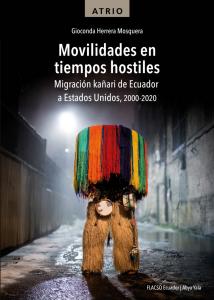
Movilidades en tiempos hostiles. Migración kañari de Ecuador a Estados Unidos, 2000-2020
Sinopsis
Gioconda Herrera incorpora gran sofisticación analítica y años de involucramiento a este libro sobre las experiencias de movilidad restringida de una comunidad indígena que se desplaza entre Ecuador y la Costa este de Estados Unidos. En este texto de escritura muy accesible cobran vida las experiencias humanas de hacer el camino. Al mismo tiempo, la autora detalla las principales fuerzas sociales —en particular los regímenes migratorios y las construcciones de la ilegalidad— que han ejercido una profunda influencia sobre amplias regiones de Cañar, en la Sierra ecuatoriana, y sobre las comunidades migrantes indígenas en Estados Unidos durante el siglo XXI.
Movilidades en tiempos hostiles es un análisis reflexivo, solidario y conmovedor de las vidas de hombres y mujeres de Ecuador y de cómo su predicamento contribuye a desarrollar nuevos conocimientos en los debates existentes en el campo de los estudios migratorios. El libro logra “desnaturalizar” y “desmigrantizar” un campo de investigación a menudo limitado a números y categorías de estatus, a la vez que enlaza el aquí con el allá, el origen con el destino. Al seguir a personas a través de las distintas fases de sus trayectorias, su “desobediencia espacial” y la reconfiguración de su vida familiar a través de las fronteras, este libro —de argumentación brillante y bella exposición— se convierte en mucho más que otro análisis sobre la migración transnacional, pues conecta con cuestiones sociales amplias y relevantes para nuestro mundo contemporáneo.
Ninna Nyberg Sørensen
DIIS - Danish Institute for International Studies
Gioconda Herrera Mosquera. Ph. D. en Sociología por Columbia University. Directora de FLACSO Ecuador para el período 2024-2028. Profesora investigadora del Departamento de Sociología y Estudios de Género de esta universidad desde 1997. Sus líneas de investigación son la sociología de la globalización y las desigualdades sociales, las migraciones internacionales y los estudios de género. Entre otras obras, es autora de “Lejos de tus pupilas”. Familias transnacionales, cuidados y desigualdad social en Ecuador, publicado por FLACSO Ecuador y ONU Mujeres en 2013; editó, junto con Carmen Gómez, Migration in South America. IMISCOE Regional Reader, del año 2022 con el sello Springer. Coordinó, junto con Liliana Rivera-Sánchez y Eduardo Domenech, el libro Movilidades, control fronterizo y luchas migrantes, aparecido en 2022 en una coedición Siglo XXI y CLACSO.
https://orcid.org/0000-0002-7540-9586
Forma de citar: Herrera Mosquera, Gioconda. 2026. Movilidades en tiempos hostiles. Migración kañari de Ecuador a Estados Unidos, 2000-2020. Quito: FLACSO Ecuador / Abya-Yala. https://doi.org/10.46546/2026-77atrio
Referencias
Achilli, Luigi. 2018. “The ‘Good’ Smuggler: The Ethics and Morals of Human Smuggling among Syrians”. Annals of the Academy of Politics and Social Science 676 (1): 77-96. https://doi.org/10.1177/0002716217746641
Achilli, Luigi, y David Kyle. 2023. Global Human Smuggling Buying Freedom in a Retreating World. Baltimore: Johns Hopkins University Press.
Ahmed, Sarah. 2004. The cultural politics of emotions. Londres: Routledge.
Álvarez Velasco, Soledad. 2016. Frontera sur chiapaneca: el muro humano de la violencia. Análisis de la normalización de la violencia hacia los migrantes indocumentados en tránsito. Ciudad de México: Universidad Iberoamericana / CIESAS.
Álvarez Velasco, Soledad. 2023. “Ecuadorean Migrant Smuggling Contemporary Patterns and Dynamics”. En Global Human Smuggling Buying Freedom in a Retreating World, coordinado por Luigi Achilli y David Kyle, 345-370. Baltimore: John Hopkins University Press.
Amelina, Anna. 2021. “After the Reflexive Turn in Migration Studies. Towards the Doing Migration Approach”. Population, Space and Place 27 (1): e2368. https://doi.org/10.1002/psp.2368
Andersson, Rubén. 2014. Illegality, Inc. Clandestine Migration and the Business of Bordering Europe. Los Ángeles: University of California Press.
Asociación de Mujeres Tránsito Amaguaña. 2013. Usos y saberes de las plantas medicinales de la parroquia de Zhud. Quito: FLACSO Ecuador / Commission Universitaire pour le Développement (CUD) / Asociación de Mujeres Tránsito Amaguaña.
Baird, Theodore, e Ilse van Liempt. 2015. “Scrutinising the double disadvantage: knowledge production in the messy field of migrant smuggling”. Journal of Ethnic and Migration Studies 42 (3): 400-417. https://doi.org/10.1080/1369183X.2015.1103172
Balarezo, Susana. 1980. “Vías de desarrollo y economía campesina, el caso Cañar”. Tesis de maestría, FLACSO Ecuador. https://bit.ly/3jdthKc
Baldassar, Loretta, y Laura Merla, eds. 2014. Transnational families, migration and the circulation of care: Understanding mobility and absence in family life. Vol. 29. Londres y Nueva York: Routledge.
Banco Central del Ecuador. 2025. Boletín analítico de la evolución anual de remesas, año 2024. Quito: Banco Central del Ecuador.
Bao, Xiaolan. 2006. Holding Up More than Half the Sky: Chinese Women Garment Workers in New York City 1948-1992. Champaign: University of Illinois Press.
Basinski, Sean. 2014. “Hot Dogs, Hipsters, and Xenophobia: Immigrant Street Food Vendors in New York”. Social Research 81 (2): 397-408. https://bit.ly/3HlyvLR
Bauman, Zygmunt. 1999. La globalización. Consecuencias humanas. México D. F.: Fondo de Cultura Económica.
Benhabib, Seyla. 2009. “Claiming Rights across Borders: International Human Rights and Democratic Sovereignty”. American Political Science Review 103 (4): 691-704. https://doi.org/10.1017/S0003055409990244
Berg, Ulla. 2021. “The Afterlife of US Disciplining Institutions: Transnational Structures of (Im)mobility among Peruvian Deportees”. En Critical Dialogues in Latinx Studies, editado por Ana Y. Ramos-Zayas y Mérida Rúa, 386-97. Nueva York: New York University Press. https://doi.org/10.18574/nyu/9781479805198.003.0030
Berg, Ulla, y Gioconda Herrera. 2022. “Transnational Families and Return in the Age of Deportation: The case of Indigenous Ecuadorian Migrants”. Global Network 22 (1): 36-50. https://doi.org/10.1111/glob.12323
Berg, Ulla, y Lucía Pérez Martínez. 2022. “The Legality of (Im)mobility: Migration, Coyoterismo, and Indigenous Justice in Southern Ecuador”. En Migration in South America, IMISCOE Regional Reader, editado por Gioconda Herrera y Carmen Gómez, 145-166. Cham: Springer.
Bergad, Laird. 2011. “Ecuadorians in the United States 1980-2008”. Latino Data Project Report, 40. https://bit.ly/3HjsUWH
Bergad, Laird. 2020. “The Geographical Distribution of the Latino Population of the New York City Metropolitan Area, 2018”. Center for Latin American, Caribbean and Latino Studies at the CUNY Graduate Center, Report 87. https://bit.ly/3HdA7Ya
Boehm, Deborah. 2012. Intimate Migration. Gender, Illegality and Family among Transnational Mexicans. Londres y Nueva York: New York University Press.
Boehm, Deborah. 2016. Returned: Going and Coming in an Age of Deportation. Vol. 39. Los Ángeles: University of California Press.
Borrero, Ana Luz, y Silvia Vega. 1995. Mujer y migración. Alcance de un fenómeno nacional y regional. Cuenca: ILDIS / Abya-Yala.
Brotherton, David, y Luis Barrios. 2011. Banished to the homeland: Dominican deportees and their stories of exile. Nueva York: Columbia University Press.
Brubaker, Rogers. 2002. “Ethnicity without Groups”. European Journal of Sociology / Archives Européennes de Sociologie / Europäisches Archiv Für Soziologie 43 (2): 163-89. http://www.jstor.org/stable/23999234
Bryceson, Deborah. 2019. “Transnational families negotiating migration and care life cycles across nation-state borders”. Journal of Ethnic and Migration Studies 45 (16): 3042-64. https://doi.org/10.1080/1369183X.2018.1547017
Bryceson, Deborah, y Ulla Vuorela, eds. 2002. The transnational family: New European frontiers and global networks. Oxford: Berg.
Burgos, Hugo. 2003. La identidad del pueblo cañari. Desconstrucción de una nación étnica. Quito: Abya-Yala.
Cando, Diego. 2011. El movimiento migratorio internacional de Chunchi: entre los riesgos y las oportunidades. Quito: FLACSO Ecuador.
Capello, Lawrence. 2018. “Gentrification in Northern Queens? Demographic and Socioeconomic Transformations in Jackson Heights and Corona, 1990-2016”. Center for Latin American, Caribbean and Latino Studies at the CUNY Graduate Center, Report 78. https://bit.ly/3JqbN8j
Caro-López, Howard. 2011. “Ecuadorians in New York City 1990-2008”. Center for Latin American, Caribbean and Latino Studies at the CUNY Graduate Center, Report 36. https://bit.ly/3wG8tOA
Carpio, Patricio. 1992. Entre pueblos y metrópolis. Cuenca: ILDIS.
Carrillo, María Cristina. 2017. “La Churona en Madrid. Familia, comunidad y nación en la migración ecuatoriana en España”. Tesis doctoral, Universidad Autónoma de Madrid.
Castles, Stephen, y Mark J. Miller. 1998. The age of migration: international population movements in the modern world. Nueva York: The Guilford Press.
CBP (U.S. Customs and Border Protection). 2025. “Stats and summaries”. Visitado el 13 de abril de 2025. https://www.cbp.gov/newsroom/stats
Chin, Margaret. 2005. Sewing Women: Immigrants in the New York City Garment Industry. Nueva York: Columbia University Press.
Colpari, Otto. 2011. “¿La muerte de la comunidad?: estudio de la des-estructuración del capital social de la comunidad indígena SISID”. Tesis de maestría, FLACSO Ecuador. https://bit.ly/40627We
Connell, Robert, y James Messerschmidt. 2005. “Hegemonic Masculinity: Rethinking the Concept”. Gender & Society 19 (6): 829-59. https://doi.org/10.1177/0891243205278639
Cordero Guzmán, Héctor, y Ramón Grosfoguel. 2000. “The Demographic and Socio-Economic Characteristics of Post-1965 Immigrants to New York City: A Comparative Analysis by National Origin”. International Migration 38 (4): 41-77. https://doi.org/10.1111/1468-2435.00120
Cordero Guzmán, Héctor, Robert C. Smith y Ramón Grosfoguel, eds. 2001. Migration, Transnationalization and Race in a Changing New York. Philadelphia: Temple University Press.
Cornelius, Wayne. 2001. “Death at the Border: Efficacy and Unintended Consequences of US Immigration Control Policy”. Population and Development Review 27 (4): 661-85. https://doi.org/10.1111/j.1728-4457.2001.00661.x
Coutin, Susan. 2010. “Legal Exclusion and Dislocated Subjectivities”. En The contested politics of mobility: Borderzones and irregularity, editado por Vicki Squire, 169-83. Nueva York y Londres: Routledge.
Coutin, Susan. 2015. “Deportation Studies: Origins, Themes, and Directions”. Journal of Ethnic and Migration Studies 41 (4): 671-81. https://doi.org/10.1080/1369183X.2014.957175
Dahinden, Janine, Gunvor Jónsson, Joanna Menet, Joris Schapendonk y Emil van Eck. 2023. “Placing regimes of mobilities beyond state-centred perspectives and international mobility: the case of market places”. Mobilities 18 (4): 635-50. https://doi.org/10.1080/17450101.2023.2218591
De Genova, Nicholas. 2002. “Migrant ‘illegality’ and deportability in everyday life”. Annual Review of Anthropology, 31: 419-47. https://doi.org/10.1146/annurev.anthro.31.040402.085432
De Genova, Nicholas. 2016. “Detention, Deportation, and Waiting: Towards a Theory of Migrant Detainability”. Working Paper 18, Global Detention Project. https://bit.ly/3wE9h6v
De Genova, Nicholas, y Peutz Nathalie, eds. 2010. The Deportation Regime. Sovereignty, Space, and the Freedom of Movement. Durham: Duke University Press.
De Genova, Nicholas, Glenda Garelli y Martina Tazzioli. 2018. “Autonomy of Asylum? The Autonomy of Migration Undoing the Refugee Crisis Script”. The South Atlantic Quarterly 117 (2): 239-65. https://doi.org/10.1215/00382876-4374823
De Haas, Hans. 2007. “Why Development Will Not Stop Migration”. Development and Change 38 (5): 819-841. https://doi.org/10.1111/j.1467-7660.2007.00435.x
De León, Jason. 2015. The Land of Open Graves: Living and Dying on the Migrant Trail. Vol. 36. Los Ángeles: University of California Press.
Deere, Carmen Diana, y Gina Alvarado. 2016. “Asset Accumulation through International Migration. Gender, Remittances and Decision Making in Ecuador”. Latin American Research Review 51 (4): 249-70. https://doi.org/10.1353/lar.2016.0058
Donato, Katharine, y Amada Armenta. 2011. “What Do We Know about Unauthorized Migration?”. Annual Review of Sociology, 37: 529-43. https://doi.org/10.1146/annurev-soc-081309-150216
Dreby, Joanna. 2015. Everyday illegal: When policies undermine immigrant families. Los Ángeles: University of California Press.
Drotbohm, Heike, e Ines Hasselberg. 2015. “Deportation, Anxiety, Justice: New Ethnographic Perspectives”. Journal of Ethnic and Migration Studies 41 (4): 551-62. https://doi.org/10.1080/1369183X.2014.957171
Eckstein, Susan, y Giovanni Peri. 2018. “Immigrant Niches and Immigrant Networks in the U.S. Labor Market”. RSF: The Russell Sage Foundation Journal of the Social Sciences 4 (1): 1-17. https://doi.org/10.7758/rsf.2018.4.1.01
Eckstein, Susan, y Thanh-Nghi Nguyen. 2011. “The Making and Transnationalization of an Ethnic Niche: Vietnamese Manicurists”. International Migration Review 45 (3): 639-674. https://doi.org/10.1111/j.1747-7379.2011.00861.x
Eguiguren, María Mercedes. 2019. Movilidades y poder en el sur del Ecuador 1960-1990. Quito: FLACSO Ecuador / Université Catholique de Louvain. https://bit.ly/3wDNvA7
El Comercio. 2021. “Dos niñas ecuatorianas fueron lanzadas desde el muro fronterizo entre EE.UU. y México por coyoteros”. 21 de abril. https://www.elcomercio.com/actualidad/seguridad/frontera-coyoteros-ninas-ecuador-muro/
El Mercurio. 2010. Edición del 28 de agosto.
Estrada, Emir, y Pierrette Hondagneu-Sotelo. 2011. “Intersectional Dignities: Latino Immigrant Street Vendor Youth in Los Angeles”. Journal of Contemporary Ethnography 40 (1): 102-31. https://doi.org/10.1177/0891241610387926
Fassin, Didier. 2011. “Policing borders, producing boundaries. The governmentality of immigration in dark times”. Annual Review of Anthropology, 40: 213-26. https://bit.ly/3WP4REw.
Feldman, Bela, Liliana Rivera, Carolina Stefoni y Marta Inés Villa, comps. 2011. La construcción social del sujeto migrante en América Latina. Prácticas, representaciones y categorías. Quito: FLACSO Ecuador / CLACSO / Universidad Alberto Hurtado.
Figueroa, María, Ligia Guallpa, Yadira Sánchez y Legna Cabrera. 2016. Standing Up for Dignity: Women Day Laborers in Brooklyn, NY. Cornell: The Worker Institute, Cornell University. https://doi.org/10.46546/standing-dignity-figueroa-et-al-2016
FLACSO Ecuador. 2012. “Encuesta FLACSO-PIC”. Documento de trabajo inédito.
Flores-González, Nilda, Anna Romina Guevarra, Maura Toro-Morn y Grace Chang, eds. 2013. Immigrant Women Workers in the Neoliberal Age. Chicago: University of Illinois Press.
Foner, Nancy. 2000. “Beyond the Melting Pot Three Decades Later: Recent Immigrants and New York’s New Ethnic Mixture”. The International Migration Review 34 (1): 255-62. https://doi.org/10.2307/2676022
Fonseca, Claudia. 2004. “The circulation of children in a Brazilian working-class neighborhood”. En Cross-cultural approaches to adoption, editado por Fiona Bowie, 165-82. Londres y Nueva York: Routledge.
Frank‐Vitale, Amelia. 2020. “Stuck in Motion: Inhabiting the Space of Transit in Central American Migration”. The Journal of Latin American and Caribbean Anthropology 25 (1): 67-83. https://doi.org/10.1111/jlca.12465
Gaber, John. 1994. “Manhattan’s 14th Street Vendors’ Market. Informal Street Peddlers’ Complementary Relationship with New York City’s Economy”. Urban Anthropology 23 (4): 373-408. https://www.jstor.org/stable/pdf/40553272.pdf
García Hernández, César Cuauhtémoc. 2019. Migrating to Prison. America’s Obsession with Locking Up Immigrants. Londres y Nueva York: The New Press.
Gilman, Denise, y Luis A. Romero. 2018. “Immigration Detention, Inc.”. Journal on Migration and Human Security 6 (2): 145-60. https://doi.org/10.1177/2331502418765414
Glick Schiller, Nina, y Noel B. Salazar. 2013. “Regimes of Mobility Across the Globe”. Journal of Ethnic and Migration Studies 39 (2): 183-200. https://doi.org/10.1080/1369183X.2013.723253
Golash-Boza, Tanya. 2015. Deported: Immigrant Policing, Disposable Labor and Global Capitalism. Nueva York: New York University Press.
Golash-Boza, Tanya. 2019. “Punishment beyond the deportee: The collateral consequences of deportation”. American Behavioral Scientist 63 (9): 1331-49. https://doi.org/10.1177/0002764219835259
Golash-Boza, Tanya, y Pierrette Hondagneu-Sotelo. 2013. “Latino immigrant men and the deportation crisis: A gendered racial removal program”. Latino Studies 11 (3): 271-92. https://doi.org/10.1057/lst.2013.14
Goodman, Adam. 2020. The Deportation Machine: America’s Long History of Expelling Immigrants. Princeton: Princeton University Press.
Green, Nancy. 2005. “From Downtown Tenements to Midtowns Lofts: The Shifting Geography of an Urban Industry”. En A Coat of Many Colors. Immigration, Globalization, and Reform in New York City’s Garment Industry, editado por Daniel Soyer, 27-43. Nueva York: Fordham University Press.
Hansen, Randall. 2023. War, Work, and Want: How the OPEC Oil Crisis Caused Mass Migration and Revolution. Oxford: Oxford University Press.
Hansing, Katrin, y Sarah Mahler. 2003. “God Knows No Borders: Transnational Religious Ties Linking Miami and Cuba”. En Religion, Culture, and Society: The Case of Cuba, editado por Margaret, E. Crahan, 123-30. Washington, DC: Woodrow Wilson Center.
Heidbrink, Lauren. 2019. “The coercive power of debt: Migration and deportation of Guatemalan indigenous youth”. The Journal of Latin American and Caribbean Anthropology 24 (1): 263-281. https://doi.org/10.1111/jlca.12385
Herrera, Gioconda. 2013. “Lejos de tus pupilas”: Familias transnacionales, cuidados y desigualdad social en Ecuador. Quito: FLACSO Ecuador
Herrera, Gioconda. 2019. “Precariedad laboral y construcción social de la ‘ilegalidad’: familias indígenas ecuatorianas en Nueva York”. Migraciones Internacionales, 10: 1-22. https://doi.org/10.33679/rmi.v1i1.2212
Herrera, Gioconda, y María Mercedes Eguiguren. 2014. “Migración y desarrollo: interrogantes y propuestas sobre el vínculo desde la experiencia latinoamericana”. En El vínculo entre migración y desarrollo a debate: miradas desde Ecuador y América Latina, editado por Gioconda Herrera, 23-70. Quito: FLACSO Ecuador. https://bit.ly/3Jv37NM
Herrera, Gioconda, y Consuelo Sánchez. 2014. “Migración y desarrollo local en Cañar-Ecuador”. Cuadernos de trabajo. Proyecto FLACSO-PIC.
Herrera, Gioconda, y Ulla Berg. 2023. “Vulnerability and (Im)mobilities: U.S. Deportation and Post Deportation Lives Among Ecuadorian Transnational Families”. En Handbook of Transnational Families Around the World, editado por Javiera Cienfuegos, Rosa Brandhosrt y Deborah Bryceson, 299-311. Cham: Springer.
Herrera, Gioconda, Ulla Berg y Lucía Pérez. 2023. “La producción del deportado: Trayectorias de ilegalización de varones migrantes indígenas y retorno forzado a Ecuador”. En Movilidades, control fronterizo y luchas migrantes, coordinado por Liliana Rivera, Gioconda Herrera y Eduardo Domenech, 204-38. Buenos Aires: Siglo XXI / CLACSO.
Herrera Mosquera, Gioconda, Soledad Álvarez Velasco, Ulla D. Berg, Tania Bonilla, Blanca Pacheco. 2025. “La migración ecuatoriana a Estados Unidos en la era de las deportaciones masivas”. FLACSO INVESTIGA, Boletín 01. https://repositorio.flacsoandes.edu.ec/items/4c6d2003-bdcc-4e7c-bc75-57e27e9fd2be
Herschander, Sara. 2021. “Day Laborer Hot Spots Swell as People Escape Ecuador at Record Rate”. Documented. 12 de noviembre. https://documentedny.com/2021/11/12/ecuadorians-flee-to-new-york-in-record-numbers-turn-to-day-laborer-corners/
Heyman, Josiah. 1999. “Why Interdiction? Immigration Control at the United States-Mexico Border”. Regional Studies 33 (7): 619-30. https://doi.org/10.1080/00343409950078666
Hiemstra, Nancy. 2019. Detain and Deport. The Chaotic U.S. Immigration Enforcement Regime. Atenas: The University of Georgia Press.
Huysmans, Jef. 2006. “International Politics of Insecurity: Normativity, Inwardness and the Exception”. Security Dialogue 37 (1): 11-29. https://doi.org/10.1177/0967010606064134
INEC (Instituto Nacional de Estadística y Censos). 2001. Censo Nacional de Población y Vivienda, 2001. Quito: INEC.
INEC. 2010. Censo Nacional de Población y Vivienda, 2010. Quito: INEC.
INEC. 2022. Censo Nacional de Población y Vivienda, 2022. Quito: INEC.
Jelin, Elizabeth, Renta Motta y Sérgio Costa. 2017. Global Entangled Inequalities. Conceptual Debates and Evidence from Latin America. Londres: Routledge.
Jokisch, Brad. 1998. “Landscapes of Remittances: Migration and Agricultural Change in Highlands of South Central Ecuador”. Tesis doctoral, Universidad de Clark.
Jokisch, Brad. 2023. “Ecuador Juggles Rising Emigration and Challenges Accommodating Venezuelan Arrivals”. Migration Policy Report. Octubre 2023. https://www.migrationpolicy.org/article/ecuador-migration-trends-emigration-Venezuelans.
Jones-Correa, Michael. 2012. Latinos in the New Millennium. Cambridge: Cambridge University Press.
Jones-Correa, Michael, y Els de Graauw. 2013. “The Illegality Trap: The Politics of Immigration and the Lens of Illegality”. Daedalus 142 (3): 185-98. https://doi.org/10.1162/DAED_a_00227
Kalir, Barak. 2019a. “Departheid: The Draconian Governance of Illegalized Migrants in Western States”. Conflict and Society: Advances in Research 5 (1): 19-40. https://doi.org/10.3167/arcs.2019.050102
Kalir, Barak. 2019b. “The Uncomfortable Truth about Luck: reflections on getting access to the Spanish State Deportation Field”. Social Anthropology 27 (1): 84-99. https://doi.org/10.1111/1469-8676.12626
Kanstroom, David. 2012. Aftermath: Deportation law and the new American diaspora. Oxford: Oxford University Press.
Kasinitz, Philip, John Mollenkopf y Mary C. Waters. 2002. “Becoming American/Becoming New Yorkers: Immigrant Incorporation in a Majority Minority City”. The International Migration Review 36 (4): 1020-36. https://doi.org/10.1111/j.1747-7379.2002.tb00116.x
Kearney, Michael. 1995 “The Local and the Global: The Anthropology of Globalization and Transnationalism”. Annual Review of Anthropology, 24: 547-65. https://doi.org/10.1146/annurev.anthro.24.1.547
Kempadoo, Kamala, Jyoti Sanghera y Bandana Pattanaik. 2012. Trafficking and Prostitution Reconsidered. New Perspectives on Migration, Sex Work and Human Rights. Nueva York: Routledge.
Kerwin, Donald. 2018. “From IIRIRA to Trump: Connecting the Dots to the Current US Immigration Policy Crisis”. Journal on Migration and Human Security 6 (3): 192-204. https://doi.org/10.1177/2331502418786718
Khosravi, Shahram, ed. 2018. After Deportation: Ethnographic Perspectives. Cham: Palgrave Macmillan.
Kichwa Hatari. 2023. “Home”. Visitado el 23 de septiembre de 2023. www.kichwahatari.org
Kostecki, Sara. 2021. Employments Trends and Poverty Status: Men and Women in the New York City Metro Area between 2000 and 2017. Nueva York: Center for Latin American, Caribbean and Latino Studies-Graduate Center. https://academicworks.cuny.edu/cgi/viewcontent.cgi?article=1097&context=clacls_pubs
Kyle, David. 2000. Transnational Peasants. Migrations, Networks, and Ethnicity in Andean Ecuador. Baltimore y Londres: The Johns Hopkins University Press.
Kyle, David, y Zai Liang. 2001. “Migration Merchants: Human Smuggling from Ecuador and China”. Working Papers, Center for Comparative Immigration Studies. https://bit.ly/3WQlNe7
Leinaweaver, Jessaca. 2008. The circulation of children: Kinship, adoption, and morality in Andean Perú. Durham y Londres: Duke University Press.
Lentz, Carola. 1997. Migración e identidad étnica. La transformación histórica de una comunidad en la Sierra ecuatoriana. Quito: Abya-Yala.
Levitt, Peggy. 2003. “‘You Know, Abraham Was Really the First Immigrant’: Religion and Transnational Migration”. The International Migration Review 37 (3): 847-73. https://doi.org/10.1111/j.1747-7379.2003.tb00160.x
Levitt, Peggy, y Nina Glick Schiller. 2004. “Conceptualizing Simultaneity: A Transnational Social Field Perspective on Society”. The International Migration Review 38 (3): 1002-39. https://doi.org/10.1111/j.1747-7379.2004.tb00227.x
Lorentzen, Lois Ann, Joaquin Jay Gonzalez, Kevin M. Chun y Hien Duc Do, eds. 2009. Religion at the Corner of Bliss and Nirvana. Politics, Identity, and Faith in New Migrant Communities. Durham: Duke University Press.
Macías-Rojas, Patricia. 2016. From Deportation to Prison. The Politics of Immigration Enforcement in Post-Civil Rights America. Nueva York: New York University Press.
Malkki, Liisa H. 1996. “Speechless Emissaries: Refugees, Humanitarianism, and Dehistoricization”. Cultural Anthropology 11 (3): 377-404. https://www.jstor.org/stable/656300
Mancomunidad del Pueblo Cañari. 2019. Plan de Ordenamiento Territorial Mancomunado 2019-2030.
Massey, Douglas. 2007. Categorically Unequal: The American Stratification System. Nueva York: Russel Sage Foundation.
Massey, Douglas, y Nolan Malone. 2002. “Pathways to Legal Immigration”. Population Research and Policy Review 21 (6): 473-504. https://doi.org/10.1023/A:1022914700681
Menjívar, Cecilia, y Leisy Abrego. 2012. “Legal Violence: Immigration Law and the Lives of Central American Immigrants”. American Journal of Sociology 117 (5): 1380-421. https://doi.org/10.1086/663575
Metcalfe, Philippa. 2022. “Autonomy of Migration and the Radical Imagination: Exploring Alternative Imaginaries within a Biometric Border”. Geopolitics 27 (1): 47-69. https://doi.org/10.1080/14650045.2021.1917550
Mezzadra, Sandro, y Brett Neilson. 2013. Border as Method. Durham: Duke University Press.
Moslimani, Mohamad, Luis Noé-Bustamante y Sono Shah. 2023. “Facts on Hispanics of Ecuadorian Origin in the United States, 2021”. Fact sheet, Pew Research Center. https://www.pewresearch.org/?p=6245
Muyulema, Armando. 1997. “La quema de Ñucanchic Huasi (1994). Los rostros discursivos del conflicto social en Cañar”. Tesis de maestría, Universidad Andina Simón Bolívar. https://bit.ly/3Jtp5Rk
New York City Department of City Planning. 2013. “The Newest New York. Characteristics of the City’s Foreign-born Population”. The City of New York.
Nir, Sarah Maslin. 2015. “The Prize of Nails”. New York Times, 7 de mayo. https://archive.nytimes.com/www.nytimes.com/2015/05/10/nyregion/at-nail-salons-in-nyc-manicurists-are-underpaid-and-unprotected.html
Odgers Ortiz, Olga. 2006. “Movilidades geográficas y espirituales. Cambio religioso y migración México-Estados Unidos”. Economía, Territorio y Sociedad 6 (22): 1-35. https://doi.org/10.22136/est002006263
ODNA (Observatorio Social de los Derechos de la Niñez y Adolescencia). 2008. Niñez y migración en el cantón Cañar. Quito: ODNA / FLACSO Ecuador. https://bit.ly/3HFJ8e4
Office of Homeland Security Statistics. 2025. “Immigration Enforcement”. Visitado el 7 de septiembre de 2025. https://ohss.dhs.gov/topics/immigration/immigration-enforcement
Office of Homeland Security Statistics. 2026. “Yearbook of Immigration Statistics”, varios años. Visitado el 4 de enero de 2026. https://ohss.dhs.gov/topics/immigration/yearbook/2000#table-data-heading
Oliviero, Katie. 2013. “The immigration State of Emergency: Racializing and Gendering National Vulnerability in Twenty First Century Citizenship and Deportation Regimes”. Feminist Formations 25 (2): 1-29. https://doi.org/10.1353/ff.2013.0026
Paerregaard, Karsten. 2008. “In the Footsteps of the Lord of Miracles: The Expatriation of Religious Icons in the Peruvian Diaspora”. Journal of Ethnic and Migration Studies 34 (7): 1073-89. https://doi.org/10.1080/13691830802230380
Pallares, Amalia. 2005. “Ecuadorian Immigrants and Symbolic Nationalism In Chicago”. Latino Studies, 3: 347-71. https://doi.org/10.1057/palgrave.lst.8600158
Palomeque, Silvia. 1990. Cuenca en el siglo XIX. La articulación de una región. Quito: FLACSO Ecuador / Abya-Yala.
Parella, Sònia. 2013. “Bolivian migrants in Spain: transnational families from a gender perspective”. En Handbook on Gender, Migration and Transnationalism, coordinado por Laura Oso y Natalia Ribas Mateos, 312-36. Northampton: Edward Elgar Publishing.
Parreñas, Rhacel Salazar. 2005. Children of Global Migration: Transnational Families and Gendered Woes. Stanford: Stanford University Press.
Pérez Martínez, Lucía. 2012. “Experiencia migratoria de la (in)movilidad: migración, género y ambiente en la zona baja del cantón Cañar”. Tesis de maestría, FLACSO Ecuador. https://bit.ly/3WOlKzl
Preston, David. 1974. “Emigration and change: experience in southern Ecuador”. Working Paper 52, University of Leeds.
Pribilsky, Jason. 2007. La ‘Chulla Vida’: Gender, migration and the Family in Andean Ecuador and New York City. Syracuse: Syracuse University Press.
Pribilsky, Jason. 2012. “Consumption Dilemmas: Tracking Masculinity, Money and Transnational Fatherhood Between the Ecuadorian Andes and New York City”. Journal of Ethnic and Migration Studies 38 (2): 323-43. https://doi.org/10.1080/1369183X.2012.646429
Quiroz-Becerra, Victoria. 2013. “Street Vendors Claiming Respect and Dignity in the Neoliberal City”. En Immigrant Women Workers in the Neoliberal Age, editado por Nilda Flores-González, Anna Romina Guevarra, Maura Toro-Morn y Grace Chang, 19-37. Chicago:University of Illinois Press.
Rebaï, Nasser. 2008. “Juncal de Cañar: la progresiva transformación territorial de una parroquia de la Sierra ecuatoriana”. Ecuador Debate, 75: 107-16. http://hdl.handle.net/10469/4175
Rivera-Sánchez, Liliana. 2006. “Cuando los santos también migran. Conflictos transnacionales por el espacio y la pertenencia”. Migraciones Internacionales 3 (4): 35-59. https://www.scielo.org.mx/scielo.php?script=sci_arttext&pid=S1665-89062006000200002
Rivera-Sánchez, Liliana, Olga Odgers Ortiz y Alberto Hernández-Hernández. 2017. Mudar de credo en contextos de movilidad. Las interconexiones entre la migración y el cambio religioso. México: El Colegio de México / El Colegio de la Frontera Norte.
Roberts, Bryan, Cecilia Menjívar y Néstor Rodríguez, eds. 2017. Deportation and Return in a Border-Restricted World. Cham: Springer.
Rodríguez, Astrid. 2009. “Demographic, Economic, and Social Transformations in Brooklyn Community District 4: Bushwick, 1990-2007”. Report, 30. https://bit.ly/3JqS3Bt
Sassen, Saskia. 2001. The Global City. New York, London, Tokyo. Princeton: Princeton University Press.
Sassen, Saskia. 2002. “Women’s Burden: Countergeographies of Globalization and the Feminization of Survival”. Nordic Journal of International Law 71 (2): 255-274. https://doi.org/10.1163/157181002761931378
Sassen, Saskia. 2006. Una sociología de la globalización. Madrid: Katz.
Schapendonk, Joris, Ilse van Liempt, Inga Schwarz y Griet Steel. 2020. “Re-routing migration geographies: Migrants, trajectories and mobility regimes”. Geoforum, 116: 211-16. https://doi.org/10.1016/j.geoforum.2018.06.007
Scheel, Stephan. 2019. Autonomy of migration? Appropriating mobility within biometric border regimes. Londres: Routledge.
Schrover, Marlou, Joanne van der Leun, Leo Lucassen y Chris Quispel. 2008. Ilegal Migration and Gender in a Global and Historical Perspective. Amsterdam: Amsterdam University Press.
Scott, James. 1990. Domination and the Arts of Resistance. New Haven: Yale University Press.
Servicio Nacional de Migración de Panamá. 2024. “Estadísticas”, visitado el 20 de noviembre de 2025. https://www.migracion.gob.pa/?s=Estadisticas+Darien
Skornia, Anna Katerina. 2014. Entangled inequalities in transnational care chain: Practices across the borders of Perú and Italy. Bielefeld: Transcript Verlag.
Sørensen, Ninna Nyberg, e Ida Marie Vammen. 2016. “¿A quién le importa? Las familias transnacionales en los debates sobre la migración y el desarrollo”. Investigaciones Feministas 7 (1): 191-220. https://doi.org/10.5209/rev_INFE.2016.v7.n1.52707
Soyer, Daniel, ed. 2005. A Coat of Many Colors. Immigration, Globalization, and Reform in New York City’s Garment Industry. Nueva York: Fordham University Press.
Spener, David. 2009. Clandestine Crossings. Migrants and Coyotes on the Texas-Mexico Border. Ithaca: Cornell University Press.
Stangler, Cole. 2016. “Organizing the Corner: How Williamsburg’s Female Housecleaners Are Fighting for Higher Wages”. The Village Voice, 8 de agosto. https://www.villagevoice.com/organizing-the-corner-how-williamsburgs-female-housecleaners-are-fighting-for-higher-wages/
Stone-Cadena, Victoria, y Soledad Álvarez Velasco. 2019. “Historicizing Mobility. Coyoterismo in the Indigenous Ecuadorian Migration Industry”. The Annals of the American Academy of Political and Social Science 676 (1): 194-211. https://doi.org/10.1177/0002716217752333
Tazzioli, Martina. 2014. Spaces of Governmentality: Autonomous Migration and the Arab Uprisings. Londres: Rowman and Littlefield International.
Tilly, Charles. 1999. Durable Inequalities. Los Ángeles: University of California Press.
Torres, Alicia. 2009. “Quilloac: memoria, etnicidad y migración entre los kañaris, Ecuador”. Tesis de maestría, FLACSO Ecuador. https://bit.ly/3XQQUHJ
TRAC Immigration (Transactional Records Access Clearinghouse). 2019. “About the Data-ICE Removals under Secure Communities”. https://bit.ly/3Rlbf5j
Triandafyllidou, Anna. 2022. “The Global governance of Migration. Towards a ‘messy’ approach”. International Migration 60 (4): 19-27. https://doi.org/10.1111/imig.12931
Uruchima, Charlie. 2021. “How I Made It: Kichwa Hatari”. NPR. https://www.npr.org/2020/07/26/895478255/how-i-made-it-kichwa-hatari?t=1643026532356
Vaillant, Michael. 2008. “Más allá del campo: migración internacional y metamorfosis campesinas en la era globalizada. Reflexiones desde el caso rural de Hatun Cañar (Andes ecuatorianos)”. En Territorios en mutación: repensando el desarrollo desde lo local, compilado por Luciano Martínez Valle, 229-51. Quito: FLACSO Ecuador / Ministerio de Cultura. https://bit.ly/3WNnAQX
Vaughan, Jessica. 2011. “Milford Mass tells Ecuador and (ICE): Enough Already!”. Center for Immigration Studies. https://cis.org/Vaughan/Milford-Mass-Tells-Ecuador-and-ICE-Enough-Already
Vogt, Wendy. 2018. Lives in Transit: Violence and Intimacy on the Migrant Journey. Vol. 42. Los Ángeles: University of California Press.
Wade, Peter. 2009. Race and Sex in Latin America. Londres y Nueva York: Pluto Press.
Waldinger, Roger. 1996. Still the Promised City? African Americans and New Immigrants in Postindustrial New York. Cambridge: Harvard University Press.
Walmsley, Emily. 2001. “Transformando los pueblos: la migración internacional y el impacto social a nivel comunitario”. Ecuador Debate, 54: 155-74. https://bit.ly/3DsH0Uu
Wilding, Raelene, Loretta Baldassar, Shashini Gamage, Shane Worrell y Samiro Mohamud. 2020. “Digital media and the affective economies of transnational families”. International Journal of Cultural Studies 23 (5): 639-55. https://doi.org/10.1177/1367877920920278
Wimmer, Andreas, y Nina Glick Schiller. 2003. “Methodological Nationalism, the Social Sciences, and the Study of Migration: An Essay in Historical Epistemology”. The International Migration Review 37 (3): 576-610. https://doi.org/10.1111/j.1747-7379.2003.tb00151.x
Wojnicka, Katarzyna, y Paula Pustułka. 2019. “Research on men, masculinities and migration: past, present and future”. International Journal for Masculinity Studies 14 (2): 91-5. https://doi.org/10.1080/18902138.2019.1622058
Youkhana, Eva. 2012. “Formas de pertenencia religiosa y procesos de construcción del espacio en la migración latinoamericana entre vínculos colonizados y redenciones creativas”. Procesos: Revista ecuatoriana de historia, 36: 111-42. https://doi.org/10.29078/rp.v0i36.27
Zamosc, Leon. 2007. “The Indian Movement and Political Democracy in Ecuador”. Latin American Politics and Society 49 (3): 1-34. https://doi.org/10.1111/j.1548-2456.2007.tb00381.x
Fecha de publicación
07-04-2026
Series
Categorías
Derechos de autor 2026 Editorial FLACSO Ecuador
Detalles sobre esta monografía
Dimensiones físicas
Cómo citar
Movilidades En Tiempos Hostiles. Migración kañari De Ecuador a Estados Unidos, 2000-2020. 2026. Atrio. Editorial FLACSO Ecuador. https://doi.org/10.46546/2026-77atrio.